Despite Bitcoin's pullback of over 30% in the past 10 weeks, which has left many investors alarmed, on-chain data suggests that the spark of the long positions market does not seem to have extinguished.
According to Glassnode data, Bitcoin's “Realized Cap” is currently firmly at the historical high of $1.125 trillion, indicating that there has not been a large-scale capital withdrawal from the market, suggesting that the bullish market structure remains solid.

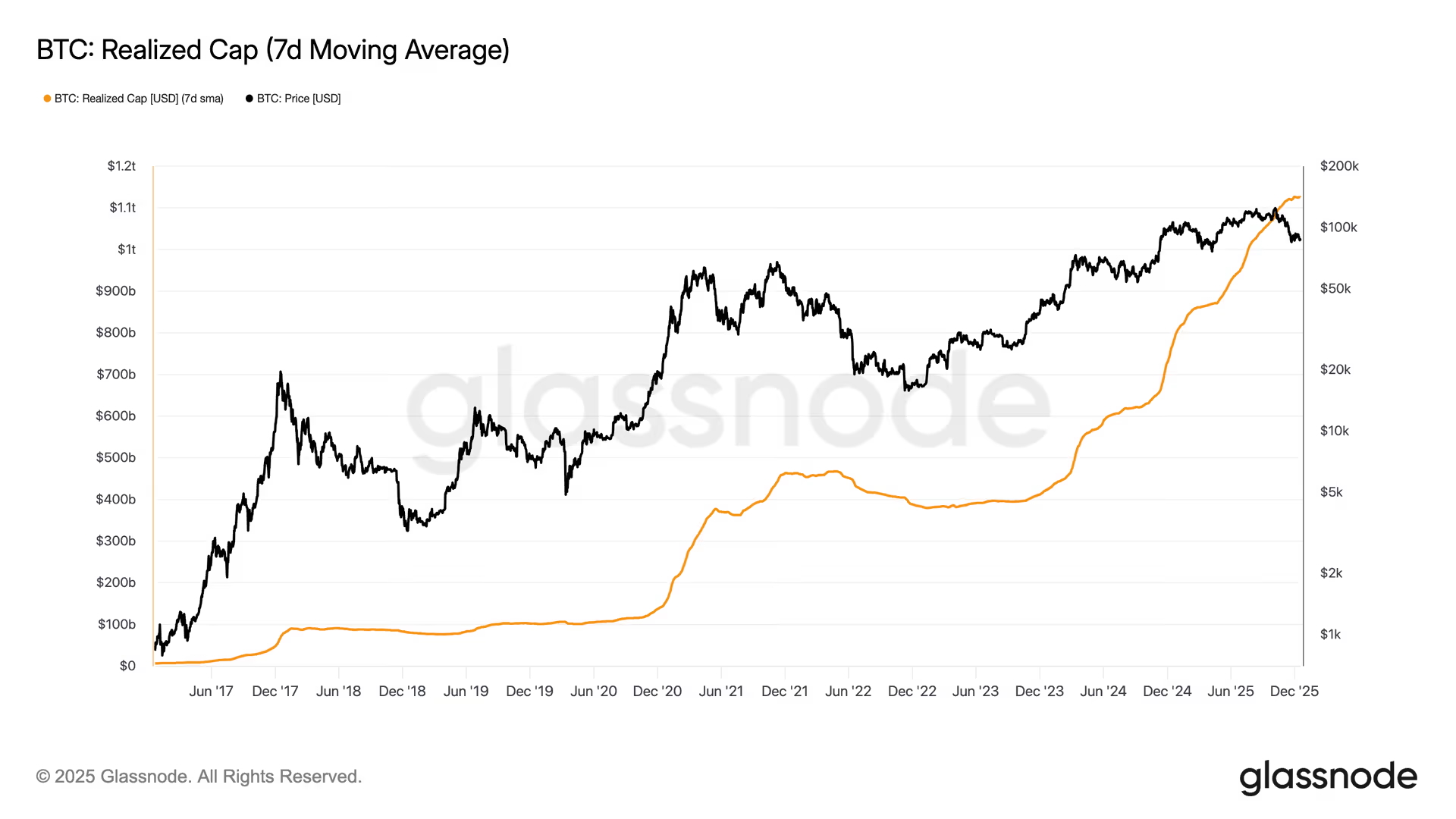
Unlike the “Market Cap” (current price x total circulation) we often see, this on-chain indicator is more valuable for reference. “Realized Market Cap” calculates the total value of each Bitcoin based on the “price at the last on-chain movement,” eliminating the speculative hype of short-term trading, reflecting the “actual cost basis of investors” and the “actual capital inflow situation.”
In other words, when the total market value fluctuates wildly with the price of coins, the realized market value remains at a high level, indicating that holders are reluctant to sell and large-scale losses have not been realized.
According to data from blockchain analysis company Glassnode, even though Bitcoin has plummeted over 30% from its historical high in October, the “realized market value” has not only not fallen, but has continued to rise during the correction period, stabilizing around $1.125 trillion recently.
This trend is reminiscent of the situation during the “tariff panic” outbreak in April this year. At that time, Bitcoin briefly dropped to $76,000, but the on-chain funding level did not recede, and the coin price subsequently rebounded strongly and reached a new high.
In contrast to the bear market in 2022, when the price of coins collapsed and investor confidence shattered, a large number of investors sold at a loss, causing the realized market value to plummet from 470 billion USD to 385 billion USD. However, the current market has not seen such panic-driven “mass sell-off” or “collective surrender” behavior.
As a result, analysts began to question the “4-year cycle” theory that is revered in the coin community.
The “4-Year Cycle” Narrative Shakes, Surprises in 2026?
Andre Dragosch, the Head of Research for Europe at asset management company Bitwise, believes that Bitcoin is likely to break free from the “4-year cycle” and experience an unexpected surge in 2026.
He explained that against the backdrop of a resilient global economy and major central banks continuing to cut interest rates, the yield curve is steepening and overall liquidity is expanding. Such an environment often weakens the dollar, and historical experience tells us that a “weak dollar” is beneficial for risk assets like Bitcoin.
In my opinion, the current price of Bitcoin seriously underestimates the overall economic environment, comparable to the recession period of the COVID-19 pandemic and the market panic triggered by the FTX collapse. However, the United States is not showing signs of economic recession; instead, we can see signals of growth accelerating again.

_
Disclaimer: This article is for informational purposes only. All content and opinions are for reference only and do not constitute investment advice, nor do they represent the views and positions of the blockchain community. Investors should make their own decisions and trades, and the author and the blockchain community will not be responsible for any direct or indirect losses resulting from investors' trades.
_
Tags: 2026 Glassnode Realized Cap Analysis Cryptocurrency Realized Market Cap Market Coin Price Investment Bitcoin Market Trend
Disclaimer: The information on this page may come from third parties and does not represent the views or opinions of Gate. The content displayed on this page is for reference only and does not constitute any financial, investment, or legal advice. Gate does not guarantee the accuracy or completeness of the information and shall not be liable for any losses arising from the use of this information. Virtual asset investments carry high risks and are subject to significant price volatility. You may lose all of your invested principal. Please fully understand the relevant risks and make prudent decisions based on your own financial situation and risk tolerance. For details, please refer to
Disclaimer.
Related Articles
EDGE (Edge Network) up 3.54% in 24 hours
Gate News reports: On March 20, according to Gate's market data, as of press time, EDGE (Edge Network) is trading at $0.1355, up 3.54% in the past 24 hours, with a high of $0.1635 and a low of $0.1250. The 24-hour trading volume reached $501,500, with a current market cap of approximately $27.543 million.
EDGE is a utility token of the Definitive platform, designed to enhance users' trading experience. Holders can stake EDGE to enjoy lower fees, gain priority access to new features, and unlock exclusive rewards tailored for premium users. Definitive is a high-level trading platform that supports trading any asset on any blockchain, providing Market, Limit, and
GateNews13m ago
Why Did Bitcoin Drop Today? Dormant Whale Awakens After 11 Years and Liquidates Holdings, Hormuz Crisis Spreads
Bitcoin has recently been affected by supply shocks and geopolitical pressures, with prices declining from their highs to approximately $69,500. Large volumes of bitcoin entering exchanges have triggered market panic. Major sellers include dormant wallets resuming activity and early investors taking profits. Technically, bitcoin has broken below the $72,000 support level, with $64,000 becoming a critical support level. A breach of this level could expose the asset to further downside risk.
MarketWhisper38m ago
US-Iran Tensions Escalate, Bitcoin Viewed as "Flight Asset"
US-Iran tensions are escalating, with markets beginning to price in prolonged conflict, impacting oil, shipping, and supply chain costs. Investors are focusing on hard assets and related resource sectors, while facing stagflation risks. It is recommended to adopt defensive trading strategies and currency diversification.
GateNews52m ago
Six Countries' Joint Statement on Defending the Strait of Hormuz, But No Specifics on What to Do? Brent Crude Falls Below $110
The UK, France, Germany, Italy, the Netherlands, and Japan released a joint statement on the 19th, committing to take "appropriate measures" for navigation safety in the Strait of Hormuz, but did not specify concrete actions, leaving political flexibility. The statement condemned Iran's attacks on commercial vessels, demanded its compliance with international law, and supported increased production to stabilize energy markets. This declaration has sparked external scrutiny and analysis, particularly regarding the ambiguity of the term "appropriate measures."
動區BlockTempo1h ago
Solana Price Trend Shows Bearish Technical Pattern, Higher Time Frames Exhibit Weakness
Gate News Report: On March 20, Solana (SOL) price action displayed bearish technical formations on higher timeframes, with the market showing weakness. Technical charts indicate that SOL has formed bearish structures across multiple timeframes, with price action under pressure.
GateNews1h ago
Israel Signals De-escalation in Conflict, Oil Prices Decline, Bitcoin Rebounds After Breaking Below 69K
Israeli Prime Minister Netanyahu's speech prompted oil prices to decline and reduced market tension. The crypto market continued to weaken, with Bitcoin briefly falling below 69K. ETF outflows indicate institutional profit-taking, and the Fear and Greed Index has retreated into the fear zone.
ChainNewsAbmedia1h ago


