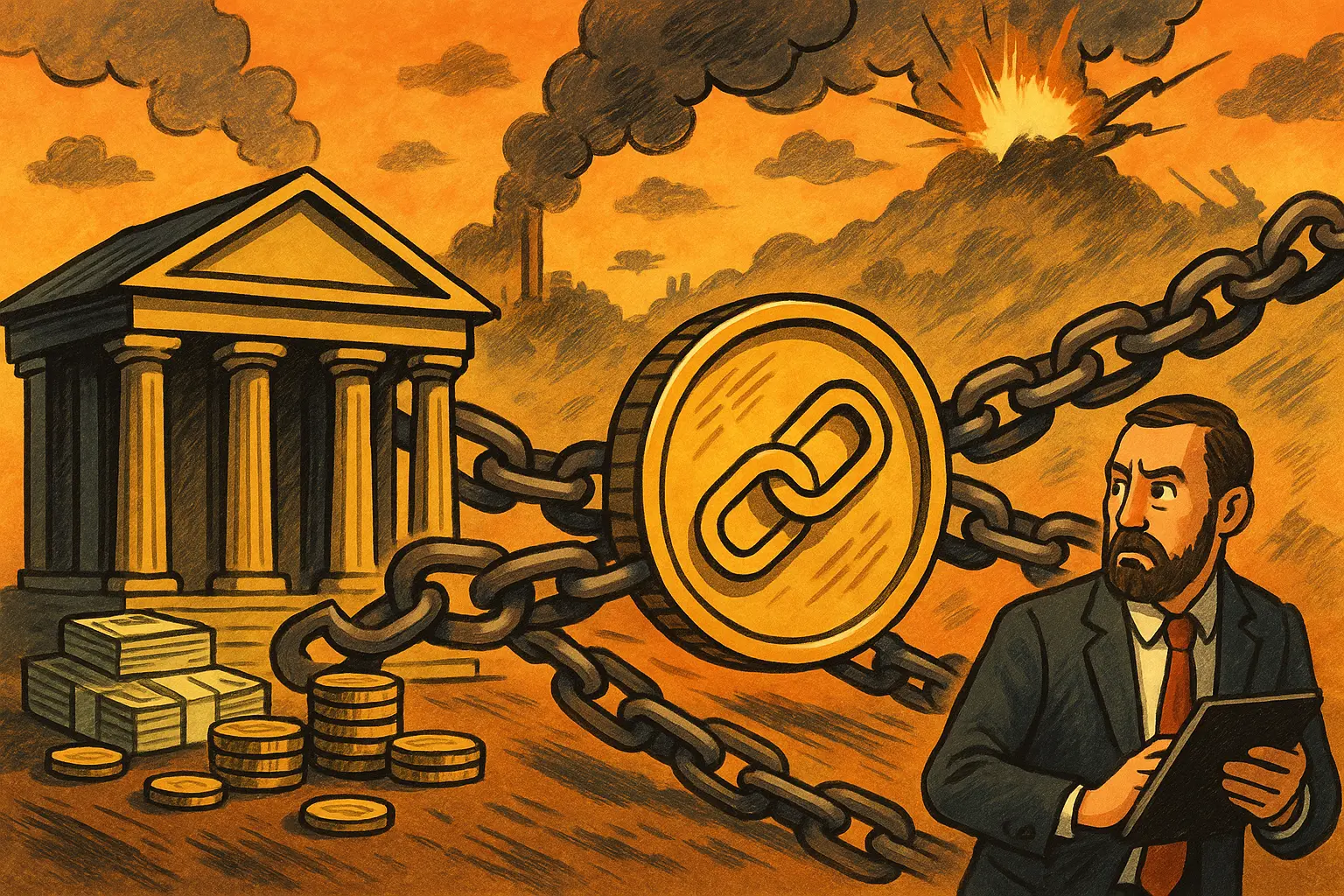
Bitwise Chief Investment Officer Matt Hougan stated in an article titled “A Weekend That Changed Finance” that during the U.S.-Iran strikes, while major global exchanges were closed, Hyperliquid became the center for trading real-world assets like crude oil and tokenized gold. He significantly revised his timeline for traditional finance (TradFi) shifting onto the blockchain.
“A Weekend That Changed Finance”: The Timing Gap Revealed by the Iran Crisis
The U.S.-Iran actions began around 3:30 a.m. UTC on Saturday, coinciding with the full closure of stock exchanges in the U.S., Europe, and Asia. During this window when traditional financial systems were completely halted, crypto platforms like Hyperliquid became the only channels for global investors to manage risk.
Hougan pointed out that over the weekend, Hyperliquid’s trading volume exceeded $11.5 billion; Tether’s tokenized gold product Tether Gold (XAUt) saw 24-hour trading surge past $300 million; and trading volumes in prediction markets like Kalshi and Polymarket also increased.
More symbolically, Bloomberg cited Hyperliquid crude oil contracts as the “most relevant price” in their coverage of the explosion event—mainstream financial media are beginning to view on-chain derivatives as more timely price discovery tools than traditional markets.
Hougan said he previously expected it would take 5 to 10 years for TradFi to move onto the blockchain, but this weekend changed his mind: “This weekend proved I was wrong. I now believe it will happen much faster than I imagined.” He added that blockchain’s 24/7 trading channels make “stock exchanges and T+1 settlement seem outdated.”
Institutions Have No Choice: NYSE’s 24/7 Strategy
Hougan noted that hedge funds, banks, and other institutional investors seeking “competitive trading” currently have no choice but to set up stablecoin wallets and learn how to trade on platforms like Hyperliquid. This indicates that TradFi institutions’ participation in on-chain finance is no longer just a strategic choice but a defensive move driven by crisis.
The New York Stock Exchange (NYSE) and its parent company Intercontinental Exchange (ICE) announced in January this year plans to implement 24/7 trading and real-time settlement for stocks and ETFs via blockchain trading systems supporting multiple chains and custody functions. However, the launch date, underlying blockchain selection, and permission architecture have not yet been disclosed.
Key Data Comparing On-Chain Finance and TradFi
- Hyperliquid weekend trading volume: Over $11.5 billion (Saturday and Sunday combined)
- Tether Gold (XAUt) 24-hour trading volume: Surged past $300 million
- Event timing significance: Strike occurred at 3:30 a.m. UTC, during global market closures
- Bloomberg citation: Used Hyperliquid crude oil contracts as the most relevant oil price benchmark during the crisis
- NYSE/ICE plans: Announced a 24/7 tokenized trading platform, but core technical details remain undisclosed
Frequently Asked Questions
Why is the “weekend timing” of the US-Iran conflict particularly significant for TradFi’s on-chain transition?
Traditional stock and commodity markets are closed on weekends. When major geopolitical events occur during this period, investors cannot adjust their positions through conventional channels. Crypto platforms operate 24/7, filling this liquidity gap. This weekend’s events serve as the largest “stress test” to date, directly validating the practical utility of on-chain finance during market closures.
Does the trading of crude oil and tokenized gold on Hyperliquid represent a true shift of TradFi onto the blockchain?
Hyperliquid’s trading involves derivatives of oil and gold (such as tokenized gold XAUt), not physical assets directly. Currently, this mainly serves as a supplementary channel for institutions when traditional markets are inaccessible, rather than a complete replacement. True TradFi on-chain transfer requires large-scale tokenization of stocks, bonds, and other traditional assets, along with infrastructure standardization—this still takes time.
What potential impact could NYSE’s 24/7 tokenized trading plans have on the existing crypto market?
If NYSE launches a 24/7 tokenized stock trading platform, it could significantly boost liquidity for traditional assets on-chain and challenge the market position of existing decentralized exchanges like Hyperliquid. The onboarding of substantial institutional capital onto the blockchain could deepen overall market liquidity, marking a key milestone in the mainstream adoption of crypto.
Disclaimer: The information on this page may come from third parties and does not represent the views or opinions of Gate. The content displayed on this page is for reference only and does not constitute any financial, investment, or legal advice. Gate does not guarantee the accuracy or completeness of the information and shall not be liable for any losses arising from the use of this information. Virtual asset investments carry high risks and are subject to significant price volatility. You may lose all of your invested principal. Please fully understand the relevant risks and make prudent decisions based on your own financial situation and risk tolerance. For details, please refer to
Disclaimer.
Related Articles
Ondo Gains Momentum as Franklin Templeton Boosts RWA Push
Key Insights:
Ondo gains strength as the Franklin Templeton partnership pushes tokenized ETFs on-chain, lifting total value locked and expanding institutional access significantly.
Futures open interest rises sharply while funding rates remain positive, showing increased trader
CryptoNewsLand13m ago
Bittensor Price Faces Resistance as Bearish Signals Emerge
Key Insights
The Bittensor price rally from $144 to $375 shows slowing momentum as resistance near $380 continues to limit further upside expansion in recent sessions.
The TD Sequential indicator flashes a sell
CryptoNewsLand23m ago
When to Buy Bitcoin Next? Analyst Outlines Exact Entry Levels
Bitcoin dumped hard in early February, plunging to a 15-month low of $60,000. This meant that it had shed over 50% of its value since early October when it peaked at over $126,000.
Although it has recovered roughly 20% since that low and sits close to $72,000 now, there are still some analysts
CryptoPotato50m ago
3 Affordable Altcoins to Invest in 2026 — BONK, FLOKI, and JASMY
BONK offers low-cost entry with Solana ecosystem exposure but remains in a downtrend.
FLOKI shows early stabilization signs and brand recognition, attracting speculative traders during consolidation.
JASMY focuses on data privacy, with improving momentum and potential short-term bounce
CryptoNewsLand1h ago
ETH Hits 0.80 MVRV Band: Bull Rally Coming?
_Glassnode data shows Ethereum testing the 0.80 MVRV band, a level that has historically preceded major bull rallies after ETH breaks its realized price._
Ethereum is flashing a signal the market has not seen casually. On-chain data from Glassnode places ETH near the 0.80 MVRV band, a threshold tha
LiveBTCNews1h ago


