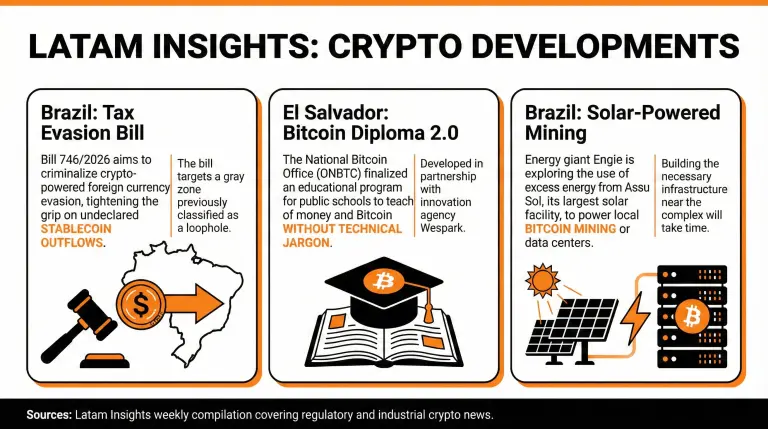
Welcome to Latam Insights, a compilation of the most relevant crypto news from Latin America over the past week. In this edition, a bill to criminalize crypto-linked foreign currency tax evasion surges in Brazil, El Salvador finalizes its Bitcoin Diploma 2.0 educational program, and Engie mulls adding bitcoin mining to its operations in Brazil.
Bill Criminalizing Crypto-Powered Foreign Currency Tax Evasion Surges in Brazil
Brazil is taking measures to tighten its grip on rising volumes of crypto outflows, especially those involving stablecoins, by imposing penalties on undeclared cryptocurrency transactions.
Bill 746/2026, introduced by Federal Deputy Tabata Amaral, explicitly defines the crime of cryptocurrency tax evasion, getting stablecoin exchanges outside a gray zone classified as a loophole by some regulators and government officials.
The crime of foreign currency tax evasion is defined in Brazilian regulation as “carrying out an unauthorized exchange operation, with the purpose of promoting the evasion of foreign currency from the country.”
Read more.
El Salvador Finalizes Bitcoin Diploma 2.0 Educational Program
El Salvador is on the verge of expanding its bitcoin and money programs with a new educational development.
The National Bitcoin Office (ONBTC) of El Salvador recently announced the completion of its Bitcoin Diploma 2.0 educational program, an overhaul of prior attempts to bring bitcoin and money concepts to Salvadoran public schools.
The program, developed in partnership with innovation agency Wespark, explains the story of money and the rise of bitcoin in the simplest way possible, avoiding technical jargon.
Read more.
Engie Eyes Bitcoin Mining to Address Solar‑Power Curtailment in Brazil
Engie, a global power company, is seeking alternatives to leverage its excess solar power generation in Brazil.
According to reports, Eduardo Sattamini, Engie county manager for Brazil, stated that the French energy conglomerate is considering using part of the energy produced in Assu Sol, its largest solar facility, to power local bitcoin mining or data center operations.
Nonetheless, while the company is currently looking at other companies that would take the energy curtailed for these processes, Sattamini acknowledges that it will not be a quick process, as the logistics behind this option encompass interested companies building infrastructure near the complex.
Read more.
FAQ
- What recent legislation related to crypto is being proposed in Brazil?
A bill in Brazil is seeking to criminalize foreign currency tax evasion linked to cryptocurrency, targeting undeclared transactions.
- What does El Salvador’s Bitcoin Diploma 2.0 program aim to achieve?
The program provides education on bitcoin and financial concepts for public schools, simplifying the subject for students.
- Why is Engie considering bitcoin mining in Brazil?
Engie plans to leverage excess solar power generation in Brazil for potential bitcoin mining operations to address solar power curtailment.
Disclaimer: The information on this page may come from third parties and does not represent the views or opinions of Gate. The content displayed on this page is for reference only and does not constitute any financial, investment, or legal advice. Gate does not guarantee the accuracy or completeness of the information and shall not be liable for any losses arising from the use of this information. Virtual asset investments carry high risks and are subject to significant price volatility. You may lose all of your invested principal. Please fully understand the relevant risks and make prudent decisions based on your own financial situation and risk tolerance. For details, please refer to
Disclaimer.
Related Articles
BTC 15-minute rally of 0.85%: Fed policy shift and ETF capital resonance drive buying momentum
From 2026-03-12 09:30 to 2026-03-12 09:45 (UTC), Bitcoin (BTC) experienced a rapid surge within a 0.93% volatility range, achieving a return of +0.85%, with prices fluctuating between 69678.0 and 70324.2 USDT. Trading volume increased approximately 38% compared to the previous hourly average. Market attention surged significantly, with short-term bullish sentiment amplified notably.
The primary driver of this market movement was the Federal Reserve Chair's early morning release of policy shift signals, hinting that the pace of future rate hikes may slow down. The market broadly interpreted this as a marginal improvement in the liquidity environment
GateNews35m ago
Why Didn't BTC Drop During Geopolitical Conflicts? Answers From Binance's Fund Structure and CVD
The article analyzes the relationship between Binance's BTC balance changes and market demand, indicating that the decrease in BTC balances in the short term is related to genuine demand, especially during the US-Iran conflict. The widening gap in spot trading volume suggests active buying activity, supporting the presence of real demand. Although short-term demand may stabilize BTC prices, the long-term trend still leans downward, and the process of demand recovery could be lengthy.
PANews43m ago
Germany's Long-Term Bitcoin Holdings Enjoy Tax-Free Advantages, Investor Interest Surges
Germany's long-term Bitcoin holding tax-exemption policy, which has been in effect since 2009 through 2026, encourages investors to hold for over one year to avoid capital gains tax. This policy reduces the tax burden and attracts global investors to build Bitcoin investment portfolios in Germany, driving market attention.
GateNews1h ago
Germany Offers Tax-Free Bitcoin Gains After 12 Months
Germany's longstanding rule allows Bitcoin holders to pay 0% capital gains tax if held for over a year, promoting long-term investment. Despite new EU transparency rules, this tax benefit remains a draw for investors.
Coinfomania1h ago


