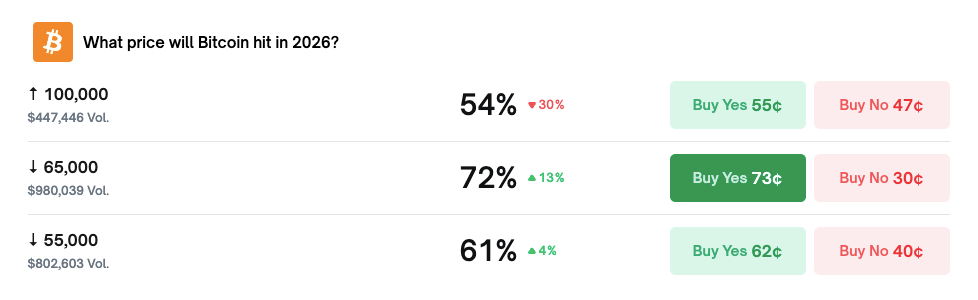
The weekend sell-off caused Bitcoin’s price to briefly dip below the psychological level of $75,000, and market sentiment seems to have shifted overnight. On the prediction platform Polymarket, a compelling wager is heating up: the probability of Bitcoin falling below $65,000 by 2026 has surged to 72%, attracting nearly $1 million in bets. This is not just a numbers game; it acts as a mirror reflecting the turbulent currents deep within the crypto market—from the exuberance after Trump’s election victory to the current widespread anxiety over “deep dips,” with the speed of change astonishing.
What’s more, some veteran players are alarmed that this decline has caused the world’s largest Bitcoin-holding publicly traded company, Strategy, to face its first test since late 2023—its average holding cost being breached. It’s like a marathon leader suddenly finding the track beneath them turning slippery.
Why has market sentiment plummeted so rapidly?
On the surface, it appears to be a price correction. But upon closer inspection, several forces are twisting together, pulling the market in different directions.
First, there are technical “breakdown” signals. According to some on-chain analysis firms, Bitcoin has been in a “bear market” cycle since falling below its 365-day moving average in November 2025. This long-term moving average is often seen as the “bull-bear dividing line”; once lost, it typically triggers systematic de-risking among technical investors. I recall during the 2018 bear market, similar long-cycle moving average breaches led to months of downward drift and bottoming processes, with early bottom-fishing being akin to “walking into a firing squad.”
Second, the macro liquidity “valve” seems to be tightening. Some macro analysts point out that the current correction is more due to liquidity tightening in the overall U.S. financial environment rather than any fundamental flaw in cryptocurrencies themselves. Changes in the Federal Reserve’s balance sheet, the draining effect of Treasury issuance—these seemingly distant macro factors are actually transmitted through risk asset pricing logic directly into Bitcoin’s price. When the tide (liquidity) recedes, the most volatile assets are the first to be exposed.
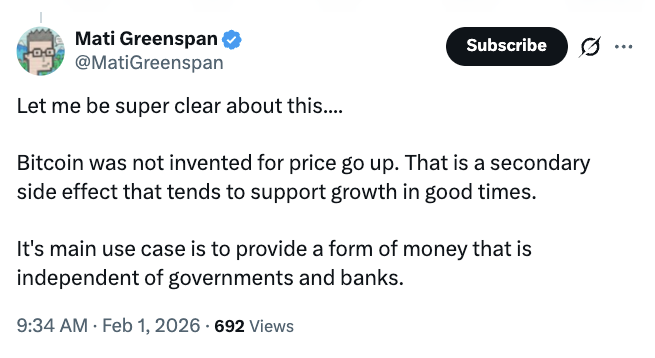
Lastly, an interesting perspective comes from industry insiders. Mati Greenspan, CEO of Quantum Economics, reminds us that perhaps we’ve been focusing on the wrong thing all along. He wrote on social media that Bitcoin’s core design goal is to be a currency independent of the traditional banking system; price appreciation is merely a potential “side effect,” not its primary purpose. This viewpoint is like a cold shower, prompting us to think: when the market only focuses on price swings, has it already strayed from its original vision?
 Are prediction markets’ “crystal balls” accurate?
The high-probability bets on Polymarket undoubtedly amplify the market’s bearish expectations. Besides the chance of falling below $65,000, bets on Bitcoin dropping to $55,000 have reached 61%. Meanwhile, there’s still a 54% chance that it will return to $100,000 before the end of the year. This tug-of-war between bulls and bears highlights the significant divergence in market views.
Are prediction markets’ “crystal balls” accurate?
The high-probability bets on Polymarket undoubtedly amplify the market’s bearish expectations. Besides the chance of falling below $65,000, bets on Bitcoin dropping to $55,000 have reached 61%. Meanwhile, there’s still a 54% chance that it will return to $100,000 before the end of the year. This tug-of-war between bulls and bears highlights the significant divergence in market views.
But here’s a key question: do the probabilities in prediction markets equal future “facts”? Not necessarily. They more accurately reflect the collective sentiment of current market participants voting with real money. This sentiment is highly contagious, capable of self-fulfillment, but it can also reverse instantly due to a sudden positive catalyst. Just like the epic bull run that followed the March 2020 crash—no one predicted the subsequent surge. Prediction markets are excellent windows into market mood, but they are not navigation charts for investing.
Additionally, Polymarket itself faces regulatory challenges, such as restrictions in Nevada due to licensing issues. This reminds us that this “sentiment barometer” is also in a dynamic environment.
Institutional opinions clash—who should retail investors listen to?
In the face of market confusion, the views of large institutions are also in a fascinating “battle.”
On one hand, bearish sentiment dominates prediction markets and some analysts. On the other, just a few months ago, several top firms issued quite optimistic forecasts. For example, Grayscale Investments predicted Bitcoin could break its all-time high of $126,000 in the first half of 2026, citing ongoing institutional adoption and gradually clarifying regulation. Analysts from Standard Chartered and Bernstein also set target prices of $150,000 for 2026, though they later lowered expectations due to slowing ETF inflows.
 This contradiction is not uncommon. The long-term logic of institutions—such as Bitcoin’s scarcity and the narrative of digital gold—often speaks a different language from short-term market fluctuations driven by liquidity, sentiment, and technical factors. For investors, the key is to discern which voice you’re hearing: is it a multi-year trend judgment or a warning about risks in the coming quarters?
What should investors focus on now?
Market noise is abundant, but I believe we can concentrate on a few more tangible indicators rather than being led solely by price movement probabilities.
- Strategy’s “cost line” defense: As a market “flag,” the relationship between its stock price and its average holding cost is worth watching. If Bitcoin remains below its average cost, will it shake long-term holding strategies or influence other listed companies’ attitudes? This is an important directional indicator.
- Real macro liquidity data: Instead of guessing, pay attention to actual data like the Federal Reserve’s balance sheet and the U.S. Treasury General Account (TGA) balance. These are the “driving forces” behind all risk assets, including cryptocurrencies.
- On-chain activity’s “quality” and “quantity”: When prices fall, is it long-term holders panic selling, or over-accumulation? On-chain data can reveal whether holdings are dispersed or concentrated. For example, changes in long-term holder supply, exchange inflows and outflows—these often provide more forward-looking signals than price charts.
- Your own investment logic: This is the most crucial point. Why did you invest in Bitcoin in the first place? Because you believe in its potential as a store of value long-term, or just for short-term speculation? If your long-term reasoning remains unchanged (such as global money supply expansion or sovereign credit risks), then market volatility can serve as a test of your conviction and an opportunity for better entry points. If you’re just riding the wave, then any fluctuation can make you restless.
Markets always swing between excessive optimism and excessive pessimism. When 72% of people on Polymarket bet on a decline, it might be the moment for us to stay calm and think contrarily. After all, in the crypto world, consensus is often very costly, and true opportunities often arise when consensus breaks down. Of course, any judgment should be aligned with your own situation—markets are inherently uncertain, and proper position management and risk control are essential skills to navigate any cycle.
Disclaimer: The information on this page may come from third parties and does not represent the views or opinions of Gate. The content displayed on this page is for reference only and does not constitute any financial, investment, or legal advice. Gate does not guarantee the accuracy or completeness of the information and shall not be liable for any losses arising from the use of this information. Virtual asset investments carry high risks and are subject to significant price volatility. You may lose all of your invested principal. Please fully understand the relevant risks and make prudent decisions based on your own financial situation and risk tolerance. For details, please refer to
Disclaimer.
Related Articles
Shiba Inu Breaks Support Amid Falling Volume and Market Pressure
Key Insights:
Shiba Inu dropped below a critical price level as declining volume and heavy liquidations reflected weakening trader confidence across the broader crypto market environment.
Falling trading activity signaled reduced participation, which often limits recovery momentum and
CryptoNewsLand43m ago
85% or 200% Surge Next for Cardano? ADA Tests Key Level Linked to Historic Breakouts
Cardano’s native token has been among the poorest performers in the past year, with on-chain data suggesting that ADA active wallets are down over 40% on their investments within this timeframe.
However, this could actually be bullish for the underlying asset, especially when it’s combined with ano
CryptoPotato57m ago
Bitcoin Tops $68K Briefly as Risk Sentiment Improves on Iran War Report
Bitcoin's price surged to $68,000 amid easing geopolitical tensions and improved investor sentiment. However, weak ETF inflows and extreme market fear signal a cautious outlook, indicating potential challenges to a sustained recovery.
LiveBTCNews1h ago
ETH 15-minute rise of 0.59%: ETF event expectations drive the intraday upward move
From 2026-03-31 13:45 to 14:00 (UTC), the ETH spot market recorded a +0.59% return. The price ranged from 2063.14 to 2079.88 USDT, with a volatility of 0.81%. During this period, market fluctuations slightly increased, activity became more prominent, and ETF-related events drew market attention. Traders’ sentiment focused on the upcoming capital flows associated with these events.
The main driver behind this movement was related to ETH ETF market developments. On March 31, 2026, regarding “Ethereum ETF Flo” (the original text is incomplete here, but the translation continues with the full content), the market reacted to the news and expectations surrounding the approval and launch of Ethereum ETFs, which influenced trading behavior and sentiment.
GateNews2h ago
Downside risk remains as bitcoin nears record-tying six-month losing streak
Bitcoin is nearing a record of six consecutive monthly losses, with declines in October, November, and December. While current support levels are holding, macroeconomic factors and ongoing conflicts pose risks to recovery.
CoinDesk2h ago
BTC Price Plunges to 3-Week Low as Analysts Map Out Next Downside Targets
The first breakdown to under $68,000 seemed as just the beginning for bitcoin’s Friday correction, which just worsened with another dip to a fresh 3-week low.
Most altcoins have followed suit, which has harmed over-leveraged traders, with more than 120,000 such participants being wrecked in the
CryptoPotato3h ago


