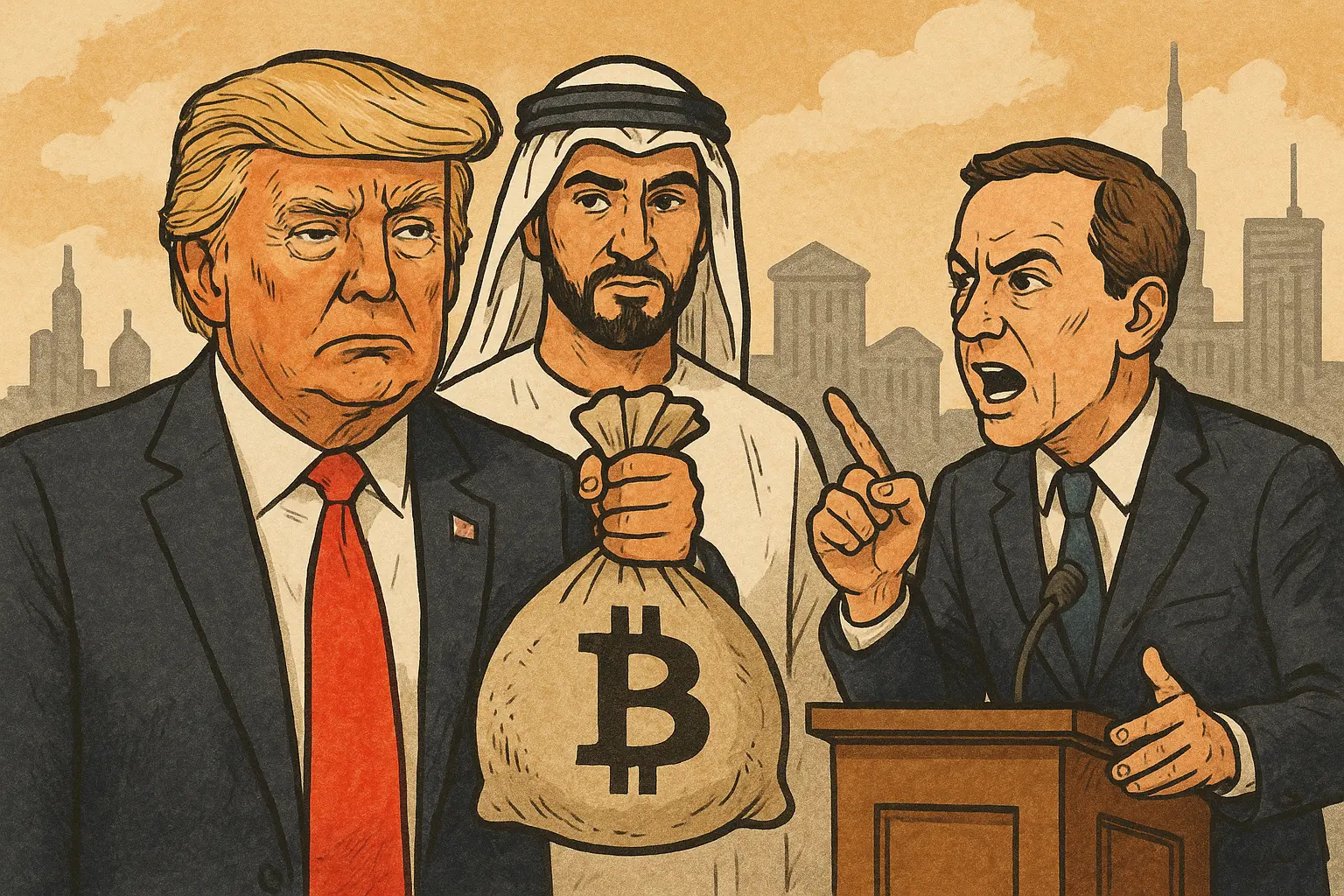
U.S. Treasury Secretary Janet Yellen was questioned by the House on Wednesday, focusing on the Trump WLFI and conflicts of interest with the UAE. The Wall Street Journal reported that before Trump took office, the UAE secretly invested $500 million to acquire a 49% stake in WLFI. Lawmakers demanded a suspension of WLFI’s banking license and questioned whether Yellen had the authority to “rescue Bitcoin,” to which Yellen clearly responded that neither the U.S. Treasury nor the Financial Stability Oversight Council have such power.
The $500 Million UAE Major Stake in WLFI Sparks Conflict of Interest Storm
On Wednesday, during a hearing held by the House Financial Services Committee (which Yellen leads), Democratic Congressman Gregory Meeks of New York harshly criticized World Liberty Financial and its ties to the United Arab Emirates. The background of this inquiry is highly sensitive: World Liberty Financial is a decentralized finance company operated by Trump’s family, and Trump himself had recently returned to the White House.
The Wall Street Journal recently reported that just days before Trump’s inauguration, an investment firm supported by UAE Emir Tahnoon bin Zayed Al Nahyan secretly invested $500 million to acquire a 49% stake in WLFI. The confidentiality and timing of this transaction have raised widespread questions. Why was it completed just before Trump’s inauguration? Why was it kept secret rather than publicly announced? As a key Middle Eastern ally, does the UAE’s massive investment in Trump’s family business influence U.S. Middle East policy?
Trump later publicly denied knowing about the investment, claiming he was unaware of the daily operations of his family business. However, this explanation is hard to believe, as WLFI’s co-founders include Trump’s sons Donald Trump Jr. and Eric Trump. It’s difficult to imagine such a significant equity transaction could have gone unnoticed by Trump himself. This denial appears more like a political “cutting ties,” attempting to distance himself legally and morally from potential conflicts of interest.
Previously, WLFI was applying for a banking license and had submitted an application to the Office of the Comptroller of the Currency (OCC) last month. If approved, WLFI would become the first bank directly controlled by a presidential family, an unprecedented move in U.S. history. Meeks stated he hopes Yellen will suspend any banking licenses related to WLFI until conflicts of interest are thoroughly reviewed and investigated.
Three Levels of Conflict of Interest in WLFI
Foreign Investment: UAE’s $500 million stake of 49% could influence U.S. Middle East policy
Presidential Family Business: Trump’s sons are directly involved, blurring the lines between politics and business
Banking License Application: If approved, it would be the first licensed bank controlled by a presidential family
Yellen said that the OCC is an independent agency, but she did not answer whether it would investigate WLFI. The debate escalated, with both sides shouting and interrupting each other. Finally, Meeks told the Treasury Secretary, “Stop protecting the President.” The intensity of this public confrontation is rare, indicating that Democratic lawmakers’ anger over Trump’s family using the presidency for commercial gain has reached a boiling point.
Yellen Clarifies: The Treasury Has No Power to Rescue Bitcoin
Yellen was also asked about the role of the U.S. Treasury in the Bitcoin space. In March 2025, Trump signed an executive order establishing a strategic Bitcoin reserve. According to the order, the reserve would initially consist of Bitcoin seized through criminal or civil asset forfeitures, and the Bitcoin stored in the reserve would not be sold. While this policy is more symbolic than substantive, it demonstrates the Trump administration’s support for Bitcoin.
Democratic Congressman Brad Sherman of California directly questioned Yellen whether she has the authority to “rescue Bitcoin,” or to “order banks to buy Bitcoin or to invest U.S. tax dollars in Bitcoin or Trump coins.” The sharpness of this question lies in linking the Treasury’s authority with Trump’s business interests. If the Treasury has the power to use public funds to buy Bitcoin, and Trump personally holds large amounts of Bitcoin and related enterprises, the conflict of interest would be severe.
“I am the Treasury Secretary, I do not have the authority to do that; as Chair of the Financial Stability Oversight Council, I also do not have that authority,” Yellen responded clearly. She added that the Treasury is holding the seized Bitcoin. This answer is legally correct: the U.S. Treasury’s scope does not include actively purchasing crypto assets or instructing banks to do so. The Treasury can hold confiscated Bitcoin but cannot use taxpayers’ money to buy Bitcoin as an investment.
This clarification is significant for the crypto market. Some Bitcoin bulls had hoped that the Trump administration might mobilize national resources to buy large amounts of Bitcoin, pushing prices higher. Yellen’s explicit statement dispels that illusion, showing that even under a pro-crypto Trump government, the federal government is unlikely to rescue Bitcoin actively. The price of Bitcoin will mainly be determined by market supply and demand, not government intervention.
CBDC and Federal Reserve Stance
During the Wednesday hearing, Yellen’s jurisdiction over Central Bank Digital Currencies (CBDC) was also questioned, as well as her knowledge of any efforts by the Federal Reserve or the government to develop a U.S. CBDC. She responded briefly, “Absolutely not.” This indicates that the Trump administration opposes CBDC, consistent with Trump’s campaign promises.
The Federal Reserve has been exploring the issuance of a CBDC and released a report in 2024 analyzing its pros and cons. However, Fed officials have previously expressed skepticism. Fed Chair Jerome Powell has stated that the Fed would not issue a CBDC without congressional approval. This cautious stance reflects the complex considerations in the U.S. financial system regarding CBDC: while technically feasible, there are major concerns about privacy, financial stability, and competition with banks.
The Trump administration’s opposition to CBDC partly stems from concerns over government surveillance. A CBDC could allow the government to track every transaction, provoking strong opposition from privacy advocates and liberals. Additionally, CBDC could compete with private banking systems, threatening traditional financial institutions’ interests. As a businessman-turned-president, Trump is more inclined to support private-sector-led financial innovations like Bitcoin and stablecoins rather than government-controlled digital currencies.
Yellen’s firm rejection of CBDC provides some certainty for the crypto industry. At least during Trump’s term, the U.S. is unlikely to introduce a CBDC that competes with private cryptocurrencies like Bitcoin. This is good news for Bitcoin and stablecoin industries, as they do not need to face government-backed digital currency competition. However, it also means the U.S. may lag behind countries like China and the European Union, which are actively advancing their digital currency initiatives.
Disclaimer: The information on this page may come from third parties and does not represent the views or opinions of Gate. The content displayed on this page is for reference only and does not constitute any financial, investment, or legal advice. Gate does not guarantee the accuracy or completeness of the information and shall not be liable for any losses arising from the use of this information. Virtual asset investments carry high risks and are subject to significant price volatility. You may lose all of your invested principal. Please fully understand the relevant risks and make prudent decisions based on your own financial situation and risk tolerance. For details, please refer to
Disclaimer.
Related Articles
Bitcoin’s implied volatility drops to an intra-year low, and the market is reacting mildly to Friday’s CPI data
April 9, U.S. March CPI data will be released on April 11. The market expects the year-over-year rate to rise from 2.4% to 3.4%. The Bitcoin market has responded calmly, with the options market’s volatility range only at 2.5%. Attention has been drawn by the rise in gasoline prices. Analysts believe that CPI data coming in either too soft or too hot will have different impacts on the crypto market.
GateNews3h ago
Federal Reserve minutes hawkish signal escalates: more officials mention rate hikes—what macro pressures are markets facing?
The Federal Reserve’s March meeting minutes show that “some” officials supported raising interest rates, with hawkish language noticeably upgrading from January’s “several” officials, putting the crypto market under pressure from tighter interest-rate expectations.
InstantTrends4h ago
South Korea’s KOSPI index closed down 1.65% on April 9, and Japan’s Nikkei 225 index fell 0.73%
Gate News news, April 9, the Korea KOSPI Index (Korean Composite Stock Price Index) closed down 96.77 points on April 9 (Thursday), a decline of 1.65%, to 5775.57 points. The Nikkei 225 Index (Japan’s stock market benchmark index) closed down 413.10 points on April 9 (Thursday), a decline of 0.73%, to 55,895.32 points.
GateNews5h ago
Market expectations: U.S. February PCE data shows inflation is still high, and the Fed may keep interest rates unchanged in April
Market expectations are that the U.S. February PCE data will show that inflation pressures remain, with PCE rising to 0.4% month over month and 2.8% year over year. Core PCE is expected to be around 3.0% year over year, above the Federal Reserve’s target. The Federal Reserve may continue to hold the 3.50%-3.75% interest-rate range in April, while rate-cut expectations cool.
GateNews5h ago
Gasoline prices hard to reverse? WSJ: After the U.S.-Iran ceasefire, only 12 ships per day are allowed to pass through the Strait of Hormuz
Despite the U.S.-Iran ceasefire agreement, passage through the Strait of Hormuz remains restricted. Iran allows only about 12 ships per day to pass and has established a toll collection system, which may keep oil prices elevated. Iran implements tiered management for ships from different countries and plans a fee-collection mechanism similar to the Suez Canal; these measures may affect global energy supply and prices.
ChainNewsAbmedia6h ago
TradFi Rise Alert: FRA40 (CAC 40) Rises Over 3%
Gate News: According to the latest Gate TradFi data, FRA40 (CAC 40) has surged by 3% in a short period. Current volatility is significantly higher than recent averages, indicating increased market activity.
GateNews6h ago


