Bitcoin remains sideways today near $92,800. Trump announced that Venezuela will transfer 30 to 50 million barrels of oil, and ETF recorded a net inflow of $471 million on January 2nd, the largest since December, with the Crypto Fear & Greed Index rebounding to 49 points, hitting a new high in October.
Venezuela Oil Trade Sparks Geopolitical Risks
Trump announced that Venezuela will transfer 30 to 50 million barrels of oil to the United States, which will be sold at market prices. The proceeds will be overseen by Trump to “benefit the peoples of both countries.” Trump has instructed Energy Secretary Chris Wray to immediately execute this plan, with the oil loaded onto oil tankers and directly shipped to U.S. unloading ports. Currently, Venezuela has not issued an official statement on this matter.
This announcement comes after the U.S. launched a large-scale military strike against Venezuela in the early hours of January 3rd. U.S. forces raided Caracas, forcibly took control of President Maduro and his wife, and transferred them out of the country. Trump stated that the U.S. would “manage” Venezuela until a “safe” transition is implemented. Subsequently, Trump said he would allow major U.S. oil companies to invest in Venezuela, rebuild oil infrastructure, and generate profits for the U.S… Sources reveal that Trump plans to convene top executives of U.S. oil giants on the 8th to discuss increasing Venezuela’s oil production.
This unprecedented direct resource takeover mode is extremely rare in international relations history. Venezuela holds the world’s largest proven oil reserves, exceeding 300 billion barrels, but due to years of sanctions and mismanagement, its oil production has fallen from a peak of 3 million barrels per day to less than 1 million. If Trump’s plan is successfully implemented, it will give the U.S. direct control over Venezuela’s oil resources, which will have profound impacts on the global energy market and geopolitical landscape.
Regarding Bitcoin news today, such geopolitical uncertainties typically increase the attractiveness of safe-haven assets. Historically, when the traditional financial system faces sovereign risk, capital controls, or currency devaluation, Bitcoin often benefits from safe-haven demand. Venezuela was once one of the countries with the highest acceptance of cryptocurrencies, as hyperinflation destroyed the bolivar’s purchasing power, prompting people to turn to Bitcoin and stablecoins to protect their wealth.
Institutional Funds Return to Bitcoin Market
(Source: The Block)
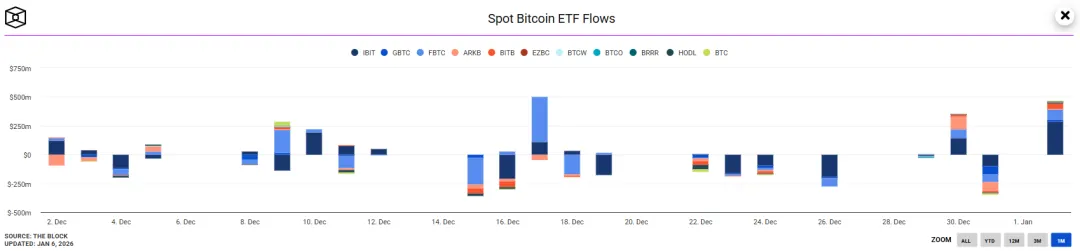
On Wednesday, Bitcoin slightly retreated to around $92,800. The crypto market has entered a “recalibration” phase at the start of the new year, rather than a clear pullback: Bitcoin consolidates above $90,000, Ethereum regains relative strength, and institutional investors are resetting their positions. Overall, Bitcoin continues to fluctuate sideways above $90,000, with price action resembling consolidation after recent gains rather than renewed selling pressure.
As the new year begins, institutional confidence in Bitcoin appears to be recovering. According to the latest data, Bitcoin ETF recorded a net inflow of $471 million on January 2, 2026. Such a scale of net inflow has not been seen since December 17, 2025, marking a reversal from the ongoing outflows in the last weeks of 2025. This change suggests that a new risk appetite phase may be forming in the short term.
Crypto analyst George Mandres from XBTO told CoinDesk: “Against the backdrop of stocks, gold, and other precious metals reaching all-time highs, we see the current situation more like a gamble — prices either continue upward to align with other assets or pull back in the coming months, consistent with the four-year cycle.”
Mandres pointed out that, compared to the end of 2025, a key difference now is the “calendar effect.” He explained: “What’s different now from a few weeks ago, besides the price surpassing $90,000, is that with the start of a new year, investors’ PNL resets to zero, so they need to reallocate funds and seek attractive risk-reward opportunities.”
This behavior can partly be explained by typical “year-end fund flows,” where portfolio rebalancing after 2025 leads to capital reallocation. In the absence of significant financial stress, institutional participants may be increasing their exposure to high-risk assets like Bitcoin.
Market Sentiment Rebounds and Key Technical Levels
(Source: CMC)
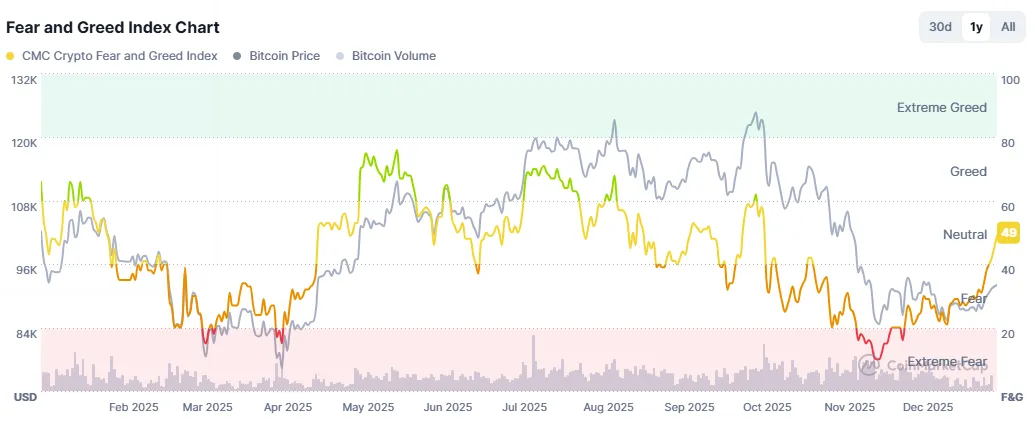
Recently, the Crypto Fear & Greed Index has shown a clear recovery, rising toward the “Greed” zone, with a reading of about 49 points, the highest since October 2025. The continued rise in confidence suggests the market may be laying the groundwork for sustained demand for BTC. If the index continues to move further into the “Greed” zone, it could confirm stronger underlying demand.
Three Key Technical Levels for Bitcoin
(Source: Trading View)
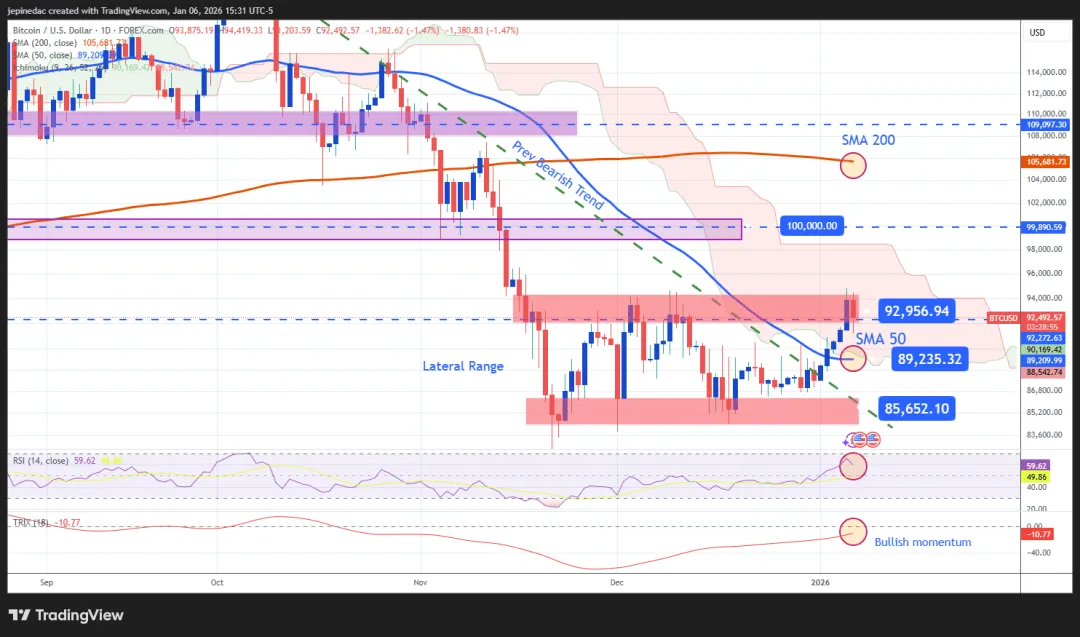
92,956 USD (Key Resistance): Recent high, aligned with the upper boundary of the sideways range. A breakout would confirm a short-term bullish trend.
89,235 USD (Near-term Resistance): Corresponds to the 50-week simple moving average, representing the core of the sideways range.
85,652 USD (Important Support): Recent low, breaking below could reactivate a downtrend.
Since the start of 2026, BTC’s price trend has shown a significant bullish bias, strong enough to break through the downtrend line dominating the market at the end of 2025. However, despite the strong upward momentum, it is still insufficient to break out of the sideways range. RSI remains above neutral 50, indicating buying momentum still dominates. TRIX shows a steady positive slope, gradually approaching the neutral zero line, suggesting selling pressure is weakening.
Glassnode’s latest report reinforces this view: the options market is actively de-risking, evidenced by shrinking open interest and rising volatility expectations; meanwhile, U.S. spot ETF capital flows have turned back to net inflows, indicating institutional demand is warming. Taken together, these signals suggest the market is more likely to be in “consolidation and rotation” rather than full risk aversion.
Disclaimer: The information on this page may come from third parties and does not represent the views or opinions of Gate. The content displayed on this page is for reference only and does not constitute any financial, investment, or legal advice. Gate does not guarantee the accuracy or completeness of the information and shall not be liable for any losses arising from the use of this information. Virtual asset investments carry high risks and are subject to significant price volatility. You may lose all of your invested principal. Please fully understand the relevant risks and make prudent decisions based on your own financial situation and risk tolerance. For details, please refer to
Disclaimer.
Related Articles
Ledger Executive: If the US Bans Stablecoin Yields, Other Countries May Fill the Regulatory Gap
Ledger Asia-Pacific Head Shibayama stated that if the US implements a stablecoin yield ban, international discussions will increase. Countries like Australia have already provided regulatory exemptions, and currently most stablecoins do not offer yields to users. US regulatory bill progress has been slow due to opposition to prohibition clauses supported by the banking industry. Asian financial institutions' focus has shifted toward financial product tokenization and stablecoin issuance, rather than crypto-native products like DeFi.
GateNews41m ago
Cambridge Study Finds Bitcoin Can Withstand 72% of Submarine Cable Failures
A study published by the Cambridge Centre for Alternative Finance on March 12, 2026, analyzing 11 years of peer-to-peer network data against 68 verified submarine cable fault events, found that 72% to 92% of inter-country submarine cables would need to fail simultaneously before more than 10% of Bitcoin network nodes disconnect.
CryptopulseElite42m ago
Will stablecoin yields be banned by the US? Ledger executive warns: the global regulatory landscape may be reshaped
Ledger's Asia-Pacific head Shibayama stated that if the US bans stablecoin yield distribution, it will trigger a new global cryptocurrency regulatory landscape, with some countries potentially introducing more attractive policies. The Asian market focuses more on blockchain infrastructure and tokenization of financial products, while large institutions show less interest in direct cryptocurrency asset investments. As regulation improves, institutional investors are becoming more cautious when selecting custodial service providers.
GateNews43m ago
Bitcoin Surpasses $72,000, but Market Increasingly Dependent on Leverage
Bitcoin enters the weekend fluctuating around the 72,000 USD mark, considerably lower than last week's peak above 74,000 USD and still quite far from the highs reached in early year. Looking at price movements alone, the market appears relatively stable.
However, the underlying structure paints a dimmer picture.
TapChiBitcoin51m ago
10x Research: Unusual Adjustments in Bitcoin On-Chain Capital Flows and Position Changes
10x Research posted a message on the X platform stating that Bitcoin prices are rising slowly, with abnormal capital flows appearing in the market. Recently, funding rates and risk indicators have undergone significant adjustments, market trends are being influenced by position structures, and changes in positions for Ethereum and Bitcoin require attention, with options trading before the end of March being particularly critical.
GateNews51m ago
BlockFills Entities File Bankruptcy After Withdrawals Halted, Court Froze Bitcoin
In brief
BlockFills entities have filed for Chapter 11 bankruptcy after suspending client withdrawals, following an asset freeze for 70 BTC earlier this month.
A lawsuit filed by its creditor, Dominion Capital, alleges BlockFills commingled assets and had a $77 million shortfall.
The
Decrypt57m ago


