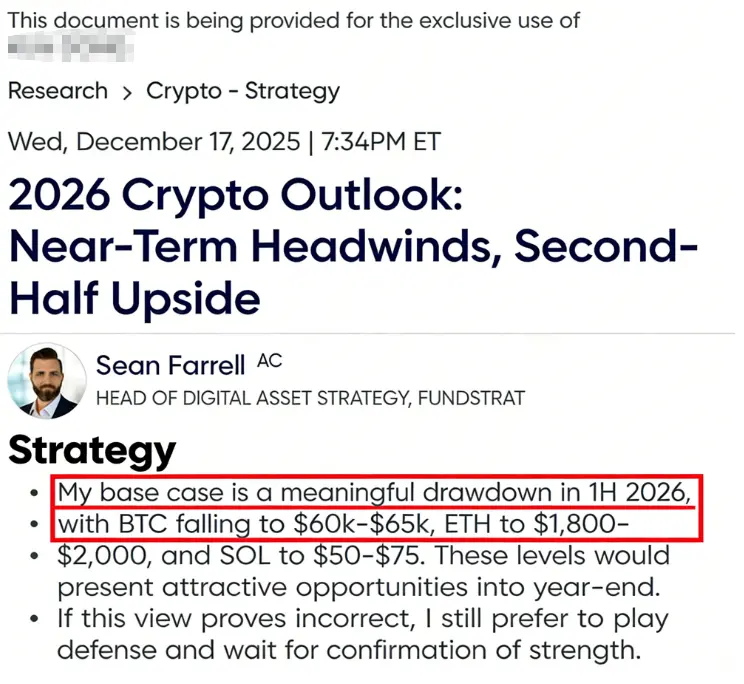
Fundstrat Global Advisors internal documents warn of a “significant fall” in the first half of 2026, predicting that Bitcoin could fall to between $60,000 and $65,000, and Ethereum could drop to $1,800 to $2,000. This contradicts the optimistic remarks made by Fundstrat managing partner Tom Lee, who publicly stated in Dubai that “Bitcoin will reach $250,000, and Ethereum is severely undervalued.”
Tom Lee publicly sings bullish while there is a surprising contradiction in Fundstrat's internal report
(Source: X)
Tom Lee, as a managing partner and research head at Fundstrat, made extremely optimistic predictions at the Binance Blockchain Week held in Dubai at the beginning of October. He publicly stated that Bitcoin could reach $250,000 within a few months and described Ethereum as “severely undervalued” at around $3,000. Lee even proposed three scenarios for Ethereum valuation: if the ETH/BTC ratio returns to the average level of the past eight years, the price of Ethereum could approach $12,000; if it returns to the relative level of 2021, it would mean a price close to $22,000; if the ETH/BTC ratio reaches 0.25, the valuation would exceed $60,000.
However, according to screenshots shared on platform X, a document allegedly published internally by Fundstrat outlines a starkly different scenario for the 2026 cryptocurrency strategy guide. The report, written by Fundstrat's Head of Digital Asset Strategy Sean Farrell, warns of a “significant fall” in the first half of 2026 and sets targets far below current prices: Bitcoin at $60,000 to $65,000, Ethereum at $1,800-$2,000, and Solana at $50-$75. These predictions stand in stark contrast to the optimistic remarks publicly made by Tom Lee.
Fundstrat has not yet publicly disclosed the information, and as of the time of publication, Cointelegraph has also not independently verified its authenticity. However, several cryptocurrency-related accounts, including Wu Blockchain, claim that the document has been distributed to internal clients. If the report is true, it implies that while Fundstrat is publicly bullish, they are privately sending bearish reports to paying clients, a “dual strategy” that will severely damage the institution's credibility.
Three Bearish Predictions from Fundstrat's Internal Report
Bitcoin falls over 30%: from the current approximately $89,000 down to $60,000 to $65,000, giving back most of the gains made in the second half of 2024, testing the validity of the previous breakout level.
Ethereum falls nearly 40%: collapsing from around 3000 USD to 1800-2000 USD, completely breaking Tom Lee's argument of “severely undervalued”, returning to mid-2023 levels.
Solana cut down over 60%: plummeting from the current 126 dollars to 50-75 dollars, retracing almost all the gains of this round, and retesting the bottom area after the FTX crash.
Classic strategy of Wall Street institutions: “bullish and bearish”?
This incident has sparked widespread questioning of the motivations of Wall Street institutions in the market. Critics argue that this is a typical “pump and dump” strategy: making optimistic predictions in public to attract retail investors to buy in, while privately offering bearish advice to institutional clients, allowing smart money to exit or short in advance. This double standard is common in traditional financial markets, but it is particularly unsettling in the cryptocurrency space, which prides itself on transparency and decentralization.
However, there is another interpretation. Fundstrat, as a research institution, may have multiple analysis teams internally. Tom Lee represents the overall brand image and long-term strategic perspective of the company, while Sean Farrell's report may focus on short-term trading strategies, serving different client groups and time frames. Tom Lee claimed last November that “Ethereum is on the same path as Bitcoin, which has seen its price rise more than 100 times since 2017.” This super cycle narrative is clearly from a long-term perspective and does not necessarily contradict the short-term correction forecast for the first half of 2026.
The key issue lies in the transparency of information disclosure. If Fundstrat indeed provided advice to internal clients that contradicts public statements, then the applicable conditions and time frames for both viewpoints should be clearly stated, rather than leaving the market to guess in confusion. Cointelegraph has reached out to Fundstrat for comment, but has not received a response as of the time of publication, and this silence further deepens market doubts.
Tom Lee's BitMine is still feverishly buying Ether
Ironically, despite internal reports predicting that Ethereum would fall below $2000, Tom Lee's BitMine has been actively accumulating Ethereum. In the information disclosed on December 8, the company stated that as of December 7, it holds nearly 3.9 million Ethereum (ETH), having increased its holdings by more than 138,000 within a week. The company claims that the amount of Ethereum it holds currently accounts for more than 3.2% of the total supply of Ethereum, which is an extremely astonishing ratio.
BitMine's large-scale buying behavior provides action support for Tom Lee's public remarks. If he truly believes that Ethereum will fall to $1800-2000, the rational approach should be to stop buying and wait for lower prices. On the contrary, BitMine continues to accelerate accumulation despite the weak market environment, indicating that Tom Lee is indeed optimistic about Ethereum's long-term prospects. This kind of “voting with real money” behavior is more persuasive than any verbal prediction.
However, this may raise another question: Is Tom Lee using public bullish statements to support the price, allowing BitMine to continue accumulating at higher price levels? If the internal report is true and predicts a significant fall in the first half of 2026, then the current purchases may be intended to complete accumulation before a correction, and subsequently add more at lower price levels. This complex operational strategy is not uncommon among institutional investors, but for retail investors, interpreting these signals becomes extremely difficult.
Who should the market trust?
This incident exposes the serious problem of information asymmetry in the cryptocurrency market. Retail investors can only see Tom Lee's optimistic predictions in public, while paying clients may receive completely opposite internal reports. In traditional financial markets, this double standard could trigger regulatory investigations, but the regulatory gray area in the cryptocurrency realm gives institutions greater leeway.
For investors, the key lesson is not to blindly trust the predictions of any single institution or individual. Tom Lee's long-term optimism may be correct, and Sean Farrell's warning of a short-term pullback may also come true; the two are not contradictory. Market participants need to establish their own analytical framework and consider multiple viewpoints, rather than relying on authoritative endorsements to make investment decisions.
Disclaimer: The information on this page may come from third parties and does not represent the views or opinions of Gate. The content displayed on this page is for reference only and does not constitute any financial, investment, or legal advice. Gate does not guarantee the accuracy or completeness of the information and shall not be liable for any losses arising from the use of this information. Virtual asset investments carry high risks and are subject to significant price volatility. You may lose all of your invested principal. Please fully understand the relevant risks and make prudent decisions based on your own financial situation and risk tolerance. For details, please refer to
Disclaimer.
Related Articles
BTC Whale Inflows Drop, LTHs Accumulate Strongly
Recent data shows Bitcoin whale inflows to exchanges have dropped to below $3 billion, indicating reduced selling pressure. Meanwhile, long-term holders have accumulated $49 billion in Bitcoin, signaling a market transition. This shift suggests potential stability and reduced volatility, although macro factors could still affect prices.
Coinfomania5m ago
NewsAlert: Trump Issues Iran Ultimatum – How BTC, ETH, And XRP is Reacting
Trump raised the temperature again with a fresh Iran deadline and warnings of overwhelming force. The rhetoric was extreme, and markets treated it as immediate macro risk.
To be precise, widely cited reports quote Trump saying Iran could be destroyed “in one night” if no deal is reached, not
LiveBTCNews21m ago
Macro investors: A BTC breakout above $76,000 and an ETH breakout above $2,400 may signal a trend reversal
Macro investor Jordi Visser believes that if Bitcoin and Ethereum break through $76,000 and $2,400 respectively, it will kick off a sustainable uptrend. He expects high inflation to push investors to seek profitable assets, and notes that the probability of an economic recession has fallen to 24%. This view contrasts with the current bearish expectations in the crypto industry.
GateNews1h ago
U.S.-Iran talks break down, BTC spikes then pulls back—how do geopolitical conflict and macro data affect the crypto market?
The breakdown of the nuclear talks between Iran and the U.S. caused Bitcoin to surge and then pull back, with the situation in the Strait of Hormuz and macroeconomic data becoming the focus. This article will explain the logic behind volatility in the crypto market amid geopolitical conflict and the movement of on-chain capital.
InstantTrends1h ago
Bitcoin Developers Release Major Update on Testnet, What Changed? - U.Today
Bitcoin developers have released v31.0rc4 for testing, introducing enhanced privacy through Tor and I2P networks, improved mempool design, fee efficiency, and performance upgrades. This update aims to optimize transaction management and protect user anonymity.
UToday1h ago
U.S.-Iran talks: after 21 hours, no agreement reached. Vance says he has proposed a “final proposal”; Iran refuses a nuclear weapons commitment.
The U.S. vice president, Vance, did not reach an agreement in the US-Iran negotiations held in Islamabad. The core dispute is that Iran refused the U.S. demand for a nuclear weapons commitment. The breakdown of the talks has increased geopolitical risk, affecting financial markets—especially crude oil and Bitcoin prices. Even though the negotiations were unsuccessful, both sides may still continue discussions, and the market will watch for further developments.
ChainNewsAbmedia2h ago


