
MicroStrategy founder Michael Saylor posted a signal indicating increased Bitcoin holdings on the X platform on March 1. According to previous patterns, MicroStrategy typically discloses a new round of Bitcoin accumulation data the day after such signals are issued. Market expectations are that a new buying record will be announced as early as this week. MicroStrategy has also raised the March dividend on its perpetual preferred stock STRC to an annual rate of 11.50%, a 25 basis point increase from last month.
Saylor Bitcoin Tracker’s Conventional Logic: Leading Signal of Accumulation
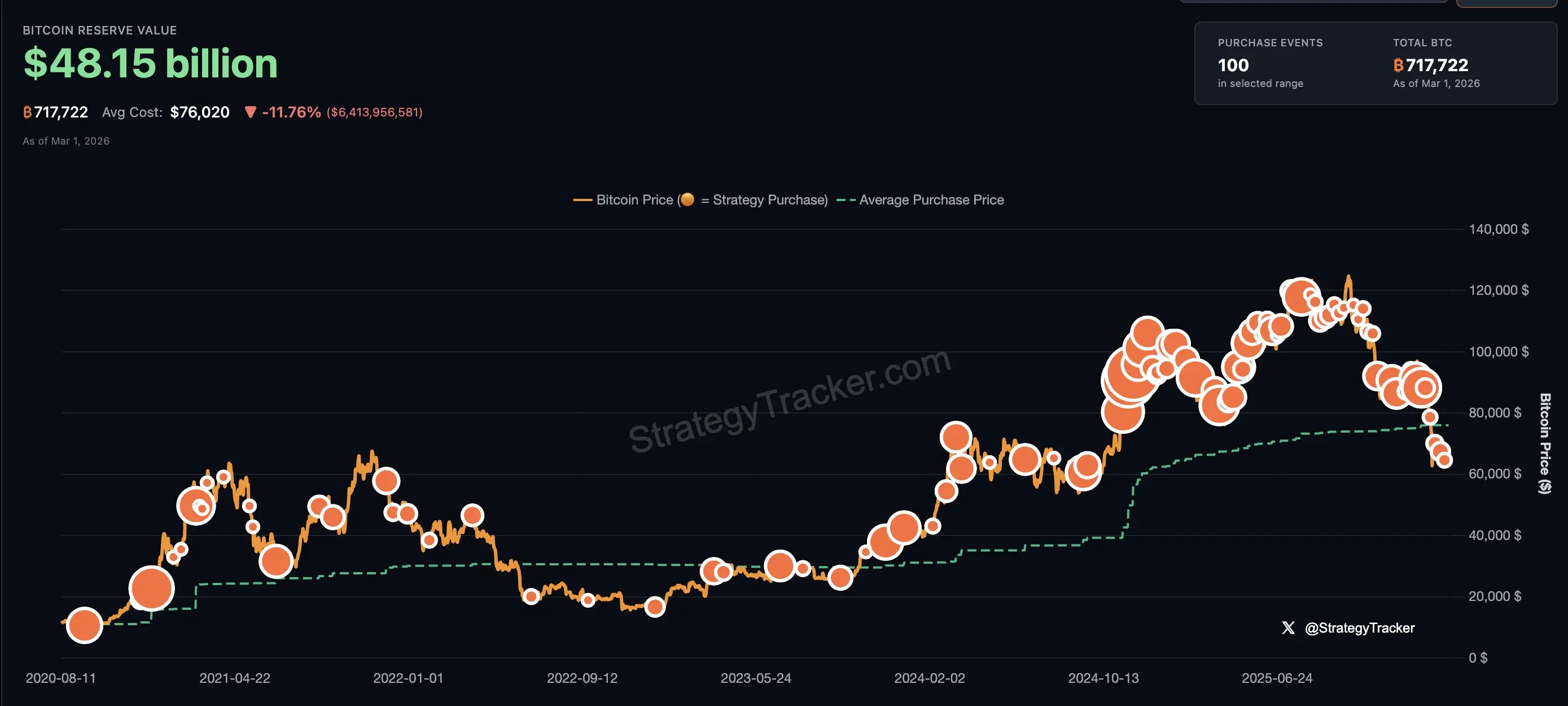
(Source: StrategyTracker)
MicroStrategy often interprets Saylor’s social media posts about Bitcoin tracking as a precursor to increased holdings. The most recent purchase occurred in mid-February, when MicroStrategy bought 592 Bitcoin at an average cost of $67,286 per coin, completing its 100th Bitcoin acquisition, bringing total holdings to 717,722 coins.
Currently, MicroStrategy’s average purchase price for Bitcoin is $76,020 per coin, while the current Bitcoin price remains below this cost, resulting in an unrealized paper loss of approximately $6.5 billion. The latest 2026 tracking report shows the market value of Bitcoin treasury assets is about $48 billion. The company states that even if Bitcoin drops to $8,000, it can still repay all debts.
Key Data on MicroStrategy’s Current Position
Bitcoin Holdings: 717,722 coins (after 100th purchase)
Average Purchase Price: $76,020 per coin
Bitcoin Treasury Market Value: approximately $48 billion
Unrealized Paper Loss: about $6.5 billion (Bitcoin below cost)
MSTR Stock Price: $129.50, significantly down from the 2024 high of over $540
Latest STRC Dividend: 11.50% annual rate (up 25 basis points from last month)
STRC Dividend Increase and MicroStrategy’s Capital Strategy Shift
The increase of STRC’s dividend to 11.50% reflects MicroStrategy’s ongoing adjustment of its overall financing strategy. The company has gradually reduced reliance on issuing MSTR common stock to finance Bitcoin purchases and shifted toward increasing the proportion of perpetual preferred stock. CEO Phong Le stated that, as of 2025, about $7 billion has been raised through preferred stocks like STRC, accounting for roughly one-third of the entire preferred stock market.
STRC’s design links monthly dividends to a $100 face value, with periodic adjustments to maintain stable trading prices. Since its first trading in July 2025, this is the seventh adjustment. This is particularly notable amid Bitcoin’s nearly 20% decline in February and MSTR’s eighth consecutive month of decline (February down 14%).
MSTR remains well below its peak at the end of 2024. The company reported a net loss of $12.4 billion in Q4 2025, despite a 1.9% year-over-year revenue increase, which has severely impacted market sentiment. Critic Peter Schiff commented that the market has given investors “ample time to sell above $65,000,” warning that those buying on dips may face similar difficulties.
Disclaimer: The information on this page may come from third parties and does not represent the views or opinions of Gate. The content displayed on this page is for reference only and does not constitute any financial, investment, or legal advice. Gate does not guarantee the accuracy or completeness of the information and shall not be liable for any losses arising from the use of this information. Virtual asset investments carry high risks and are subject to significant price volatility. You may lose all of your invested principal. Please fully understand the relevant risks and make prudent decisions based on your own financial situation and risk tolerance. For details, please refer to
Disclaimer.
Related Articles
Bitcoin and Solana ETFs See Inflows While Ethereum ETFs Record Outflows on March 24
Gate News bot message, according to the March 24 update, Bitcoin ETFs recorded a 1-day net inflow of 2,715 BTC (+$190.21M) and a 7-day net inflow of 1,091 BTC (+$76.44M). Ethereum ETFs showed a 1-day net outflow of 12,464 ETH (-$26.61M) and a 7-day net outflow of 97,844 ETH (-$208.9M). Solana ETFs r
GateNews1h ago
Over the past 24 hours, the crypto market liquidated $171 million, with long positions accounting for over 65%
According to CoinGlass data, on March 24th, the cryptocurrency market experienced liquidations totaling $171 million within 24 hours, with long positions accounting for over 65% of the total. BTC liquidations reached $53.8812 million, ETH liquidations reached $40.0353 million, affecting 82,511 traders, with the largest single liquidation at $6.4509 million.
GateNews1h ago
ZRO maintains an upward trend, benefiting from MoonPay integration as derivative flows increase sharply
LayerZero (ZRO) decreased by about 3% after a prior 14% rise. Its partnership with MoonPay's Open Wallet Standard is expected to enhance AI-driven commerce across 170 blockchains, resulting in a significant increase in open contracts.
TapChiBitcoin3h ago
CoinDesk 20 performance update: Polkadot (DOT) drops 2.3% as index trades lower
The CoinDesk 20 Index is trading at 2044.07, down 0.2%. Among its assets, APT and XLM are leaders with gains, while DOT and XRP are lagging.
CoinDesk3h ago
Stablecoin USR Suddenly Crashes and Depegs! Resolv Reveals "Minting Vulnerability" Exploited by Hackers, Who Steal $25 Million
DeFi protocol Resolv suffered an attack on March 22, where hackers minted 80 million stablecoins USR at low cost and cashed out approximately $25 million, causing USR to depeg and triggering market volatility. The attack stemmed from a lack of security measures on the protocol's privileged accounts, impacting overall liquidity and affecting the lending market. Resolv subsequently suspended the protocol and emphasized that collateral pools remained unaffected, but experts believe the hidden losses caused by the incident are significant.
区块客5h ago
Kalshi, Polymarket Tighten Rules to Curb Insider Trading
Polymarket and Kalshi are introducing new rules to prevent insider trading and market manipulation amid increased regulatory scrutiny. Polymarket has updated governance to strengthen enforcement, while Kalshi has implemented screening tools to block insider trading in elections and sports events, showcasing a trend towards aligning prediction markets with traditional finance standards.
TheNewsCrypto6h ago


