Key Takeaways:
- Strategy bought 13,627 BTC for $1.25 billion at an average price of $91,519 per coin
- The company’s total Bitcoin holdings now stand at 687,410 BTC, acquired for $51.8 billion
- The purchase reinforces Strategy’s position as the largest corporate holder of Bitcoin in the world
Strategy has once again made a massive Bitcoin move, adding 13,627 BTC to its balance sheet in a single week. The aggressive accumulation highlights Michael Saylor’s continued conviction in Bitcoin as a long-term treasury asset and signals growing confidence among institutional players despite elevated price levels.
Read More: Strategy Eyes $4.2B War Chest After $10B Profit, Could It Double Down on Bitcoin Again?
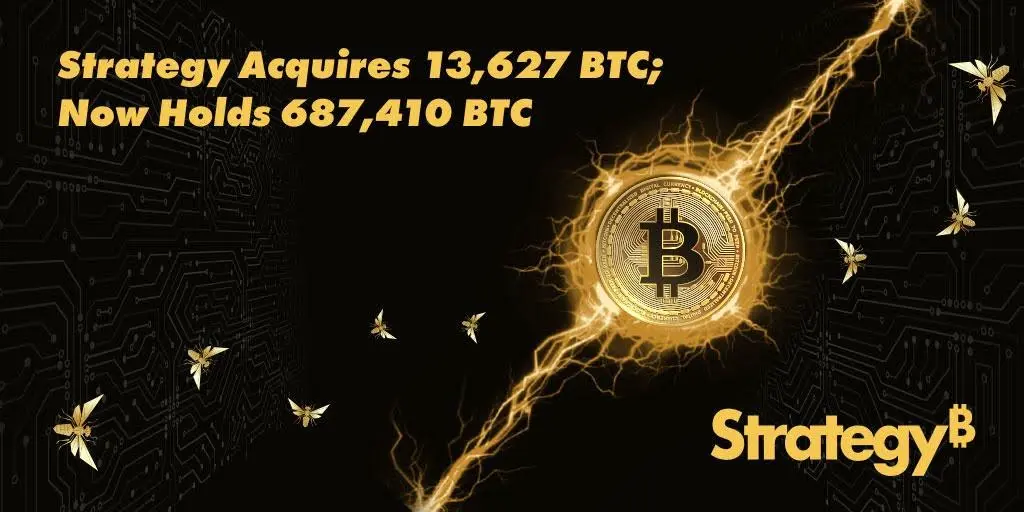
Table of Contents
- Strategy’s Latest Bitcoin Buy: $1.25B in a Single Week
- How Strategy Funded the Purchase
- Saylor’s High-Conviction Bitcoin Playbook
- Why Strategy Keeps Buying at High Prices
- What This Signals to the Market
- Bitcoin as a Corporate Treasury Asset
Strategy’s Latest Bitcoin Buy: $1.25B in a Single Week
Strategy chairman Michael Saylor confirmed the purchase in a public post, stating the company acquired 13,627 Bitcoin for approximately $1.25 billion at an average price of $91,519 per BTC. The transaction was completed between January 5 and January 11, 2026.
With this addition, Strategy’s total Bitcoin holdings have climbed to 687,410 BTC, making it by far the largest publicly traded corporate holder of Bitcoin globally. The company has now deployed $51.8 billion into Bitcoin at an average acquisition cost of $75,353 per coin.
This marks Strategy’s largest Bitcoin purchase since July and its third consecutive weekly accumulation, underscoring a renewed acceleration in buying activity.
How Strategy Funded the Purchase
The latest Bitcoin acquisition was not funded through cash reserves. Instead, Strategy raised capital through its ongoing at-the-market (ATM) offering program, selling both common stock and preferred equity.
According to regulatory filings, the company generated:
- $1.1 billion from the sale of MSTR Class A common stock
- $119 million from its perpetual preferred equity known as STRC
In total, these equity sales provided the $1.25 billion needed for the Bitcoin purchase.
Strategy still retains significant firepower. It has approximately:
- $10.3 billion remaining capacity for MSTR stock issuance
- $20.3 billion available under its STRK preferred stock program
This means further Bitcoin buys remain highly possible in the near term.
Saylor’s High-Conviction Bitcoin Playbook
Michael Saylor has been consistent and unapologetic in his Bitcoin strategy. The company is not trading, hedging, or rotating out of positions. It is accumulating and holding, regardless of short-term price movements.

Why Strategy Keeps Buying at High Prices
Strategy is not attempting to catch the market. Long-term belief in the value of Bitcoin is the basis of its approach:
- A superior store of value compared to fiat
- A hedge against monetary debasement
- A digital alternative to gold
Strategy is sending a strong message by still purchasing at prices above $90,000: it does not consider the prevailing prices as “expensive” when it has its long-term perspective. This conduct is similar to those of Saylor in the past. The increase in purchasing has historically been made during the rallies and the pullbacks, and is not regarding the entry point, but the overall accumulation.
What This Signals to the Market
The aggressive buying of strategy is not occurring alone. It comes at a time when:
- Spot Bitcoin ETFs continue to attract institutional inflows
- Major banks are filing for crypto ETFs
- Regulatory clarity in the U.S. is improving
- Corporate treasuries are re-evaluating Bitcoin exposure
The fact that a company of Strategy invested 1.25 billion dollars within a week is a very strong message to the market: even the institutional trust in Bitcoin is high at such high levels.
Read More: Wells Fargo Buys $383M in Bitcoin ETFs as Retail Fear Peaks
Bitcoin as a Corporate Treasury Asset
Strategy has become a Bitcoin treasury company successfully. It now closely relies on the performance of Bitcoin in its business model and has turned into a proxy instrument of institutional Bitcoin exposure.
Other companies are getting affected by this strategy. Other companies are investigating:
- Holding Bitcoin on balance sheets
- Issuing debt or equity to acquire BTC
- Using Bitcoin as a long-term reserve asset
The scale of strategy provides it with a special advantage. The company holds almost 700,000 BTC and it has a significant share of the total number of Bitcoins in circulation. This focus contributes to the supply squeeze in which additional BTC is deposited in long-term corporate holdings.
Strategy shares rose a bit in pre-market trading, following the disclosure, and Bitcoin was trading above the $90,000 mark. The low response indicates how the market has become complacent with regards to the aggressiveness of Bitcoin purchases by Strategy.
Disclaimer: The information on this page may come from third parties and does not represent the views or opinions of Gate. The content displayed on this page is for reference only and does not constitute any financial, investment, or legal advice. Gate does not guarantee the accuracy or completeness of the information and shall not be liable for any losses arising from the use of this information. Virtual asset investments carry high risks and are subject to significant price volatility. You may lose all of your invested principal. Please fully understand the relevant risks and make prudent decisions based on your own financial situation and risk tolerance. For details, please refer to
Disclaimer.
Related Articles
Gold and silver fall across the board, and the BTC/ETH volatility index rises slightly
On April 13, gold and silver prices fell to $4,732.92 per ounce and $74.209 per ounce, respectively. The BTC volatility index rose by 0.42%, and the ETH volatility index rose by 0.31%. The U.S. dollar versus the Chinese yuan and the Japanese yen edged up slightly, major European stock indexes generally fell, while WTI and Brent crude oil prices rose. The Gate platform supports trading for multiple asset types.
GateNews21m ago
BTC 15-minute rise of 0.86%: A rebound driven by a convergence of short liquidations and inflows into ETFs
2026-04-13 13:45 to 2026-04-13 14:00 (UTC), the BTC price fluctuated within the 70945.9 to 71699.9 USDT range. Within 15 minutes, it recorded a notable gain of +0.86%, with a swing of 1.06%. Market attention has surged, short-term volatility has clearly intensified, and on-chain large transfers, spot, and derivatives trading volumes have expanded in sync, indicating that the activity level of funds by major players is at one of the highest points of the year.
The main driving force behind this anomaly is that BTC has been probing the 72000–73500 USDT range with a large amount of leverage shorts
GateNews25m ago
Bernstein: The Bitcoin market has already priced in the risk from quantum computing, and developers have 3 to 5 years to push forward with a post-quantum upgrade
Bernstein’s research report states that the Bitcoin pullback reflects market concerns about the risks of quantum computing, and argues that the quantum threat is manageable and does not constitute a systemic risk. Current technological progress provides a cushion for Bitcoin, giving developers 3 to 5 years to push forward a post-quantum upgrade. Institutional investors will help drive consensus formation, but user migration remains the main challenge.
GateNews26m ago
The New York Times reignites the “Satoshi identity mystery”; after Adam Back was targeted, he quickly clarified
Author: Nancy, PANews
Satoshi Nakamoto’s true identity remains the mystery that has continued in the crypto world for 17 years. Speculation about this pseudonym has never stopped—from cryptographers to corporate founders, various candidates have been brought up in turn, but there has always been a lack of evidence strong enough to settle the matter once and for all.
Recently, The New York Times published a long-form investigation of more than 10,000 words. Based on multiple comparisons drawn from language style, technical pathways, and historical context, it ranked Blockstream CEO Adam Back as the strongest candidate for Satoshi Nakamoto. However, this claim was quickly and clearly denied by Back himself, and the relevant arguments were widely questioned across the industry as being hard to support.
The dispute over Satoshi Nakamoto’s identity reignites as the long-form investigation targets Adam Back
In this investigation, New York Times reporter John Carreyrou spent more than a year thoroughly sifting through decades of archives, as well as the cypherpunk email list to
区块客53m ago
Exodus, the Nasdaq-listed Bitcoin treasury company, sues the W3C to demand enforcement of the acquisition agreement
U.S.-listed Bitcoin custody company Exodus Movement filed a lawsuit in Delaware state court on April 13, seeking W3C Corp and its CEO to carry out the 2025 share acquisition agreement and to speed up the completion of the transaction. Exodus has received approval from the UK’s financial regulator and plans to drive the acquisition forward through litigation and the enforcement of security interests.
GateNews54m ago


