In 2025, the roster of nation-states holding BTC quietly shifted, and what follows is a look at the top five countries sitting on large caches of the world’s leading crypto asset.
Seized, Mined, Stockpiled: How Governments Became Major Bitcoin Holders in 2025
Early this year, in May, estimates put the United States’ bitcoin stash at 198,012 BTC, but a major confiscation—127,271 BTC tied to a wanted Chinese national—quickly made that pile much heavier.
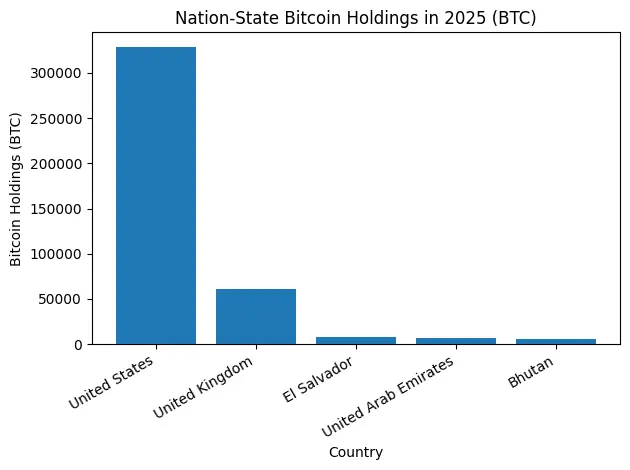
Thanks to that seizure by U.S. authorities, the country’s holdings ballooned in short order. As 2025 winds down, data logged by Arkham Intelligence shows the U.S. government sitting on roughly 328,372.32 BTC. At current BTC exchange rates, that hefty trove carries a price tag of about $28.7 billion.
Right behind the United States sits the United Kingdom, with the U.K. government holding 61,245.01 BTC, according to Arkham records. The story traces back to 2018, when the U.K. Metropolitan Police raided a property tied to Jian Wen and Zhimin Qian, two Chinese nationals linked to a £5 billion investment fraud and money laundering scheme that ran from 2014 to 2017. During the operation, authorities seized devices containing more than 61,000 BTC, with the government securing full access to the holdings in July 2021.
Sitting below the U.K. in third place is El Salvador, a country where bitcoin ( BTC) holds legal-tender status. At present, the nation controls a cache of 7,509.37 BTC, according to Arkham’s logs. The government says these holdings come from national treasury allocations. Outside observers, including the International Monetary Fund (IMF), have raised doubts, suggesting El Salvador may not have acquired new bitcoin since early 2025 and that transactions labeled as “purchases” could simply reflect internal wallet transfers rather than genuine additions to reserves.
Next on the list is the United Arab Emirates (UAE), holding 6,568.30 BTC, a balance sourced directly from mining operations conducted through Citadel Mining. The ownership trail is straightforward: Citadel Mining is 85% owned by UAE Royal Group, a heavyweight conglomerate steered by Abu Dhabi’s ruling family. The UAE has recently climbed the ranks among nation-states holding BTC, as the region has increasingly positioned itself as a central hub for crypto, blockchain, and artificial intelligence (AI).
Bhutan ranks as the fifth-largest nation-state holding BTC, and much like the UAE’s position, its stash is built through mining. The Royal Government of Bhutan acquires bitcoin this way, with oversight handled by Druk Holdings (DHI), the sovereign wealth fund and commercial arm of the state. DHI has laid out an ambitious roadmap, targeting tenfold growth in these investments by 2035. That said, Bhutan trimmed its holdings in 2025 and once controlled a noticeably larger cache. Today, the country holds about 5,984.54 BTC, valued at just over half a billion U.S. dollars.
Also read: Bitcoin Logs 4th Straight Outflow Day With $189 Million Exit
Together, the top tier of nation-state BTC holders in 2025 paints a picture driven less by ideology and more by how each government arrived at its stack. Some landed here through court seizures and confiscated hardware, others via mining operations humming away in deserts or mountain valleys, and a few through treasury strategies that continue to spark debate.
Different routes, different rationales—but the common thread is that bitcoin has quietly found a place on sovereign balance sheets. Looking ahead to 2026, nation-state bitcoin ownership is no longer a novelty or a curiosity. It’s a line item markets track, critics dissect, and policymakers weigh with increasing seriousness. Whether these holdings expand, contract, or simply shift between wallets, governments owning BTC has moved from theory to hard data.
FAQ 🇺🇸 🇬🇧 🇸🇻 🇦🇪 🇧🇹
- Which country holds the most bitcoin in 2025? The United States leads all nation-states, holding roughly 328,372 BTC largely sourced from law enforcement seizures.
- Why do governments hold bitcoin? Nation-states acquire BTC through seizures, mining operations, or treasury strategies tied to financial policy decisions.
- Is bitcoin legal tender anywhere? El Salvador remains the only country where bitcoin is recognized as legal tender.
- How do analysts track government bitcoin holdings? Platforms like Arkham Intelligence monitor on-chain data to estimate wallets linked to government entities.
Disclaimer: The information on this page may come from third parties and does not represent the views or opinions of Gate. The content displayed on this page is for reference only and does not constitute any financial, investment, or legal advice. Gate does not guarantee the accuracy or completeness of the information and shall not be liable for any losses arising from the use of this information. Virtual asset investments carry high risks and are subject to significant price volatility. You may lose all of your invested principal. Please fully understand the relevant risks and make prudent decisions based on your own financial situation and risk tolerance. For details, please refer to
Disclaimer.
Related Articles
BTC Breaks Through 72000 USDT
Gate News bot 消息,Gate 行情显示,BTC 突破 72000 USDT,现价 72002.5 USDT。
CryptoRadar2m ago
Gold and silver fall across the board, and the BTC/ETH volatility index rises slightly
On April 13, gold and silver prices fell to $4,732.92 per ounce and $74.209 per ounce, respectively. The BTC volatility index rose by 0.42%, and the ETH volatility index rose by 0.31%. The U.S. dollar versus the Chinese yuan and the Japanese yen edged up slightly, major European stock indexes generally fell, while WTI and Brent crude oil prices rose. The Gate platform supports trading for multiple asset types.
GateNews40m ago
BTC 15-minute rise of 0.86%: A rebound driven by a convergence of short liquidations and inflows into ETFs
2026-04-13 13:45 to 2026-04-13 14:00 (UTC), the BTC price fluctuated within the 70945.9 to 71699.9 USDT range. Within 15 minutes, it recorded a notable gain of +0.86%, with a swing of 1.06%. Market attention has surged, short-term volatility has clearly intensified, and on-chain large transfers, spot, and derivatives trading volumes have expanded in sync, indicating that the activity level of funds by major players is at one of the highest points of the year.
The main driving force behind this anomaly is that BTC has been probing the 72000–73500 USDT range with a large amount of leverage shorts
GateNews45m ago
Bernstein: The Bitcoin market has already priced in the risk from quantum computing, and developers have 3 to 5 years to push forward with a post-quantum upgrade
Bernstein’s research report states that the Bitcoin pullback reflects market concerns about the risks of quantum computing, and argues that the quantum threat is manageable and does not constitute a systemic risk. Current technological progress provides a cushion for Bitcoin, giving developers 3 to 5 years to push forward a post-quantum upgrade. Institutional investors will help drive consensus formation, but user migration remains the main challenge.
GateNews45m ago
The New York Times reignites the “Satoshi identity mystery”; after Adam Back was targeted, he quickly clarified
Author: Nancy, PANews
Satoshi Nakamoto’s true identity remains the mystery that has continued in the crypto world for 17 years. Speculation about this pseudonym has never stopped—from cryptographers to corporate founders, various candidates have been brought up in turn, but there has always been a lack of evidence strong enough to settle the matter once and for all.
Recently, The New York Times published a long-form investigation of more than 10,000 words. Based on multiple comparisons drawn from language style, technical pathways, and historical context, it ranked Blockstream CEO Adam Back as the strongest candidate for Satoshi Nakamoto. However, this claim was quickly and clearly denied by Back himself, and the relevant arguments were widely questioned across the industry as being hard to support.
The dispute over Satoshi Nakamoto’s identity reignites as the long-form investigation targets Adam Back
In this investigation, New York Times reporter John Carreyrou spent more than a year thoroughly sifting through decades of archives, as well as the cypherpunk email list to
区块客1h ago


