Individuals transacting cryptocurrency on offshore platforms or independently must now report their movements when the amount of crypto transacted surpasses $5,000 per year. Users must now deliver sensitive data, including the purpose of each transaction, hashes, and destination addresses.
Paraguay Ramps Up Crypto Reporting Requirements For VASPs and Individuals
The government of Paraguay is ramping up the scrutiny of the cryptocurrency market.
The National Directorate of Tax Revenue (DNIT), Paraguay’s tax watchdog, has issued a resolution creating a new figure, a sworn cryptoassets statement, to obtain a more granular control and oversight of the crypto movements in the country.
Resolution No. 47 establishes that both operators of virtual asset service providers (VASPs) and individuals making crypto transactions with volumes going over $5,000 per year, even if transacting using offshore accounts or outside exchange platforms, must issue this detailed statement.
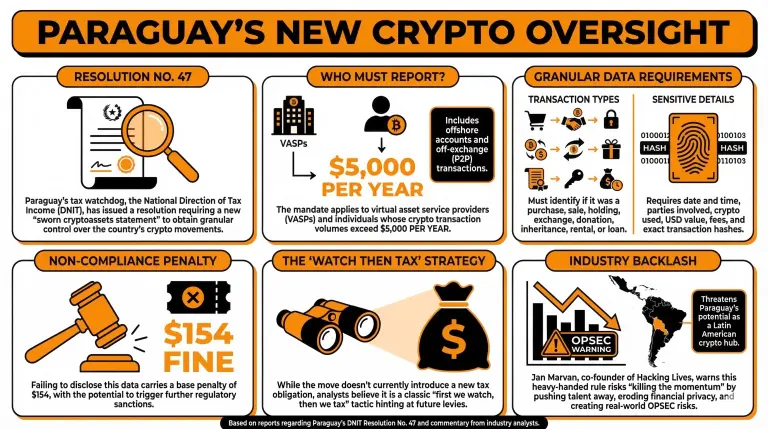
The document must identify, at the very minimum, the class of transaction completed -purchases and sales, holding or possession, exchanges between different crypto assets, donations, inheritances, temporary assignments, rentals, or loans, among others.
In the same way, for each transaction, the user must include sensitive data, such as date and time, the parties involved, the cryptocurrency used, the amount traded, the value transacted in U.S. dollars, fees, and transaction hashes.
The penalty for failing to disclose this data during the expected period is $154, and it could result in other penalties.
While this move doesn’t introduce a tax obligation, analysts believe this might be a classic “first we watch, then we tax” move, hinting at future moves to leverage this information via new levies.
Jan Marvan, co-founder of Hacking Lives, stressed that this was a troubling development for the nation’s crypto scene, as it could affect its possibilities of becoming a crypto hub in Latin America.
“This kind of heavy-handed rule risks killing that momentum. It will push talent away, slow down everyday adoption, erode financial privacy, and in the worst cases create real-world OPSEC risks for users,” he concluded.
FAQ
- What recent action has the government of Paraguay taken regarding cryptocurrencies?
Paraguay is increasing scrutiny of the crypto market by implementing a sworn cryptoassets statement for enhanced oversight of crypto transactions.
- What does Resolution No. 47 require from virtual asset service providers and individuals?
Operators and individuals engaging in crypto transactions over $5,000 per year must issue a detailed statement identifying transaction types and sensitive data.
- What details must be included in the sworn statement?
The statement must include transaction specifics such as date, time, parties involved, cryptocurrency used, and amount traded, along with the transaction hash.
- What implications does this resolution have for Paraguay’s crypto market?
Analysts warn that while it doesn’t introduce new taxes now, it may lead to future taxation, potentially hindering Paraguay’s growth as a crypto hub in Latin America.
Disclaimer: The information on this page may come from third parties and does not represent the views or opinions of Gate. The content displayed on this page is for reference only and does not constitute any financial, investment, or legal advice. Gate does not guarantee the accuracy or completeness of the information and shall not be liable for any losses arising from the use of this information. Virtual asset investments carry high risks and are subject to significant price volatility. You may lose all of your invested principal. Please fully understand the relevant risks and make prudent decisions based on your own financial situation and risk tolerance. For details, please refer to
Disclaimer.
Verwandte Artikel
Koreanische Steuerbehörde ergreift Maßnahmen zur Sicherung beschlagnahmter Kryptobestände
Südkoreas Nationale Steuerbehörde plant, private Verwahrstellen für beschlagnahmte Kryptowährungen einzustellen, nachdem eine Sicherheitsverletzung Mängel in ihrem Speichersystem aufdeckte. Diese Umstellung zielt darauf ab, die Sicherheit zu verbessern und die Vermögensverwalte angesichts zunehmender Regelungen für digitale Vermögenswerte zu rationalisieren.
TodayqNews4Std her
Senator Cramer mahnt zur Abstimmung über CLARITY Act vor Ostern
Senator Kevin Cramer forderte den Kongress auf, das CLARITY Act vor Ostern zu beschleunigen, um legislative Verzögerungen bei der Kryptoregulierung zu verhindern. Er erörterte Bedenken des Bankwesens und Stablecoin-Belohnungsstrukturen und betonte die Notwendigkeit schnellen Handelns, um die Führungsposition der USA bei digitalen Vermögenswerten zu bewahren.
CryptoFrontNews4Std her
CLARITY Act's Stablecoin Yield Deal in Reichweite, da SEC Tokens neu definiert
Gesetzgeber und Aufsichtsbehörden machen Fortschritte in der Kryptopolitik, wobei bald mit einem Stablecoin-Rendite-Vorschlag gerechnet wird. Die SEC und die CFTC haben die meisten Kryptowerte als keine Wertpapiere eingestuft und mehrere als digitale Rohstoffe bezeichnet.
CryptoFrontNews4Std her
US SEC verlängert die Frist für die Entscheidung über die Notierungsanträge für Nasdaq-Bitcoin-Index-Optionen bis zum 27. Mai
Die US-amerikanische Securities and Exchange Commission (SEC) hat beschlossen, die Frist für ihre Entscheidung über die Regeländerungen der Nasdaq PHLX Exchange bezüglich der Notierung und des Handels von Bitcoin-Optionen zu verlängern. Die neue Frist wurde von dem 28. März 2026 auf den 27. Mai 2026 verschoben, um eine umfassende Prüfung des Vorschlags und der öffentlichen Stellungnahmen zu gewährleisten.
GateNews5Std her
USA CFTC veröffentlicht FAQ zu Kryptowährungen und Blockchain-Geschäftstätigkeiten zur Stärkung der Konsistenz von Regulierungsregeln
Der Vorsitzende der US-CFTC, Mike Selig, gab bekannt, dass die Behörde am 20. März einen FAQ zu Kryptowährungen und verwandten Vermögenswerten veröffentlicht hat, der klare Compliance-Richtlinien für registrierte Institutionen und Handelseinheiten festlegt. Dies ergänzt die Erklärungen zu tokenisierten Sicherheiten und digitalen Asset-Margen und bietet Marktteilnehmern einen klaren operativen Rahmen.
GateNews5Std her
Kentucky Krypto-Gesetzentwurf entfacht Debatte über Wallet-Compliance
Kentuckys Gesetzgeber fördern Haushaltsgesetz 380, um Kryptowährungs-Geldautomaten zu regulieren und den Verbraucherschutz zu verbessern. Kritiker warnen, dass spezifische Bestimmungen die Compliance mit nicht-verwahrten Wallets behindern könnten, was die Nutzerprivatsphäre und Innovation gefährdet. Das Ergebnis wird die Kryptolandschaft des Staates prägen.
TodayqNews7Std her


