In addition to the two main internal and external variables of ETF and Ordinals wave, there are also some positive potential variables that have never appeared in the previous halving cycle that are advancing rapidly and may have an impact on the new round of market evolution.
Written by Terry
There are currently less than 4 months left before the fourth Bitcoin halving, which is expected to be April 23, 2024, when the block reward will drop from 6.25 BTC to 3.125 BTC.
As one of the most important narratives in the crypto industry, the “Bitcoin halving” has always been an important stimulating event that the market has huge expectations for. As the new halving cycle comes to an end, what should we expect? What new variables have emerged in the market? **
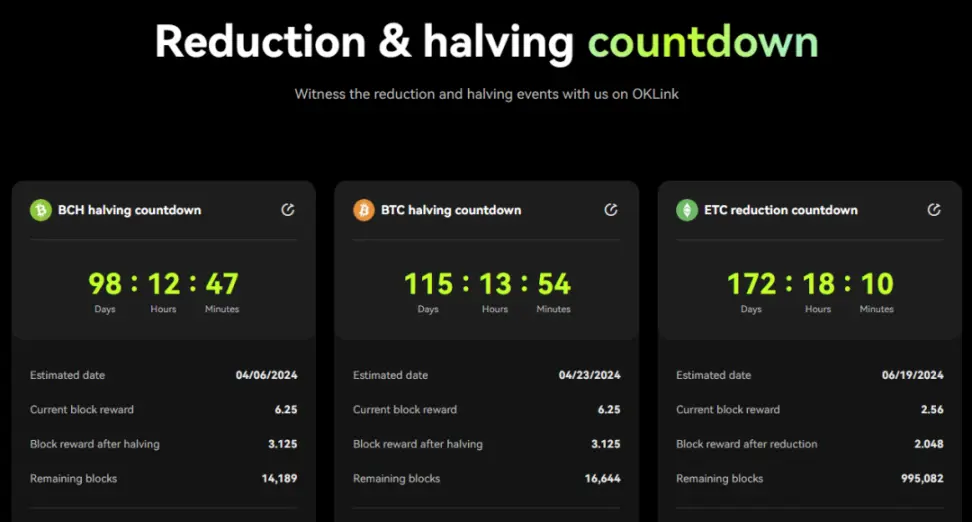
Source: OKLink
**What impact will the halving have on the crypto market? **
For the crypto industry, each round of halving is a grand event, especially the first two halving cycles of Bitcoin, which both saw an astonishing increase of dozens of times (in the short term, after the two halvings, both were accompanied by profits. Although there was a short-term decline, the adjustment was then completed and a long-term rise emerged).
**However, starting from the third halving in 2020, as the number of industry practitioners, market attention, and the completeness of supporting infrastructure have all improved significantly than before, Bitcoin is no longer a niche limited to geek circles. Products have begun to interact with more external factors. **
To summarize simply:
- Before the first halving, geeks in the circle were more concerned about the possibility of Bitcoin serving as electronic cash;
- During the second halving cycle, the focus on Bitcoin shifted to its properties as a payment tool, which also triggered a series of debates (the subsequent BCH fork was almost the top trend in the circle);
- In the third halving cycle, Bitcoin has become an alternative asset, and attention to the layout of traditional institutions and capital has begun to become the main theme;
**So compared to the first two halvings, the popularity of Bitcoin’s third halving is also unprecedented. At the same time, the overall political and economic environment of the world during Bitcoin’s third halving also affected its performance: **
Under the influence of macro factors, from March 12 to March 13, two months before the halving on May 11, Bitcoin began to decline from $7,600, first falling to $5,500 and fluctuating. Subsequently, it broke through the support point all the way, reaching as low as 3,600 US dollars. The overall market value evaporated by 55 billion US dollars in an instant, and the entire network liquidated more than 20 billion yuan, accurately achieving “price halving”.
However, after the halving in May, DeFi started a new bull market cycle in the summer, and Bitcoin also hit $60,000, nearly 20 times higher than the lowest point before the halving.
**In general, judging from historical experience, it is very likely that a new bull market cycle will start after the halving. It may be difficult to achieve an increase of more than 10 times in terms of current volume, but it will surpass the high point of the last bull market. $60,000 is quite worth the wait. **
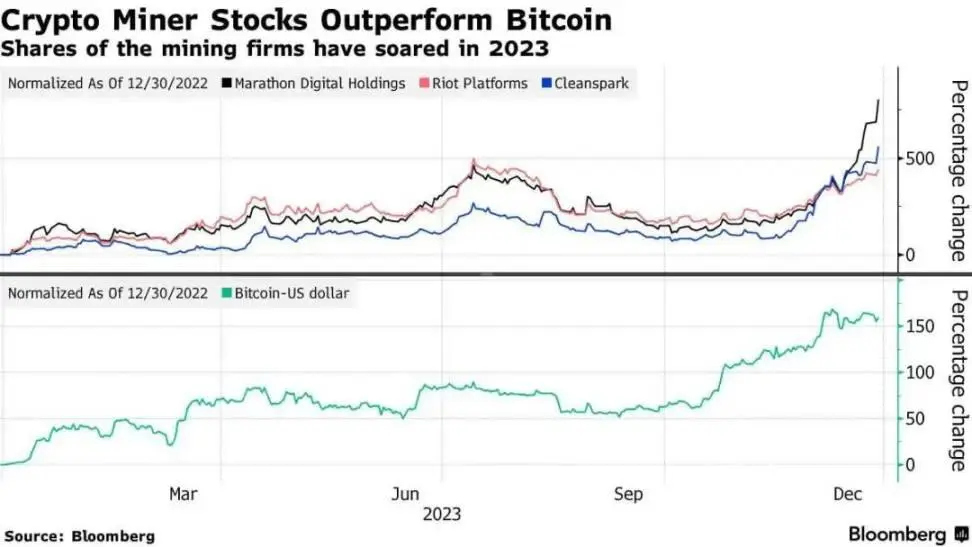
In addition, it is worth noting that before every Bitcoin halving, listed mining companies are also the best “self-leveraged” related targets:
Among the listed mining companies, there are currently 15 miners listed on Nasdaq and the Toronto Stock Exchange. Among them, MARA, as the leader, has risen for 11 consecutive trading days, with an increase of more than 100%. This year, the total increase has exceeded 800%. Riot this year The increase also exceeded 400%, while Bitcoin’s increase during the same period was only about 160%.
New variables beyond halving
However, at the same time, under the background that Bitcoin has experienced three halvings, the block reward has been reduced to 6.25, and the number of mined coins has reached more than 19 million, in fact, many situations and many things have to be reconsidered from a new perspective. It’s time.
**In particular, the entire industry and Bitcoin itself have seen some new variables worthy of attention compared to previous halvings. **
1) The incremental funding impact of spot ETFs
The core factor of the market’s rise in the past two months is the expected impetus of the “Spot Bitcoin ETF”.
Judging from the established timetable, the closest time point to the spot Bitcoin ETF application results is January 10, 2024: The ARK 21Shares Bitcoin ETF, which has been delayed twice, will usher in the final decision.
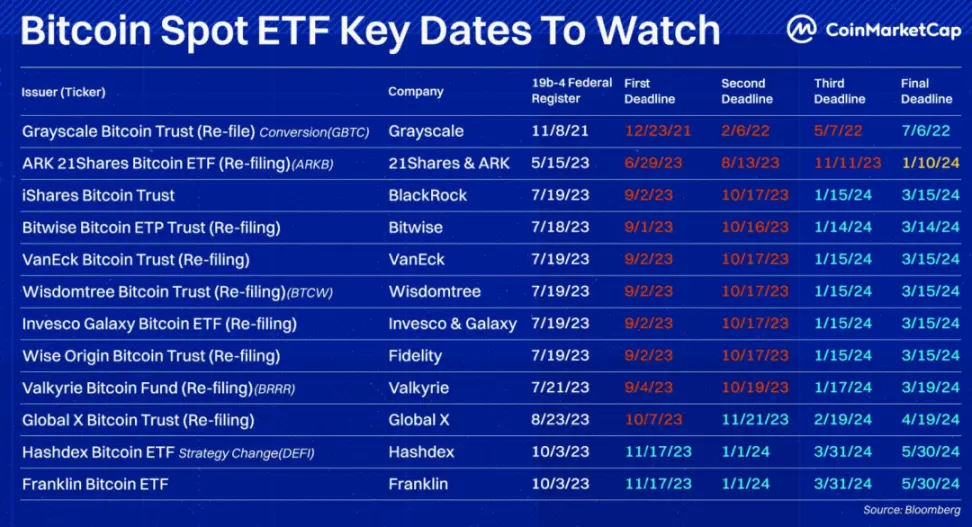
In addition, from January 14 to 17, 2024, there are also 7 spot Bitcoin ETF applications that will usher in the time node for the US SEC to make a decision. However, according to past practice, there is a high probability that it will continue to be postponed. The final time window is mid-March.
**But even if it is postponed again to mid-March, the dust will eventually settle before the Bitcoin halving in late April, which also means that the final decision on spot ETFs will be earlier than the Bitcoin halving time node. **
Once the ETF is passed and the halving event is superimposed, Bitcoin may start a new cycle driven by dual benefits. Even if it is not as good as expected, it can still play a certain role in hedging.
In addition, in fact, there is already a “quasi-Bitcoin ETF” on the market that is constantly expanding in size - leaving aside the exchange as a custodian, there are currently corporate entities holding more than 100,000 Bitcoins, except for Block .one and the long-defunct Mt.Gox, ranking third is MicroStrategy.
**As a veteran of Bitcoin, MicroStrategy’s purchase of Bitcoin has long been a well-known strategy. **The news of its public purchase of Bitcoin can be traced back to August 11, 2020, and this In March, MicroStrategy and its subsidiaries once again purchased approximately 14,620 Bitcoins for approximately US$615.7 million in cash:
The average purchase price is $42,110, and as of December 26, 2023, MicroStrategy held 189,150 BTC, with an average purchase cost of $31,168.
You must know that the total market value of MicroStrategy’s stock is only US$9 billion, of which Bitcoin assets account for US$6 billion, which means that 2/3 of the net assets can be understood as the value of Bitcoin, which has led many investors to regard MicroStrategy as “Quasi Bitcoin ETF” is configured.
2) Internal evolution of Bitcoin ecosystem
According to Bitcoin’s halving rules, the block reward starts with 50 Bitcoins, and the rule is to be halved every four years. It has been halved three times to 6.25.** This will continue to decrease until Bitcoin 2140 There will be no more block rewards;**
The handling fees will always exist, so with each round of halving, the block rewards will gradually decrease or even approach nothing. In the future, the income of miners will become very single, only handling fee rewards.
Since the beginning of this year, the prosperity of the Bitcoin ecosystem, especially BRC20, has set off a new wave of “BitcoinFi”. The activity of transactions within the Bitcoin ecosystem has reached a new peak, thus boosting the surge in Bitcoin’s fee income.
In this context, protocol innovations such as Ordinals, accompanied by the conquest of leading projects such as ORDI and SATS, have profoundly affected the rate model of the Bitcoin network - most directly, it has completely changed the economic model and incentive model of Bitcoin. . **
The latest data from Dune shows that as of December 29, the cumulative cost of Ordinals inscription casting exceeded 5,135 BTC, exceeding US$200 million.
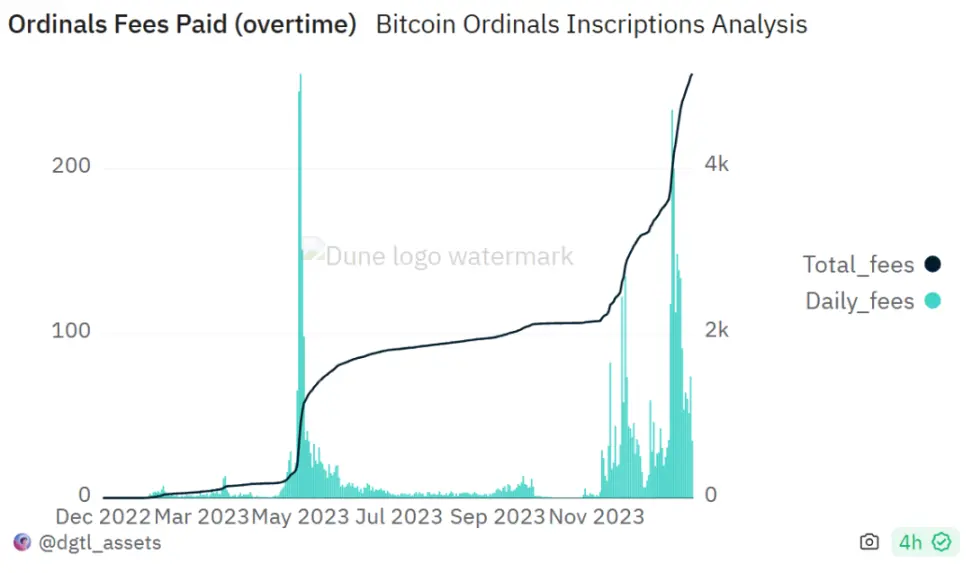
This has also helped BTC mining fee income hit a new high in the past five years. Previously, the historical average data of miner fee income often accounted for only about 2%, but the average data in the past three months has reached about 8%, setting a record. record.
**As subsequent block rewards gradually decrease until they approach zero, the handling fee will become more and more important until it eventually becomes the only source of income. **
So this round of BRC20 is equivalent to a preview. Regardless of whether it is successful or not, with the subsequent Bitcoin halving, the variables along the way are bound to profoundly change the overall rate model of Bitcoin.
Summary
In addition to the two main internal and external variables of ETF and Ordinals wave, there are also some positive potential variables that have never appeared in the previous halving cycle that are advancing rapidly and may have an impact on the new round of market evolution.
**On the one hand, the Bitcoin bond “Volcano Bond” has been approved by the El Salvador Digital Assets Commission and is expected to be issued in the first quarter of 2024. **
This is also the first national bond issuance to focus on Bitcoin. Half of the funds raised from the bond will be used to purchase Bitcoin and be held for five years. The remainder will be used to fund Bitcoin-related construction projects. Follow-up It’s worth paying attention to what kind of ripples it creates.
On the other hand, the Ordinals wave has introduced a huge amount of funds, users, and developers into the Bitcoin ecosystem through the inscription pipeline:
If Bitcoin in the past only had advantages in “orthodox cognition” and total market capitalization, the inscription trend has directly and greatly increased the richness of new assets in the Bitcoin ecosystem. Humanity’s demand for new assets is eternal, and it also indirectly Increased the number of developers and user base.
At the same time, new innovations such as the RGB protocol, Slashtags (serving identity accounts, contacts, communications, and payments in the Bitcoin Lightning Network ecosystem), the Impervious browser integrating many P2P services, the Taproot-based asset protocol Taro, and the Lightning Token OmniBOLT are all Quite worth looking forward to.
Generally speaking, although the footsteps of this halving are getting closer and closer, the expansion of Bitcoin in all dimensions has obviously ushered in almost all new variables, which even once overwhelmed the attention of the halving. As for these new variables Where they will ultimately lead Bitcoin is worth looking forward to.


