Layer2 Lego, the higher the pile, the higher it gets.
Written by: Peng SUN, Foresight News
Does 2023 belong to Ethereum?
Since the completion of the Shanghai upgrade in April, the Ethereum ecosystem has been waiting for the Cancun upgrade (Dencun, Cancun/Deneb) for the past six months. It was not until recently that the core developers of Ethereum planned to launch Dencun on the Goerli test network on January 17, 2024. Kun upgrades.
Although various conferences such as ETHDenver, ETHParis, and ETHDevconnct are vigorous, the voices of the entire Ethereum and Layer 2 pale in comparison to the fair launch of Bitcoin Inscription and the recovery of the non-EVM public chain ecosystem.
However, in those calm days, was there no progress in Layer 2? Not so. They are willing to sit on the bench and insist on achieving decentralization in all aspects of the ecology. Foresight News also noticed that in the past year, mainstream Layer2 such as OP Mainnet, Arbitrum, zkSync Era, Starknet, Polygon zkEVM, etc. have been actively developing their own customized Layer2 and Layer3 solutions, trying to further solve transaction costs and availability through modularization. Scalability issues. In this field, OP Mainnet has taken more initiative by virtue of its first-mover advantage and institutional ecosystem. Mainnets such as zkSync Era, Scroll, Polygon zkEVM, Base, opBNB, and Linea have been launched successively, and their technical advantages, airdrop expectations, and ecological applications have left users’ imaginations full. In addition, Base, Blast, and ZKFair won many markets in the second half of the year with their brutal playing styles.
2023 is about to go away, and the undercurrent of the Layer 2 war is surging. Based on this, the author will make a brief inventory of the progress of mainstream Layer2 and some potential Layer2 in the past year for the benefit of readers.
Mainstream Layer2
ON Mainnet
Currently, Optimism Network TVL is $6.45 billion. Recently, OP broke through $3.8, reaching a record high.
(1) Network upgrade and hard fork: Regolith, Bedrock and Canyon
For Optimism, the most important development in 2023 is the completion of the Bedrock upgrade.
On March 18, in accordance with Optimism Collective: Bedrock proposal v2, Optimism activated the Regolith hard fork on the Goerli test network and completed the Bedrock hard fork upgrade in June. The Regolith hard fork is mainly used for deposit system transactions required by L2. The Bedrock upgrade is the first official version of OP Stack. This upgrade launches the Bedrock sequencer. Key improvements include: further reducing transaction fees, shortening deposit time by 70%, improving proof modularity, and improving node performance.
In November, Optimism also activated the “Canyon” hard fork on the Superchain test network. This upgrade is Optimism’s first network upgrade after Bedrock, built and implemented in cooperation with Base.
(2) OP Stack and Superchain
How to solve the scalability problem of blockchain, the answer given by Optimism is the modular component OP Stack. OP Stack is similar to Cosmos. Cosmos focuses on starting new Layer1, while OP Stack focuses on starting new Layer2. This component allows the assembly and construction of custom chain “op-chains” to serve any specific blockchain use case. According to Optimism’s vision, by sharing the ordering and messaging layer, the boundaries between “op-chains” will disappear in the future, and L2 will be integrated into a single operational and composable system superchain (Superchain) to solve the problem. L2 fragmentation and interoperability issues.
Currently, Optimism has launched the “Superchain Token List” function to simplify the cross-chain process of tokens between Ethereum and various OP chains, and simplify the discovery and management of tokens. At the same time, Optimism also launched the “Law of Chains” (blockchain law) to provide an open and neutral framework for OP Stack super chain ecosystem participants to promote the core principles of user protection, decentralization and economic autonomy. The Law of Chains v0.1 version has been opened for community feedback, and Optimism plans to officially introduce it into Optimism governance, as well as the initial governance process for new chains to join the super chain ecosystem.
In addition, Optimism is also developing OP Stack’s “failure proof system”, including components such as error proofing program (FPP), fault proofing virtual machine (FPVM), Dispute Game, etc. The separation of FPP and FPVM allows the same operating program to be used in FPVM. It can also run in ZKVM to help OP Stack ZKP implement ZK-based validity proof and provide support for low-latency cross-chain bridges between different networks.
This month, OP Labs further published an article discussing the decentralization roadmap of the Optimism ecosystem, stating that the ultimate goal is to reach the second stage as soon as possible, that is, no organization can change the state root of the code. At the same time, the Security Council plans to become independent from the Optimism Foundation in 2024.
After the launch of OP Stack, many institutions or projects have launched OP chains in 2023, including Coinbase’s Base, Opclave, opBNB, ZORA Netowork, Public Goods Network, Mode, DeBank Chain, Ancient8 Chain, Lattice’s Redstone, Lyra V2 and so on. Conduit, a crypto infrastructure startup led by Paradigm, public chain Celo, and blockchain infrastructure company Espresso S, are also interested in launching the OP Stack chain.
OP Stack client:
- a16z Crypto launches the Rollup client “Magi” based on OP Stack, which replaces the consensus client (Rollup client) in OP Stack and works together with execution clients (such as op-geth) for synchronization;
- Test in Prod joined the core development team of Optimism Collective and developed an alternative execution client op-erigon using the modular and open source OP Stack;
- Paradigm, OP Labs, and Base have cooperated to develop the OP Stack high-performance client OP Reth. The Ethereum node Reth can now be used in OP Stack without modification.
(3) Retroactive public product fundraising
Optimism Retrospective Public Goods Funding (RetroPGF) originally originated in 2021 to sustainably finance public goods. In 2023, Optimism relaunched RetroPGF and completed the second round of retrospective public product fundraising (RetroPGF 2) in March, allocating 10 million OP to 195 individuals and projects including L2BEAT and ETHGlobal.
Optimism’s third round of Retroactive Public Goods Fundraising (RetroPGF 3) voting ended on December 7 and will provide 643 contributors to the ecosystem (including influential developers, artists, creators, and educators) 30 million OP tokens will be allocated, and the results and token distribution will be announced in early January 2024.
Decision
Arbitrum is currently the chain with the largest TVL on the Ethereum Layer 2 network. The current TVL is US$9.13 billion, accounting for 44.97% of the total TVL on the Ethereum Layer 2 network. According to Dune data, the total number of transactions on the Arbitrum chain has exceeded 460 million, the total number of accounts created has exceeded 12 million, and the total number of contracts on the chain has exceeded 4 million.
(1) ARB Airdrop and Foundation Dispute
The ARB airdrop in March can be regarded as one of the major events in 2023. More than 1 billion ARB airdrops have been claimed by more than 580,000 addresses. The generous feedback has won praise from the community.
However, shortly thereafter, the Arbitrum community had a debate on the “AIP-1: Arbitrum Improvement Proposal Framework” proposal. The Arbitrum Foundation sold 10 million ARBs without authorization before the community vote, causing the community to worry about Arbitrum’s over-centralization.
(二)Arbitrum Orbit 与 Arbitrum Style
Optimism built the OP Stack, and Arbitrum launched Arbitrum Orbit, a Layer3 solution for scalability, in March 2023.
The difference between OP Stack and Arbitrum Orbit is that the OP chain (L2) is an independent network that shares security with each other, while the Arbitrum Orbit chain (L3) is built on Arbitrum One, Arbitrum Nova, Arbitrum Sepolia and Arbitrum Goerli, allowing developers Launch their own Layer 3 blockchains without permission and share the security of Ethereum.
Arbitrum Orbit uses Rust, C and C++ to write smart contracts while maintaining full EVM compatibility of the Orbit chain, saving more than 10 times the gas cost in complex encryption. In the future, the Orbit chain can adopt any improvements made to the Arbitrum Nitro technology stack without DAO approval and without permission, including permission-free verification, MEV capture, further cost reduction and other functions. In addition, the Orbit chain is driven by Arbitrum Nitro node software, and all Orbit chains can communicate with each other.
In October this year, Arbitrum stated that Arbitrum Orbit was ready for the mainnet launch, and the Arbitrum Orbit development tools and quick start guide were released. Currently, Ethereum expansion project AltLayer’s RaaS solution, decentralized derivatives exchange Syndr, encryption infrastructure startup Conduit, modular blockchain Celestia, Layer2 network Kinto, TreasureDAO, Horizen Labs (Apechain), and NEAR are all interested in Arbitrum Orbit supports it and may launch the Orbit chain.
It is worth noting that the Arbitrum Orbit L3 chain will also support Stylus. Stylus is the next-generation programming environment launched by Offchain Labs this year for Arbitrum One and Arbitrum Nova. It is also an upgraded version of Arbitrum Nitro. The problem it wants to solve is the developer problem, because the Ethereum ecological language is mainly Solidity, but the Solidity language has too many problems and the number of developers is limited. However, there are many developers in Rust, C language, etc., so it attracts more It is Arbitrum’s choice for developers to build ecological DApps.
Stylus allows users to deploy DApps on Arbitrum using languages other than Solidity such as Rust, C, and C++ through the WebAssembly smart contract function. At the same time, Stylus is an order of magnitude faster, lowers costs, and is fully interoperable with the EVM. Currently, Stylus supports developers to write smart contracts using C language, but it is still in the alpha stage. Since September, encryption infrastructure startup Conduit and Rollup as a Service (RaaS) project Caldera have expressed support for Arbitrum Stylus.
(3) Community, Ecology and Governance
- 50 million ARB short-term incentive plan
In October, the Arbitrum community voted to pass the 50 million ARB short-term incentive plan, Camelot, Jones, Dopex, GMX, Galxe, LODESTAR, Socket, Timeswap, RADIANT, Pendle, MUX, Frax, Tally, Rysk, Silo, Stella, Good, Gamma , Umami, Abracadabra, KyberSwap, OpenOcean, Angle, Trader, Dolomite, Premia, Vertex, Perennial and Balancer, etc. 29 projects were selected.
**Foresight News Note: Arbitrum’s original proposal recommended distributing 75 million ARBs to community active ecological protocols, but the community voted to distribute 50 million ARBs. *
In addition to the 29 projects, there are 26 projects that have been selected but missed the first round of funding, that is, they have been funded by the network’s short-term incentive program but failed to receive funding due to the program’s original budget of 50 million tokens. To this end, the Arbitrum community voted in December to increase the total STIP incentive budget by 21.4 million and increase the total number of participating protocols by 26. The 26 projects that received this grant include Gains Network (4.5 million ARBs), Stargate Finance (2 million ARBs), Synapse (2 million ARBs), PancakeSwap (2 million ARBs), Wormhole (1.8 million ARBs), Magpie (125 10,000 coins), RabbitHole (1 million coins), dForce (1 million coins), Vela (1 million coins), etc.
- Arbitrum Security Council
In September, the Arbitrum team implemented on-chain voting based on a smart contract system, and its first application was in the election of Arbitrum Security Council members.
In October, the Arbitrum Security Council election was voted on, with Patrick McCorry (Arbitrum Foundation), 0xhombre (PlutusDAO Tech Lead), John Morrow (Gauntlet Co-founder), Omer (Chaos Labs CEO), Harry Kalodner (Offchain Labs) and Matt Fiebach (Blockworks Research Analyst) Six candidates joined the Council, and the Safe multisig was subsequently updated with the addresses of the six elected Security Council members.
- Restart Odyssey
In September, Arbitrum partnered with Galxe to restart the seven-week Odyssey event.
(4) Network upgrade and hard fork
Currently, the Arbitrum community is conducting on-chain voting on the “ArbOS 11 version” AIP proposal, which will end on January 8, 2024.
The proposal introduces several improvements to Arbitrum, including support for the EVM Shanghai upgrade and PUSH0 opcode, as well as various bug fixes. These improvements have now been reviewed and made available for adoption by the Arbitrum Orbit chain, Arbitrum One, and Arbitrum Nova, the latter two of which are covered by this proposal. The proposal states that the ArbOS upgrade could be considered an Arbitrum hard fork.
zkSync Era
As the leader of ZK Rollup, zkSync has also made important progress in 2023.
(1) zkSync Era mainnet online
In February this year, zkSync announced that zkSync 2.0 was renamed zkSync Era∎, and zkSync 1.0 was renamed zkSync Lite.
In March, the zkSync Era mainnet was publicly released. At the same time, zkSync published a decentralized vision, stating that the sequencer, ZK prover, zkPorter, community governance, and all other key parts of the zkSync Era network will be decentralized after the core virtual machine and prover are consolidated and stabilized.
It is worth noting that Matter Labs CEO Alex Gluchowski said that once you want to decentralize the sequencer, you need tokens, and the sequencer will be decentralized in a year or so. In terms of time, zkSync will realize the decentralization of the sequencer around March 2024. Then, it can be predicted that zkSync will issue coins in the first quarter of 2024. In July this year, zkSync Era also launched a new STARK-based proof system called Boojum, which complements the zkSync Era sequencer. Boojum provers only require 16GB of RAM, enabling decentralization of large-scale provers in the future.
Currently, the zkSync Era network TVL is US$597 million. OKLink browser data shows that the number of addresses on the zkSync chain exceeds 6.4 million, and the total transaction volume is 25.07 million ETH.
(二)ZK Stack - Hyperchain
Similar to Optimism’s OP Stack and Arbitrum’s Arbitrum Orbit, Matter Labs released the ZK Stack for developing “Hyperchain” in June this year. Hyperchain developers can choose to create a Layer2 network that runs in parallel with zkSync Era, or on top of it. Running Layer 3 network, the zkSync Era will be considered the first Hyperchain. Hyperbridges can be used to cross-chain between chains.
Currently, Klaytn, Ankr, GRVT and Cronos Labs have all reached partnerships with Matter Labs and will launch their respective Hyperchains.
In terms of mainnet upgrade, zkSync launched the mainnet upgrade plan for numbers, timestamps and hash values on September 7. After the upgrade, block.number, block.timestamp and blockhash will return the number and timestamp of the L2 block respectively. and hash value.
(3) Progress of Ecology and Decentralized Communities
In June this year, Matter Labs allocated US$1 million to a16z crypto’s “Crypto Startup School” accelerator program, and the funds will be used directly for the team using zkSync Era. In September, zkSync launched a paid online plan lasting 4 to 6 months, aiming to promote the development of zkSync, ZK Stack and ZK Credo through the technical contributions of individuals and teams. Successful applicants will receive a monthly grant of US$3,500 during the Fellowship to develop their personal products.
In September, Blockframe, the NFT market and creator platform on zkSync Era, joined the zkSync core development team and participated in building new primitives that other developers can use, ultimately leading to the permissionless construction of ZK Stack and its community ownership.
In October, zkSync Era officially open sourced two key components “Block Explorer” and “Portal (Bridge)” and entrusted them to the core contributor community. Subsequently, Matter Labs’ role in zkSync technology development and its ecosystem management will gradually decrease. Community users can now run the zkSync Portal themselves and seamlessly bridge tokens. At the same time, the main interface for users and developers to explore transactions, blocks and contracts, “Block Explorer”, is now fully open source and supports local operation.
Starknet
Starknet Networks TVL is now $143 million. According to Nethermind Starknet data, the number of active accounts on Starknet has exceeded 69,000, the block creation time has been reduced from 2000 seconds to 97.09 seconds, and the total past cross-chain fund inflow through StarkGate has increased from less than 6000 US dollars to 109 million US dollars. As of October 1 this year, the number of full-time developers was 166.
(1) STRK Token
As one of the leading projects for Layer 2 expansion through ZK Rollup, the issuance and airdrop of STRK is expected to be the top priority for Starknet in 2023.
The total supply of STRK is 10 billion, and the first unlock date has been postponed from November 29, 2023 to April 15, 2024.
At present, the qualification and quantity standards for STRK air investment have been determined, and the Starknet Foundation will distribute more than 1.8 billion STRK tokens:
- About 900 million STRK have been allocated to the Foundation Supply Committee to reward users and community members for their past and future contributions;
- 900 million tokens have been dedicated to user rebates to return their transaction fees on the network;
- 50 million STRK have been allocated for DeFi on-chain incentives;
- Allocate a portion of the network fees to developers through the “Devonomics” plan. The initial allocation covers all transaction fees accumulated from the launch of the project to November 30, 2023, and is distributed in ETH, totaling approximately 1,600 ETH (more than 3.5 million US dollars) . In the future, distribution will switch to using the Starknet token STRK, expected after Starknet upgrades to version 0.13. Devonomics allocations will be performed automatically, algorithmically calculated based on the level of fees each dApp generates.
(2) Cairo 1.0 and mainnet upgrade
As early as early January this year, StarkWare launched the first public version of Cairo 1.0. Cairo is a Turing-complete programming language first launched in 2020 for efficient writing of STARK-provable programs. One of the most important changes in Cairo 1.0 is the syntax. The new version of Cairo allows for writing more secure code. Cairo 1.0 also introduces Sierra, a new intermediate representation that ensures every Cairo run is provable.
In March, when Starknet Alpha v0.11.0 was launched on the main network, Cairo 1.0 was launched for the first time. Its important improvements include a 5-fold reduction in computing costs. In June, the Starknet mainnet was upgraded to v0.11.2, officially activating Cairo 1, allowing developers to deploy Cairo 1 smart contracts on the mainnet.
Then in April, Starknet’s 2023 goals and roadmap focused its main development efforts on improving network performance and UX, including improving network efficiency, reducing transaction costs, and implementing a fee market.
According to this plan, Starknet main network v0.12 Quantum Leap launched the test network and main network successively in July. Quantum Leap focuses on solving throughput and latency issues. In August, Starknet launched the second part of Quantum Leap v0.12.1, which included memory pool verification, inclusion of failed transactions, built-in Keccak and other changes. The focus of this upgrade is to optimize transaction efficiency. On September 5, Starknet completed the upgrade to Starknet v0.12.2, further improving the maximum throughput and TPS.
At the same time, the Starknet core stack is all open source, including Full Node, ution Engine, Sequencer and Prover, including StoneProver. Open-sourcing the core stack is an important step towards decentralization of Starknet.
In the October Starknet decentralization roadmap, Starknet aims to transition the operations of sequencers and provers to a decentralized proof-of-stake protocol, including two paths: Component; a transition process that will gradually delegate operational power to Starknet stakers. Among them, the transition process to decentralize operational power to Starknet stakers includes four paths: transition to a decentralized network architecture while sequencer operations remain centralized; ensure the availability of a fully open source software stack; develop increasingly extensive testing and Integrate the network; get stakers on board before the sequencer eventually transitions to proof-of-stake.
Accordingly, Starknet completed the mainnet v0.12.3 upgrade on December 21. The Starknet Feeder centralized gateway has stopped serving various types of queries. It only retains synchronization-related endpoints for complete nodes and serves as a centralized sequencer for querying Starknet status. gateway of the server. Previously in August, full nodes supporting Starknet’s JSON RPC protocol had matured. Starknet had recommended that developers switch to three full nodes, Pathfinder, Juno and Papyrus. The current Feeder network management was only a temporary solution.
In addition, recent news shows that the Starknet mainnet v0.13 update will be carried out on January 10, 2024. At that time, Starknet will support STRK tokens to pay Gas, and the test network is now online. Starknet also plans to improve the fee market in the first quarter of 2024 and deploy the hybrid on-chain and off-chain data solution Volition in the second quarter of 2024.
(3) Starknet application chain
While Optimism, Arbitrum, and zkSync Era are all working on customized Layer 2 and Layer 3 blockchains, Starknet has not fallen behind.
In July 2023, Starknet announced at the EthCC conference in Paris that it would launch its own Layer3 - Starknet application chain (Appchains). Starknet application chains can be started by applications using the Starknet stack, and network block size, latency, and data can be configured specifically according to the App. Availability models, transaction fees, consensus mechanisms, etc., have the characteristics of customizability, decentralization, rapid iteration, independent governance, cost efficiency, avoiding network congestion, and enhancing privacy.
As shown in the figure below, developers can also build Layer3 on Starknet, and even build Layer4 and other other layers on Layer3.
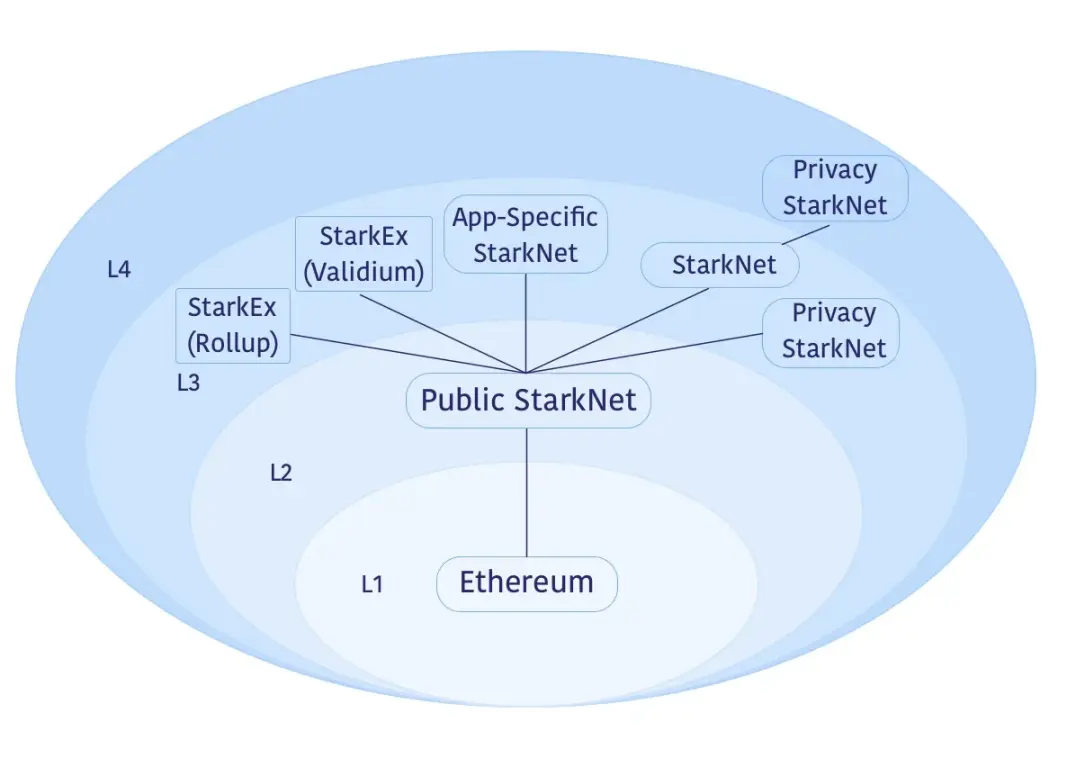
Currently, Paradigm, a cryptocurrency institutional liquidity platform, has incubated an application chain called “Paradex” on Starknet. Paradex is a hybrid derivatives exchange that will combine the liquidity of Paradigm with the transparency and self-custody of DeFi. It will operate as its own chain based on the Starknet developer stack and is an ongoing six-month collaboration between StarkWare and Paradigm. the result of.
In addition, the dedicated sequencer on Starknet Layer3 is Madara, which can be used to execute transactions and package transactions, which can also improve Starknet interoperability and on-chain privacy levels.
Scroll
Scroll is the darling of the Ethereum ecosystem. Since the launch of the main network, the Scroll network TVL is now US$53.89 million.
(1) US$50 million financing
In March this year, Scroll completed US$50 million in financing, with investors including Polychain Capital, Sequoia China, Bain Capital Crypto, Moore Capital Management, iant Fund, Newman Capital, IOSG Ventures, Qiming Venture Partners and OKX Ventures. The valuation of this round of financing reaches US$1.8 billion.
(2) Mainnet online
In August, Scroll announced the launch of the Scroll Beta test network for developers and users on the Sepolia test network. New features or improvements include zkEVM upgrades, bridge upgrades, and infrastructure upgrades.
At 14:00 on October 10, the Scroll mainnet genesis block was born. A week later, on October 17, Scroll officially announced the launch of the mainnet. The Scroll mainnet will first be anchored by infrastructure providers, and will later support the deployment of various projects and development tools. The next milestone on the Scroll roadmap is building a decentralized proof network and a decentralized sequencer.
(3) Scroll Origins NFT and airdrop expectations
In mid-2023, after launching three successful testnets and launching the mainnet, Scroll began to encourage developers to deploy contracts on its mainnet. From October 10th to December 9th, if you deploy any contract to the Scroll mainnet within 60 days of the Genesis Block, you will have the opportunity to obtain NFTs (Quintic, Quartic, and Cubic) in three different deployment stages. This NFT is a pass to participate in future airdrops
Scroll Origins NFT has opened for minting on December 15th.
(4) Future Development
In the “Foresight 2024: Web3 Wave Chaser “New Year’s Eve Speech”” held by Foresight News on December 27, Scroll co-founder Sandy Peng shared that the tools currently needed by developers such as Chainlink, The Graph, and RPC are Basically all are online. Next, some familiar Ethereum ecological projects will be gradually deployed on Scroll. At the same time, the focus of development in 2024 will also tend to be native projects on Scroll. Next year, ecological projects will be encouraged to do more Fair Launches. Support equitable community participation.
Polygon zkEVM
Polygon zkEVM is the EVM equivalent ZK-Rollup solution and was launched on the mainnet for the first time in late March. Polygon zkEVM works by integrating ZKP into the EVM environment on Polygon. ZKP is used with zk-rollups to allow large volumes of transactions to be processed off-chain, which are then packaged and verified on-chain. This approach will greatly improve network throughput.
Currently, the Polygon zkEVM network TVL is $135 million. The cumulative number of wallets exceeds 480,000, the cumulative number of contract deployments exceeds 22,000, and the number of active wallets is approximately 7,334.
(1) Mainnet Beta launch and network upgrade
In October 2022, the Polygon zkEVM testnet will be launched. After multiple reviews, the Polygon zkEVM mainnet Beta version was officially launched in March. This version includes features such as no need for permission, EVM equivalence, and open source. In the first phase of the mainnet Beta, a dedicated security committee will be set up to quickly upgrade Polygon zkEVM. In the second phase, Polygon will implement a series of measures to ensure users are protected if any issues arise, but will be more decentralized and will not have a security council with special access rights.
Polygon zkEVM cross-chain bridge Polygon Bridge was launched in April. Currently, about 40 projects have been deployed on Polygon zkEVM, including QuickSwap, Balancer V2, Gamma, Beefy, PancakeSwap, etc. The Polygon team has open sourced all of zkEVM’s code under the AGPL v3 license to share its code and encourage collaboration with the developer community.
The Polygon zkEVM mainnet will not have a separate token. Network Gas fees are paid in ETH. It is expected that staking and governance in Polygon zkEVM will use POL tokens in the future. In addition, Polygon zkEVM supports account abstraction through ERC-4337, which will allow users to Pay fees using any token.
After the mainnet Beta version was launched, Polygon zkEVM carried out major upgrades of dragon fruit (ForkID5) and Inca berry (ForkID6) in September and November respectively. After the Pitaya upgrade is implemented, the Polygon zkEVM mainnet Beta version will be synchronized with the latest version of Solidity and maintain the equivalence between Rollup and EVM by incorporating support for the latest EVM opcode PUSH0. The Inca Berry upgrade includes cryptographic optimizations and bug fixes, as well as updates to nodes and provers, including adding data streams to the sequencer and improving Websocket subscription functionality.
(2) Launch of Polygon 2.0
For scalability and interoperability, Polygon’s solution is to launch a new L2 product suite to unify Polygon zkEVM, Polygon PoS and Supernets.
In June this year, Polygon launched Polygon 2.0, a unified network composed of L2 chains powered by ZK technology. It aims to achieve interoperability between Polygon zkEVM, Polygon PoS and Supernets through cross-chain coordination protocols to provide Unlimited scalability and unified mobility. The Polygon 2.0 architecture consists of four protocol layers, namely the pledge layer, the interoperability layer, the execution layer and the certification layer.
In addition, the launch of Polygon 2.0 will also update MATIC to POL, and the Polygon 2.0 upgrade is expected to be completed in 2024.
Base
Base network TVL is now $674 million. According to Dune data, the total number of transactions on the Base network is 65.95 million, the total number of users exceeds 2.66 million, and the total number of contracts created exceeds 55.2 million.
(1) Mainnet online
Base is the Ethereum Layer 2 network built by Coinbase based on OP Stack. The test network was launched in February and the main network was launched in August.
Previously, Coinbase reminded many times that Base had no plans to issue tokens. However, at Mainnet 2023 hosted by Messari in September, Coinbase Chief Legal Officer Paul Grewal said that Base has not completely ruled out the possibility of issuing coins, but it is currently not paying much attention to the economics and tokenization of the protocol. He believes that supervision is clear. Sex is very important.
Currently, Base has open sourced the monitoring system Pessimism, smart contracts and GitHub repositories.
(2) Cooperation with Optimism
First of all, when the Base testnet was launched, it stated that it would be upgraded to an initial superchain (Superchain) structure that shares bridging and sorting with the Optimism mainnet and other L2s in the short term.
Secondly, after the launch of Base mainnet, cooperation with Optimism also includes protocol management, economy and governance. In terms of protocol management, if the Law of Chains (Blockchain Law) is approved, the Decentralized Security Council will be responsible for Base, OP Mainnet and other OP chain upgrades. Before adopting this blockchain rule, Base and OP Mainnet will also share upgrades.
Regarding economics and governance, part of the transaction proceeds from Base will be returned to Optimism Collective. Specifically, the greater of 2.5% of Base’s total sequencer revenue or 15% of Base’s net on-chain sequencer revenue (L2 transaction revenue minus L1 data submission costs) will go to the Collective. Optimism’s vision is for this structure to become a “blueprint” for all Superchain members, enhancing the sustainability of shared infrastructure.
The Optimism Foundation also provides Base with the opportunity to earn up to approximately 118 million OP tokens over the next six years, aiming to retroactively reward Base for its contribution to expanding Ethereum and the OP Stack.
(3) Tokenized Asset Alliance
On September 7, Coinbase, Circle and Aave jointly launched the Tokenized Asset Alliance (TAC). Other members of the alliance include Base, Centrifuge, Credix, Goldfinch, and RWA.xyz. The alliance believes that RWA tokenization is the future of the crypto industry and aims to help educate the industry, advocate for standardization and innovative companies, and jointly build the infrastructure required for RWA adoption.
(4) Ecology and Community
- Base Ecosystem Fund
As of press time, there are more than 276 DApps and service providers in the Base ecosystem, including Chainlink, Blockdaemon, Infura, QuikNode, Blockscout, Etherscan, Dune analytics, Hop Protocol, Nansen, 0x, Ondo, Panoptic, Aave, Gelato Network, Python Network, Rainbow Wallet, Ribbon Finance, Balancer, PoolTogether, Euler Labs, The Graph, Wormhole, SushiSwap, Covalent, and more. Coca-Cola also launched NFT on Base in August.
Coinbase and Coinbase Ventures have launched the Base Ecosystem Fund specifically to make substantial investments in Base-based companies and organizations at the pre-seed stage. The four major directions supported by its ecological fund: 1. Stable coins (flatcoins) that can track the inflation rate; 2. On-chain reputation platform; 3. On-chain price order book (LOB) trading platform; 4. Safer DeFi, This includes tools that can prevent smart contract code vulnerabilities or protocol logic errors, and ultimately on-chain insurance and insurance protocols, or any other product that can provide critical support to users in the event of smart contract failure.
- Community Incentive Activities
Shortly after the mainnet went online, Base launched Onchain Summer, Build on Base, Based Accounts, Builder Grants and other activities to encourage developers to build digital art, music, games, social networking, new protocols, new tools, new infrastructure, Account abstraction infrastructure, etc.,
It is worth mentioning that the social application friend.tech became an instant hit on Base in August.
opBNB
(1) Mainnet online
opBNB is a Layer 2 network based on OP Stack launched by BNB Chain. The test network was launched in June and the main network was officially launched on September 13. opBNB is EVM compatible and can maintain a similar security level to L1.
(2) Technological progress and future planning
Judging from the opBNB website and documents, the goal of opBNB is to host games, social networking, metaverse, high-frequency trading, etc. Therefore, reducing transaction costs and improving TPS are important technical goals of opBNB.
In December, the average transaction cost of opBNB dropped from about $0.005 to about $0.001. BNB Chain developers said that in the next 6 months, the average transaction cost will be further reduced to US$0.0005, and TPS will be increased from 4,761 to 10,000.
At the same time, opBNB will also focus on enhancing the resilience and decentralization of the network through Proof Enhancement, account abstraction, BNB Greenfield’s data availability (DA), interoperability with BNB Greenfield, decentralized sequencer, etc. Specifically, BNB Greenfield will be used on the entire chain or DApp through the infrastructure provided by the multi-chain platform to achieve cross-chain programmability with opBNB. Greenfield will also be positioned as the basic data availability layer of opBNB. Greenfield will also enable smart contracts as resource owners from 2023 Q4 to 2024 Q1 to better control the permissions of BSC/opBNB.
In addition, the BNB Chain community released the opBNB roadmap proposal on November 22. opBNB may also use OP Stack’s Superchain to build AppChain to achieve interoperability with multiple Layer2 networks.
Currently, Hooked Protocol, Orbiter Finance, Muverse, PancakeSwap, LayerZero, Thena, Polyhedra Network, zkPass, MyShell and other projects are online or integrated with opBNB.
(3) Ecological incentives
On December 6, BNB Chain announced the TVL incentive plan to encourage project parties to deploy applications on opBNB. Currently, the project application period has ended and is in the competition stage. The competition will end on January 14. The total prize pool is up to US$160,000. Participating project parties will receive corresponding shares according to the competition ranking ratio.
Line
Linea is a zkEVM Rollup developed by Consensys. The current network TVL is US$184 million.
(1) Mainnet online
In March this year, ConsenSys reshaped its Layer 2 network ConsenSys zkEVM into Linea and opened testing to all developers, users or protocols.
In July, Linea officially launched the mainnet Alpha version, opening access to Linea Mainnet Alpha to the Linea community. Linea’s TVL exceeded US$12 million three days after its launch. On August 17, Linea completed the launch of Alpha mainnet and deployed the ERC-20 standardized token bridge.
However, previously on July 11, Linea also stated that it would use ETH as its native currency and currently has no plans to launch Linea tokens.
On November 15, Linea stated that it is preparing for the next major version, Alpha v2. The new version has lower transaction costs, faster transactions, and 100% EVM coverage. It will also open source Linea Stack. Specifically, Alpha v2 will use blobs to store call data on L1 to reduce rollup costs. Additionally, the team is working to reduce the cost of fixed transactions by compressing data sent to L1 and aggregating proofs. Linea will reduce Linea’s block time to 4 seconds, increase speed by 3 times, and release a mechanism to easily further reduce block time in the future. For client diversity, both Besu and geth are supported, and the new Linea sequencer will replace Linea-geth with Linea-Besu.
(2) Linea Ecosystem Investment Alliance
On August 17, Linea launched the Linea Ecosystem Investment Alliance (EIA), an investment consortium composed of more than 30 venture capital companies, including Amber Group, Animoca Brands, BlockTower Capital, Fenbushi Capital, Huobi Ventures, IOSG Ventures etc. to support the builders of the Linea ecosystem.

(三)Linea Voyage
Linea Voyage is a loyalty program launched by Linea, which has been launched twice this year.
One is that between May and June, Linea launched a 7-week loyalty program, Linea Voyage, on the public testnet, aiming to reward NFT users who perform certain tasks related to using the testnet, in order to gain valuable experience before the launch of the mainnet. The network exerts pressure and conducts large-scale testing activities.
The second is the 6-week The Linea Voyage: DeFi activity launched by Linea on the mainnet in November, with a total of 10 activities and 10 core tasks, and more than 40 DApps participating.
In addition, Linea launched the soul-bound token Voyage XP on September 28, aiming to uniformly measure and recognize contributions to the development of the Linea ecosystem. Voyage XP represents each community member’s contribution to the development of the ecosystem, covering users, startups, DApps and Linea team members.
Blast
From the end of November to the beginning of December, the most exciting thing about the Layer 2 track was Blast, a Layer 2 network launched by Blur founder Pacman, which completed a US$20 million financing with participation from Paradigm and Standard Crypto.
Built specifically for NFTs, Blast will allow the Blur ecosystem to avoid asset depreciation, reduce NFT transaction costs, and launch NFT perpetual transactions. Blast can provide native income for ETH and stablecoins. Users’ balances will automatically compound interest and earn additional Blast rewards. When a user cross-chains ETH or stablecoins such as USDC, USDT, and DAI to Blast, it is deposited into an on-chain treasury protocol such as MakerDAO, and the proceeds are transferred back to Blast users via Blast’s automatic base stablecoin USDB.
What caused controversy in the community was Blast’s Pinduoduo-style fission marketing and the centralization risk of its contract address. In terms of marketing methods, Blast allows users to invite friends to earn airdrop points and promote the growth of the Blast network by attracting new users. Data proves that due to Blur, Pacman and airdrop expectations, this approach that has been broken in Web2 is still effective in Web3. As of December 28, Blast Network TVL has exceeded $1.1 billion.
As for the contract risk, because the Blast contract is an upgradeable contract controlled by 3/5 multi-signatures, and the 5 addresses are all anonymous new addresses, it is possible for Blast to perform code upgrades through multi-signatures and steal funds immediately. This 3/5 multi-sign is very likely to be evil, and may even be controlled by the same person. It can be said that except for the contracts issued on Ethereum, the rest are centralized, but endorsed by well-known institutions.
Potential Layer2
Lumoz (formerly Opside)
Lumoz is a decentralized ZK-RaaS platform that uses PoS and PoW hybrid consensus, allowing developers to quickly generate zkEVM application chains. The co-founder and CEO of Lumoz is Liu Sheng, who graduated from Tsinghua University and worked for ByteDance. He is also the founder of Trustless Labs. In April this year, Lumoz completed a $4 million seed round of financing, led by Web3.com Ventures.
In May, Lumoz launched a three-month incentivized Pre-Alpha test network and launched the pre-application for the verification node whitelist. At the same time, Lumoz disclosed token economics, 33% of which will be allocated between PoS and PoW rewards.
In August, Lumoz launched ZK-Rollup LaunchBase on the test network, supporting developers to build dedicated application Rollup, including Layer1, zkEVM, Gas, Data Availability and Sequencer components. LaunchBase now allows developers to choose from EVM-compatible Layer 1 such as Lumoz, Goerli, Mumbai and BNB testnet to build specific rollups for their applications, and supports four zkEVMs: Polygon zkEVM, zkSync, Scroll and Starknet.
In the third and fourth quarter of this year, Lumos completed the expansion of ETH, BNB Chain, and Polygon basic chains; expanded zkEVM type networks such as zkSync, Scroll, and Linea; native cross-Rollup communication; and GPU version of PoW.
Recently, Lumoz will launch Fair-L2 LaunchBase to support more high-quality ZK-L2 projects that are launched fairly. Currently, more than 20 project parties have submitted applications for Fair-L2 launch, including BTC L2, game platform chain, DePIN chain, and social networking Application chain and other tracks.
In addition, Liu Sheng stated at the “Web3 Technical Infrastructure: Layer 2 Network” forum at the “2023 Hong Kong Web3 Carnival” that the main network will be finally launched next year.
Ola
Ola is a two-layer programmable privacy and expansion solution based on ZKVM, developed by the Sin7y Labs team. In July this year, Ola completed a US$3 million seed round of financing, co-led by Web3.com Ventures and Foresight Ventures, with participation from Token Metrics Ventures, J17 Capital, Skyland Ventures, LD Capital, CatcherVC and others.
In February this year, Ola completed the proof of concept, launched the custom smart contract language Ola-lang, and integrated Ola-lang into the developer-friendly platform IDE: VScode.
In April, Ola released the second version of its technical white paper, which emphasized how to design and build the most important basic modules in Ola, the high-performance ZKVM, OlaVM; the ZK-friendly smart contract language, Ola-lang; and the privacy design architecture.
In August, Ola supported Poseidon2 hash in its proof system, and Prover performance increased by 40%.
During the Istanbul DevConnect in November, Ola also announced the opening of the Ola Dev Testnet whitelist application. At the same time, the codes of its two major components, the smart contract language Ola-lang and the virtual machine OlaVM, were also officially open source. The Ola public testnet and mainnet will be launched next year. online.
Recently, Ola has reached a strategic cooperation with ZK-RaaS (ZK-Rollup as a Service) platform Lumoz. Ola will be integrated into Lumoz’s ZK-Rollup LaunchBase, allowing developers to generate ZK-Rollups that support privacy attributes without code.
ZKFair
ZKFair was the star of December, rapidly gaining market attention through various airdrops. This is a ZK-L2 network. The testnet was launched on December 7th and the mainnet was launched on December 20th, with a 100% fair launch. In just one week, ZKFair Network TVL reached US$123 million.
The reason for the skyrocketing ZKFair TVL is Gas Fee Airdrop. The total supply of ZKFair tokens ZKF is 10 billion, all of which are distributed to the community through airdrops, of which 2.5 billion are airdropped to community users, including Polygon zkEVM, zkSync, Linea, Scroll, ZKSpace interactive addresses, Lumoz point holders, Ordinals community, etc.; the other 7.5 billion coins will be produced through Gas Fee Airdrop in 4 rounds starting at 11:00 on December 24. By the end of December 26, more than 200,000 people had participated in the airdrop event, and the total Gas consumption was 108 million USDC.
The ZKF obtained by users will officially begin to be claimed at 11:00 on January 1, 2024, at which time all 10 billion ZKF tokens will be released and circulated uniformly. ZKFair will no longer issue any additional ZKF tokens in the future.
2023 Foresight News year-end series recommended reading:
“Top Ten Annual Events in 2023: Hong Kong, Binance, BlackRock…”
“Year-End Inventory|A glance at the hot search list of the encryption industry in 2023”
“Ten Good Crypto Articles You Must Read in 2023”
“Web3 + AI track panoramic inventory: more than 130 projects, what are the undiscovered treasures?” 》
“2023 Collection of Anxious Moments: A hundred times a thousand times everywhere, you must be free”
“On the eve of the outbreak of Web3 games?” Taking stock of the big players that have reached the tens of millions of financing threshold》


