As long as BTC continues to outperform the traditional world, it will probably be difficult for micro-strategies to make a big splash.
Written by: Liu Jiaolian
A few days ago, Michael Saylor, the founder of Microstrategy, tweeted that Microstrategy took action again and added another 14,620 BTC at an average price of about 42,110 knives. As of 2023.12.26, MicroStrategy has accumulated a total of 189,150 BTC, with a total cost of approximately 5.9 billion U.S. dollars, and the average cost of adding a position is approximately 31,168 U.S. dollars.
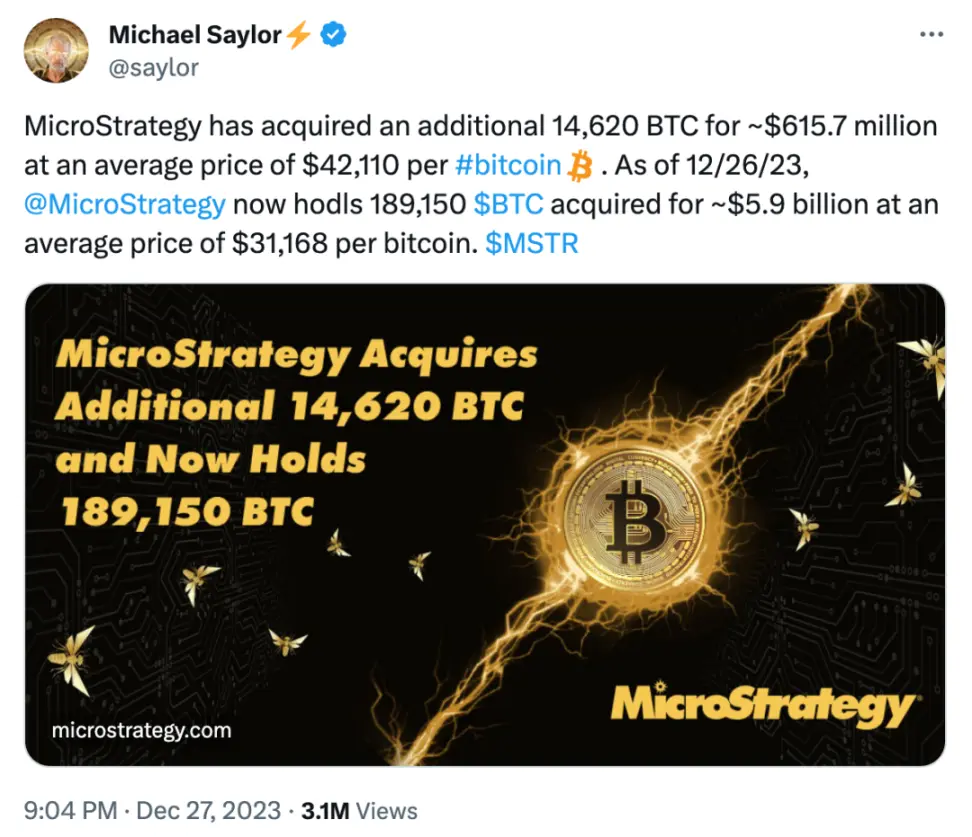
A simple calculation shows that based on the current BTC current price of about 43k, the micro-strategy’s position floating profit (43000-31168)/31168 = 38%, and the net profit is about more than 2.2 billion US dollars.
Jiaolian compiled the historical data of all positions added by micro-strategy from the beginning of August 2020 to the end of December 2023 as follows:
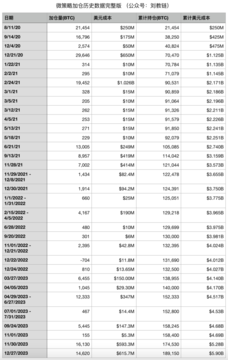
Since buying the first batch of BTC at the end of 2020, the micro-strategy has continued to add positions, passing through bull and bear markets. After adding positions at the high point of the bull market in 2021, it also experienced adding positions at the low point of the bear market at the end of 2022. It has climbed through snow-capped mountains and walked through grass. After going through hardships and dangers, he finally achieved initial success.
From a longer perspective, the only effect of the bull market is to increase the cost of adding positions. So for long-term hoarders who continue to add to their positions, which one is a better journey, the broad plateau cattle (2021 kind) or the pointed alpine cattle (2017 kind)?
Interestingly, the micro-strategy’s strategy of insisting on adding BTC regardless of whether it is bullish or bearish is also the only strategy that is suitable for the vast majority of newbies.
However, looking deeper, MicroStrategy actually does some “more professional” operations that go beyond what a novice would do.
**First, lend the position. **
Michael Saylor has said more than once that micro-strategies will always hold their BTC positions and never sell.
However, he also disclosed at the end of 2021 that MicroStrategy would lend his BTC to hedge funds.
In other words, the micro-strategy itself will never sell coins, but the hedge fund that borrows BTC will definitely sell coins, buy and sell them back and forth, and perform arbitrage.
This is similar to the U.S. Treasury Department/Federal Reserve not selling the gold they hold, but lending gold to investment banks like JP Morgan to “make markets” in the gold market.
So there is an additional layer of risk here, that is, the hedge fund that borrowed BTC messed up and lost BTC. The hedge fund cannot afford the compensation and goes bankrupt, and the micro-strategy cannot recover the equivalent amount of BTC as the currency standard, and there will be a net loss. Amount of BTC.
In the long run, hedge funds losing money is an inevitable event.
Some friends may put their digital assets on financial management platforms to “deposit and earn interest”. This is somewhat similar to what micro-strategy does. The risk point is naturally that the financial management platform loses money or even runs away.
**Second, off-site leverage. **
MicroStrategy has issued some long-term junk bonds in previous years. Some do not even need to pay interest, and their maturity dates are several years long, with most maturing around 2027-2028. Michael Saylor firmly believes that the price of BTC will become higher and higher in a few years, which will allow micro-strategies to repay debt and pay maturity returns.
It is said that MicroStrategy currently holds a total of about 2.2 billion knives in debt, and its current BTC position has a current value of about 8.1 billion knives, which means that every 100 BTC corresponds to 27 knives in debt. This does not take into account MicroStrategy’s other business assets. These debts are over-the-counter debts. Unless BTC falls below $11,000 on the maturity date, which is around 2027-2028, its BTC will be enough to cover these debts.
However, if MicroStrategy is forced to sell such a large amount of BTC to pay off debt, it may be a heavy blow to the market.
Many pie hoarders with mortgages may be in a situation similar to micro-strategy and other over-the-counter leverage. Of course, mortgages require monthly interest payments, and the interest rate is quite high, and it is floating (LPR), which is much worse than the leverage of micro strategies. However, housing loans are almost the best leverage that ordinary workers can use.
**Third, raise funds to increase positions. **
Just some time ago this year, MicroStrategy issued additional shares (MSTR) in the U.S. secondary market, raised funds from the secondary market, and used the money of U.S. stock investors to increase its BTC position. Benefiting from the market situation of BTC this year, it has strongly promoted the rise of MSTR stock, allowing Michael Saylor to use additional stock issuance to raise funds to increase his position.
Some people question whether the micro-strategy will be forced to sell BTC to save the market if BTC turns downward, or if MSTR is decoupled from the performance of BTC.
However, you must know the difference between stock financing and bond financing. Stocks do not promise to repay, so even if MSTR falls to zero, the micro strategy can be ignored. Of course, it is unclear whether Michael Saylor has done equity pledge financing. If so, the stock will fall to a certain extent, which will cause the stock to be liquidated, and the related pledged stocks will be liquidated by the brokerage. However, brokers cannot force MicroStrategy or Michael Saylor to sell BTC to replenish margin.
Grayscale’s continued negative premium in 2022 has set a certain example. Even in the worst times, GBTC’s negative premium was as high as -50%, but Grayscale remained unchanged. At that time, many people FUD the market and said that Grayscale was about to explode. However, Grayscale is a trust that cannot be breached by any recourse.
The size of the 630,000 BTC Grayscale Trust is more than three times the size of the micro-strategy holdings.
From the perspective of a legal firewall, Grayscale Trust is definitely more ironclad than MicroStrategy.
But in any case, even if some netizens said that after the listing of the Bitcoin spot ETF, it took away MSTR users and caused users to sell MSTR, it would only be a decline in the US stock MSTR, or even decoupling from the correlation with BTC. However, it does not This does not necessarily result in micro strategies being forced to sell BTC positions. Grayscale does not promise that the performance of GBTC will be consistent with BTC, and MicroStrategy will not promise that the performance of MSTR will always be consistent with BTC.
Here we need to remind some friends who hold MSTR as a Bitcoin ETF in the US stock market to pay attention to the risk of decoupling negative premium.
This kind of gameplay essentially transfers risks to external investors through the rules of the game. For example, Grayscale GBTC had a negative premium, and the risk was blocked by the trust firewall, which blew up speculators such as Sanjian Capital who were speculating on GBTC premium arbitrage. Then, micro-strategy MSTR may also experience a negative premium, and equity financing itself cuts off the promise of income and isolates the risk in the US stock market, with US stock investors paying for it.
For ordinary people, there may not be such a commitment-free financing channel to obtain funds to add BTC.
**Fourth, off-site income. **
Don’t forget, micro-strategy itself has business and business income. It has a steady stream of off-site cash flow to support its position-building behavior.
Of course, this is similar to most ordinary cake hoarders. The best strategy is to make money off-site and use the income earned off-site to add BTC.
To sum up, it can be seen that micro-strategy can use some financial instruments that are not available to ordinary people, or are better than those that ordinary people can obtain, to help it better hoard BTC. Then, micro-strategy can run It is a high probability to win over most ordinary cake hoarders. The excess returns people earn come from structural advantages.
After analysis, micro-strategy may lose its BTC position due to its aggressive leverage strategy during extreme black swan risks, causing it to underperform the currency standard. However, as long as BTC continues to outperform the traditional world, then micro-strategy It’s probably very difficult to cause a thunderstorm.


