Coverage, legislative approach, regulatory framework for fiat stablecoin issuers, custody and purchase services, and transitional measures.
Written by: Blog, Bailu Living Room
Stablecoins have been one of the most profitable businesses in the crypto industry. Taking Tether as an example, in the first quarter of 2023 alone, it made US$1.5 billion in revenue. On December 20, the total market value of USDT exceeded US$91 billion. Tether has proven time and time again that stablecoins will always be the core of the global encryption market.
The Hong Kong market is no exception. Coupled with the need for people from all walks of life to issue non-US dollar stablecoins to break their monopoly, the Hong Kong market urgently needs a more favorable regulatory environment to promote the development of the Hong Kong stablecoin market.
On December 27, the Financial Services and the Treasury Bureau (Treasury Bureau) of Hong Kong and the Hong Kong Monetary Authority (HKMA) jointly issued a public consultation document to collect opinions on legislative proposals for the supervision of stable currency issuers.
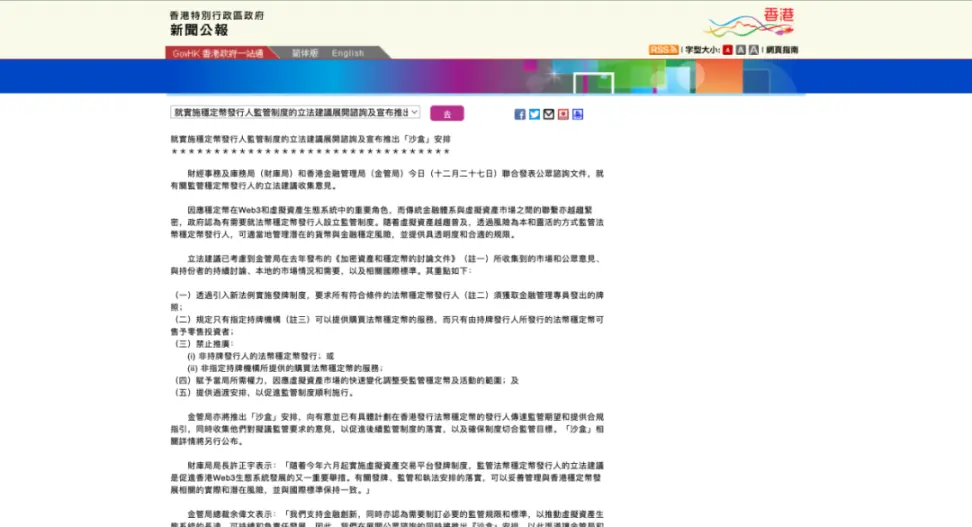
The consultation document covers the latest measures and legislative suggestions from the Hong Kong government on the supervision of stablecoin issuance,** including: the scope of stablecoin supervision, legislative methods, the regulatory framework for fiat currency stablecoin issuers, and the custody and purchase services of fiat currency stablecoins. , regulatory rights, violations of regulations and sanctions, appeals, and transitional measures and other aspects. **Solicit opinions from all aspects of the SAR to promote the implementation of stable currency regulatory legislation.
In this issue of the article, Bailu Living Room has comprehensively compiled the contents of the consultation documents for readers to help readers better understand the regulatory direction of the Hong Kong government. At the same time, we look forward to the Hong Kong government’s response to the opinions of all parties.
Important content:
- It is proposed to introduce new legislation to implement the licensing system for fiat currency stablecoin issuers, and have the following elements:
(a) Define fiat currency stablecoins as cryptographically protected digital forms of value that claim or appear to maintain a relatively stable value with one or more legal currencies and have other relevant characteristics, but do not include projects that are already regulated by other regulatory systems ( such as deposits).
(b) Require all companies that (i) issue fiat currency stablecoins in Hong Kong; (ii) issue stablecoins that are claimed or appear to maintain a relatively stable value relative to the Hong Kong dollar (Hong Kong dollar stablecoins); or (iii) actively promote them to the Hong Kong public The issuer of fiat currency stablecoins obtains a license issued by the Financial Management Commissioner. The document further explains the relevant licensing criteria and conditions;
© ProvisionsOnly designated licensed institutions can provide services for purchasing legal currency stablecoins in Hong Kong. As for fiat stablecoins issued by non-licensed issuers, considering the risks they bring, we currently believe that the relevant purchase services can only be provided to professional investors;
(d) Taking into account the continuous evolution of the virtual asset market, the regulatory system will have certain flexibility and will provide authorities with the necessary powers to adjust the scope of regulated stablecoins and activities. In addition, the regulatory system will also empower the Monetary Authority to implement the licensing system and regulatory enforcement functions, and propose violations of regulations, sanctions and appeal mechanisms;
(e) It is recommended to implement transitional arrangements to allow eligible existing fiat stablecoin issuers to transition to the new regulatory regime in an orderly manner.
- The Treasury Bureau and the Hong Kong Monetary Authority sincerely invite the public to provide comments on the proposed regulatory system for fiat stablecoin issuers contained in this consultation document, so that we can carefully study and consider it when drafting relevant legislation.
The following is the text of the consultation document:
Overview of Hong Kong’s current regulatory framework
Under the coordination of the Treasury Bureau, financial regulatory agencies, including the Hong Kong Monetary Authority and the Securities and Futures Commission, are working closely to develop a comprehensive virtual assets regulatory framework with reference to applicable international standards to supervise various virtual asset-related activities. .
In accordance with international practice, supervisory work focuses on the main deposit/withdrawal channels within the virtual asset ecosystem. Since the Legislative Council passed the Anti-Money Laundering and Counter-Terrorist Financing (Amendment) Bill 2022 in December 2022, a new licensing system has been established for virtual asset service providers under the Anti-Money Laundering and Counter-Terrorist Financing Ordinance. Effective June 1, 2023.
Under this system, virtual asset exchanges must be licensed and supervised by the Securities and Futures Commission. The Treasury Bureau, the Hong Kong Monetary Authority and the Securities and Futures Commission will continue to work closely with stakeholders to improve the regulatory environment for virtual assets, including carefully considering the need to bring other virtual asset-related activities into the scope of supervision.
As noted in the summary document, many respondents noted that some stablecoin activities may overlap with other regulatory regimes in Hong Kong, in particular:
(i) The licensing system for virtual asset service providers under the responsibility of the Securities and Futures Commission under the Anti-Money Laundering Ordinance; and
(ii) The stored value facility licensing system under the Payment Systems and Stored Value Facilities Ordinance (Chapter 584) is the responsibility of the Hong Kong Monetary Authority.
Regarding the licensing system for virtual asset service providers, the Treasury Department and the Hong Kong Monetary Authority have been cooperating with the Securities and Futures Commission and other stakeholders when formulating the details of the regulatory system for fiat stablecoin issuers to prevent regulatory arbitrage and Identify and respond to overlaps or gaps in different regulatory regimes and mitigate risks arising from different activities.
As far as the SVF licensing regime is concerned, we note that certain stablecoin arrangements (especially stablecoins used for payment) may be similar to SVF to a certain extent. To ensure clarity of regulatory scope, we propose that the definition of fiat stablecoins will not include any stored value stored in a stored value facility or payment instrument deposit, although in some cases, whether a certain digital form of value or its issuance constitutes " Stored value payment instruments as defined in the Payment Ordinance still need to be judged based on relevant factors, such as the structure of the relevant entity or product, the relationship between related parties and operational details, which need to be considered based on the actual situation.
In addition, during previous consultations, we also considered whether to use existing laws or introduce new laws to implement the regulatory system. Given that the virtual asset market is rapidly changing and very complex, we believe it is appropriate to introduce new legislation to implement a regulatory system for issuers of fiat currency stablecoins. In the future, as circumstances require, relevant legislation may be added to the regulatory system for other aspects of the virtual asset market.
Recommended policy objectives and guiding principles for the regulatory framework
The main policy objectives are as follows:
(a) Develop appropriate preventive measures to address potential risks to monetary and financial stability posed by fiat stablecoins;
(b) Provide adequate protection for users of fiat currency stablecoins;
© Develop a regulatory regime for fiat stablecoin issuers that is appropriate and consistent with international regulatory recommendations to maintain Hong Kong’s status as an international financial center; and
(d) Provide a clear legal and regulatory environment to promote the sustainable and responsible development of Hong Kong’s virtual asset ecosystem.
When formulating legislative proposals, we will follow the guiding principle of “same business, same risks, same supervision”. In addition, it is proposed that the regulatory regime will:
(a) Be risk-based and prioritize areas that pose higher actual, expected or potential risks;
(b) can be adjusted in response to evolving market developments and relevant international discussions;
© be proportionate to the risks, that is, not impose an undue regulatory burden on the regulated institution that is disproportionate to the risks involved; and
(d) Ensure a level playing field and address possible regulatory arbitrage.
Coverage
With reference to the definitions currently adopted by international organizations and standard-setting organizations, as well as the mainstream vocabulary commonly used in the virtual asset market, ** we recommend that stablecoins be defined as cryptographically protected digital forms of value that comply with, but are not limited to, the following description—**
(a) Expressed in terms of units of account or storage of economic value;
(b) Serves or is intended to be used as a publicly accepted medium of exchange for payment for goods or services, settlement of debts and/or investments;
© Can be transferred, stored or traded electronically;
(d) use distributed ledgers or similar technologies that are not solely controlled by the issuer; and
**(e) Claims or appears to maintain a relatively stable value relative to a particular asset, group or basket of assets. **
With reference to the regulatory scope of the current relevant regulatory framework, we propose that the definition of “stablecoins” does not include deposits (including tokenized or digital deposits), certain securities or futures contracts (mainly recognized collective investment schemes and recognized structured products) ), any stored value amount or instrument deposit stored in a stored value facility, legal tender in digital form issued by or on behalf of the central bank and certain limited-purpose digital forms of value.
As for **fiat currency stablecoins, they will be defined as stablecoins whose specific assets are single or multiple fiat currencies. **Because fiat stablecoins have the potential to develop into a universally accepted payment method, fiat stablecoins pose a more pressing threat to monetary and financial stability than other virtual assets or other types of stablecoins (such as commodity stablecoins). risk. In view of this, the Treasury Bureau and the Hong Kong Monetary Authority propose that the issuance of fiat currency stablecoins will become a regulated stablecoin activity under the proposed new regulations. **If applicable conditions are met, fiat stablecoin issuers will be required to obtain a license from the Financial Controller. **
Under the proposed regulatory regime, all fiat stablecoin issuers will be required to comply with the same regulatory framework regardless of the stabilization mechanism and related supporting assets of the fiat stablecoin. For example, issuers of fiat stablecoins whose value is derived through arbitrage or algorithms will also fall within the scope of regulation.
However, it is extremely unlikely that issuers of such fiat currency stablecoins will meet the relevant licensing standards and conditions (especially those regarding reserve management) and obtain a license.
In view of the rapidly changing market and regulatory environment of the virtual asset industry, we need to promptly respond to the new risks posed by the virtual asset industry to monetary and financial stability, and comply with relevant international standards. In view of this, the Treasury Department and the Hong Kong Monetary Authority intend to give the authorities the necessary powers to adjust the scope of regulated stablecoins and activities.
Legislative approach
After weighing the introduction of the proposed supervisory system by amending the Anti-Money Laundering Ordinance, the Payments Ordinance and formulating new legislation, the Treasury Bureau and the Hong Kong Monetary Authority recommend the formulation of new legislation based on the following considerations:
**(a) The characteristics of stablecoins and stored value instruments may vary. Therefore, it is more appropriate to formulate separate legislation to supervise issuers of fiat currency stablecoins rather than incorporating the relevant regulatory systems into the Payment Ordinance. **
**(b) It seems more appropriate to use new legislation to deal with areas such as stablecoins that are still in their infancy. If necessary, the new legislation can also serve as the basis for extending the regulatory regime to other virtual asset activities in the future. **
It is now recommended that issuers of fiat currency stablecoins be brought under the supervision of the Hong Kong Monetary Authority. As markets and international regulatory discussions continue to evolve, the government will continue to work with other financial regulators to assess the risks of other virtual assets and activities and consider their need to be included in regulations.
The Treasury Bureau and the Hong Kong Monetary Authority also note that under the proposed regulatory regime for fiat stablecoin issuers, regulated issuance activities may overlap with other financial regulatory regimes in Hong Kong. In order to prevent issuers of fiat-currency stablecoins from being supervised by multiple regulatory systems, it is now recommended that licensed issuers issue fiat-currency stablecoins.
Exclusions from certain regulatory regimes, such as those applicable to securities (including collective investment schemes) and stored value facilities.
Regulatory framework for fiat stablecoin issuers
Licensing system for fiat currency stablecoin issuers
It is now proposed that under the new licensing system for fiat stablecoin issuers, unless it is a company holding a license issued by the Monetary Authority, no one may:
(i) Issuing or showing itself to be issuing fiat stablecoins in Hong Kong;
(ii) Issue or appear to be issuing a stablecoin that is claimed or appears to maintain a relatively stable value relative to the Hong Kong dollar; or
(iii) Actively promote the issuance of its fiat currency stablecoin to the Hong Kong public.
Licensing Criteria and Conditions
(a) Reserve Management and Stabilization Mechanism
Full reserve support: Fiat stablecoin issuers must ensure that the total reserve asset value of the fiat stablecoin is at least equal to the face value of the circulating fiat stablecoin at all times. Given the fundamental difficulties in maintaining a robust stabilization mechanism for issuing fiat stablecoins whose values are derived through arbitrage or algorithms in the absence of valuable reserve assets, such issuers will not be licensed.
Investment Restrictions: Reserve assets must be of high quality, highly liquid, and involve minimal market, credit and concentration risks. The currency in which reserve assets are denominated should correspond to the currency referenced by the fiat stablecoin, and appropriate flexibility will be allowed subject to individual approval by the Monetary Authority. When deciding on the allocation of reserve assets, fiat stablecoin issuers should consider the liquidity needs of the relevant assets and how to ensure that relevant needs can be met when managing reserve assets and making relevant investments.
Financial regulators must be able to satisfy themselves that the types of assets and allocations recommended for investment by fiat stablecoin issuers are appropriate. Therefore, issuers need to formulate investment policies and review their investment policies in a timely manner as the fiat currency stablecoin business gradually develops.
Separation and safekeeping of reserve assets: Issuers of fiat currency stablecoins should develop effective trust arrangements to ensure that reserve assets are kept separate from other assets and used to meet redemption requirements and in the event that the issuer becomes insolvent. Ensure users’ legal rights and priority claims on reserve assets. The issuer must set up a separate account with a licensed bank or other custodian under arrangements satisfactory to the Monetary Authority to manage reserve assets. As part of the internal control measures and procedures, the issuer must establish effective internal control measures and procedures to protect reserve assets from operational risks (including the risk of theft, fraud and misappropriation).
Risk management and control procedures: Issuers of fiat currency stablecoins must formulate sound policies, guidelines and control measures to properly manage all investment risks related to reserve asset management, and ensure that there are sufficient funds and liquid assets to cope with the issue of circulating fiat currency stablecoins. Redemption Requests. The issuer must adopt comprehensive liquidity risk management measures with clearly defined strategies and execution tools to deal with large-scale redemptions (i.e., runs or liquidity stress scenarios). The issuer should also conduct regular stress tests to monitor the adequacy and liquidity of reserve assets.
Disclosure and Reporting: Issuers of fiat currency stablecoins must regularly disclose to the public the total amount of fiat currency stablecoins in circulation, the market value of reserve assets and the composition of reserve assets. The issuer must, after consulting the Monetary Authority, appoint a qualified independent auditor to certify its: (i) composition and market value of reserve assets; (ii) denomination of fiat stablecoins in circulation; (iii) during the certification coverage period Whether the reserve assets on the last working day are sufficient to fully support the value of the circulating legal tender stablecoins and have sufficient liquidity; and (iv) whether they have fully complied with the conditions set by the Monetary Authority for the management of its reserve assets. It is now recommended that issuers disclose the total amount of fiat stablecoins in circulation and the market value of reserve assets at least daily, disclose the composition of reserve assets at least weekly, and have relevant certification conducted by a qualified independent auditor at least monthly.
Interest Payments Prohibited: Any income or loss from reserve assets, including but not limited to interest, dividends or capital gains or losses, accrues to the issuer. Referring to international regulatory practices, fiat stablecoin issuers are not allowed to pay interest to fiat stablecoin users.
Effective Stability Mechanism: Regardless of whether the specific operating procedures of the stability mechanism of the fiat currency stablecoin are executed by a third party, the issuer must bear the ultimate responsibility for the effective operation of the stability mechanism of the fiat currency stablecoin it issues.
(b) Redemption Request
Users of fiat currency stablecoins should have the right to redeem fiat currency stablecoins from the fiat currency stablecoin issuer at face value and have a claim against the reserve assets (and a claim against the issuer when the issuer cannot fulfill its redemption obligations). **Redemption requests must be processed without unreasonable fees and within a reasonable time. **The issuer may not impose unreasonable conditions on redemptions (such as a very high minimum threshold amount). Redemption fees must be clearly communicated to users and should be proportionate, and should not be so high as to prevent users from redeeming in disguise. The issuer must make payment in the fiat currency or currencies referenced when fulfilling a redemption request.
When fiat stablecoin users are unable to exchange fiat stablecoins into one or more fiat currencies through other channels (for example, due to intermediaries or infrastructure operations being blocked), the issuer must ensure that redemptions are provided directly to users at face value within a reasonable time.
Issuers must develop and maintain contingency plans to still enable users to redeem fiat stablecoins in an orderly manner should they be unable to fulfill redemption requirements (including when the issuer’s license is suspended or revoked).
© Restrictions on Business Activities
Issuers of fiat stablecoins must obtain approval from the Monetary Authority before commencing any new business. The issuer must also conduct a risk assessment and prove that it has sufficient resources to invest in the issuance of fiat stablecoins and maintain its operations, that the new business will not bring additional risks to it, and that it has risk management and control measures to ensure that new business activities will not affect its ability to perform its functions as an issuer.
Issuers may obtain approval to carry out activities ancillary to or incidental to the issuance of fiat stablecoins, such as providing wallet services for the fiat stablecoins issued by them to facilitate the issuance and redemption process. **When providing such wallet services, the issuer should formulate corresponding policies and procedures for the segregation and custody of user assets, as well as the withdrawal and deposit of user assets.
For the avoidance of doubt, **Issuers should not engage in lending and financial intermediary activities, nor should they engage in other regulated activities, such as the Securities and Futures Ordinance, the Mandatory Provident Fund Schemes Ordinance or the Insurance Industry Ordinance specified regulated activities. **
(d) Have a physical company and office in Hong Kong
The issuer of fiat currency stablecoins must be a company established under the laws of Hong Kong and have a registered office in Hong Kong. Its chief executive officer, senior management team and key personnel must be resident in Hong Kong and implement effective control over the issuance and related activities of its legal currency stablecoins. This requirement will enable the Monetary Authority to effectively regulate such entities.
(e) Financial Resource Requirements
Issuers of fiat currency stablecoins must have sufficient financial resources to operate the fiat currency stablecoin issuance business, including meeting minimum paid-up capital requirements. The purpose of this requirement is to ensure that the issuer has sufficient financial resources to maintain the issuer’s operations and serve as a buffer against losses.
After referring to international regulatory practices, we recommend that the minimum paid-up share capital is HKD 25,000,000, or a fixed percentage of the face value of the circulating fiat stablecoin, whichever is higher. We recommend that this fixed percentage be set at 2%.
If the Monetary Authority deems it necessary, it may also impose higher levels of paid-up capital requirements on issuers through licensing conditions under the system.
(f) Disclosure Requirements
A fiat stablecoin issuer must publish a white paper to disclose general information about the issuer, the rights and responsibilities of fiat stablecoin users, the fiat stablecoin stabilization mechanism, reserve asset management arrangements, and the technology and risks used. . Issuers must notify the Monetary Authority before publishing white papers and other related publications.
Issuers of fiat stablecoins must disclose redemption policies, clearly specifying the redemption procedures, redemption time limits, applicable fees, and the rights of fiat stablecoin users regarding redemptions.
(g) Governance, knowledge and experience
The controller, chief executive and directors of a fiat stablecoin issuer must be fit and proper, and their appointments, as well as changes in the issuer’s ownership or management, must be approved in advance by the Monetary Authority. In addition, the issuer must establish a comprehensive control system for the appointment of senior management, as well as a robust corporate governance structure, and appoint personnel with the necessary knowledge and experience to effectively perform their duties.
(h)Risk Management Provisions
Issuers of fiat stablecoins must develop appropriate risk management procedures and measures for their operations. These measures include** adequate security and internal control measures to ensure the security and integrity of data and systems; effective fraud monitoring and detection measures; technology risk management measures; and robust contingency arrangements to deal with disruptions to business operations. ; and other operational and security measures commensurate with the scale and complexity of the business. **The issuer should also conduct risk assessments from time to time (at least once a year) to ensure that internal control measures, risk management and governance procedures are sound and effective.
(i) Auditing Requirements
**Issuers of fiat stablecoins are required to submit audited financial statements to the Monetary Authority annually. **If required by the Monetary Authority, the issuer must submit a report prepared by an external independent auditor and evaluator to confirm the effective management and sound operation of the fiat currency stablecoin issuance business, such as whether the issuer is in reserve asset management, There are adequate control systems for network security and the robustness of “smart contracts”.
(j) Anti-Money Laundering and Counter-Terrorist Financing Provisions
**Issuers of fiat stablecoins must ensure that the design and implementation of fiat stablecoin issuance has a sound and appropriate control system to prevent and combat activities that may involve money laundering and terrorist financing. **The issuer must have a sound and appropriate control system in place to ensure that the company complies with the applicable provisions of the Anti-Money Laundering Ordinance and the rules of the Monetary Authority for the purpose of preventing, combating or detecting money laundering or terrorist financing, Measures published in regulations, guidelines or other forms. Relevant requirements include, but are not limited to, adequate customer due diligence measures for customers when issuing and redeeming fiat stablecoins, transaction monitoring and requirements regarding telex transfers (“Transfer Rules”) to comply with FATF standards and requirements under the Anti-Money Laundering Ordinance.
Other licensing matters
(a) Eligibility to apply for a license
It is now recommended that all entities be eligible to apply for a fiat stablecoin issuer license as long as they meet the licensing criteria and conditions. Applicants for licenses need to go through a strict approval process, which requires them to demonstrate compliance with the licensing criteria and conditions including but not limited to those set out in this document.
Taking into account that licensed banks are already subject to strict prudential regulatory requirements and are subject to the ongoing comprehensive supervision of the Monetary Authority, we propose that the licensing criteria include © restrictions on business activities, (d) having a physical company and offices in Hong Kong and (e) ) financial resource requirements do not apply to fiat stablecoin issuers that are themselves licensed banks, as licensed banks are already subject to the banking regulatory regime in these respects.
(b) Continuing Licensing Conditions
In addition to setting licensing criteria, we recommend that the Monetary Authority be given the power to set, modify or cancel the continued licensing conditions for fiat stablecoin issuers. The Monetary Authority will determine such conditions as necessary. Such conditions may include, for example, requirements for reserve assets and restrictions on the types of services that the issuer can provide.
© Issuance of more than one fiat stablecoin
**We recommend that fiat stablecoin issuers obtain Monetary Authority approval before issuing any new fiat stablecoins under their license. **The purpose of this regulation is to ensure that new fiat stablecoins will not affect the operation of existing fiat stablecoins.
(d) OPEN LICENSE
**We recommend that the fiat stablecoin issuer license be made an open license. As long as the licensed issuer continues to operate and its license has not been revoked by the Monetary Authority (for example due to non-compliance or the issuer ceases operations), its license will continue to be valid. . **
(e) Register of Licensees and License Fees
We recommend that fiat stablecoin issuers must display their license number on any advertising items and any software applications they provide to customers to make the public aware of their licensing status. The Monetary Authority will maintain a central register of licensees for public inspection.
We recommend giving the Monetary Authority the power to impose an annual license fee on fiat stablecoin issuers, including licensees who are themselves licensed banks.
Custody and purchase services for fiat stablecoins
Some stakeholders believe that virtual asset custody and purchase services should be subject to specific supervision. The Treasury Bureau, the Hong Kong Monetary Authority and the Securities and Futures Commission will work closely to assess the appropriate regulatory model for the relevant services.
As far as providing services for purchasing fiat stablecoins is concerned, we believe that the risks involved in fiat stablecoins issued by non-licensed issuers are not transparent, and therefore the above-mentioned fiat stablecoins are not suitable for public use. **To protect fiat stablecoin users, it is now recommended that only licensed fiat stablecoin issuers, authorized institutions, licensed corporations and licensed virtual asset trading platforms can provide services for purchasing fiat stablecoins in Hong Kong, or actively provide services to fiat stablecoins. The Hong Kong public actively promotes relevant services. When authorized institutions, licensed corporations and licensed virtual asset trading platforms provide this service, if the relevant fiat currency stablecoins are issued by non-licensed issuers, they can only be sold to professional investors and must be clearly stated The fiat stablecoin is not issued by a licensed fiat stablecoin issuer.
The authority’s power to amend the system
Given the rapid evolution of the industry, we recommend that regulatory regimes should be appropriately flexible to address new risks arising from emerging stablecoins, activities or entities. With reference to the regulatory regime for virtual asset service providers, we recommend giving authorities the necessary powers to adjust the scope of regulated stablecoins and activities.
We recommend that the authorities exercise this option after taking into account factors such as (i) risks to Hong Kong’s monetary and financial stability; (ii) risks to Hong Kong’s ability to function as an international financial centre; and (iii) matters of significant public interest. Waiting for power. In determining the importance and level of risk involved, authorities may consider factors including, but not limited to, the following:
(a) Number and categories of users;
(b) Number and value of transactions;
© Scale and type of reserve assets;
(d) Circulation value;
(e) Market share;
(f) Degree of interconnection with the financial system; and/or
(g) Business, structural and operational complexity.
Supervisory powers of the Monetary Authority
In relation to the licensee’s management powers
Considering the potential impact that a fiat stablecoin issuer’s default or failure may have on the financial system, we recommend giving the Financial Controller the power to intervene in the operations of the licensee when necessary. With reference to similar powers under the Banking Ordinance, Securities and Futures Ordinance, Payments Ordinance and Anti-Money Laundering Ordinance, we recommend that the Monetary Authority be given powers to Consider that the licensee (i) is or is likely to be insolvent or unable to meet its obligations; (ii) is operating its business in a manner detrimental to the interests of its users or creditors; or (iii) has breached licensing conditions or proposed regulation In the case of provisions in the system:
(a) require the licensee to take any action in relation to the affairs, business or property of the licensee that the Monetary Authority considers necessary, including restricting the licensee’s business of issuing fiat stablecoins under the relevant license;
(b) direct the licensee to seek advice from an adviser appointed by the Monetary Authority in relation to the management of its affairs, business and property; and
© direct that the affairs, business and property of the licensee shall be managed by an administrator appointed by the Monetary Authority.
In order to enable the Monetary Authority to ensure that the owners and management of the licensee meet the fit and proper conditions, we recommend that the Monetary Authority’s consent be obtained for any of the following changes in ownership or management:
(a) Merger, including the adoption of any arrangement or agreement to sell or dispose of all or part of the business of the fiat stablecoin issuer;
(b) A person becomes or is a “controller” (a major shareholder controller, a minority shareholder controller and an indirect controller) and the sale of shares; and
© Appointment of chief executive officer and directors.
As Hong Kong authorized institutions are already subject to the supervision of the Monetary Authority under the Banking Ordinance, the Monetary Authority’s powers with respect to the management of licensees under the proposed supervisory regime will generally apply to licensees who are Hong Kong authorized institutions.
Other regulatory powers
To ensure that fiat stablecoin licensees continue to comply with relevant statutory requirements, including the minimum licensing standards and any licensing conditions that they are required to comply with based on their fiat stablecoin issuance business, we need to give the Monetary Authority appropriate supervisory powers. . With reference to the corresponding empowering provisions of the Banking Ordinance and the Payments Ordinance, some of the powers are set out below:
Power to collect information
We propose to empower the Monetary Authority to require licensees to provide information or documents on a regular basis or at such time as the Monetary Authority considers appropriate, including but not limited to reports from internal and external auditors, and books of relevant licensees or their subsidiaries. , accounts and transactions. We also propose to empower the Monetary Authority to conduct on-site inspections of licensees’ premises to collect information to effectively monitor licensees’ compliance with the requirements under the proposed regulatory regime.
Power to issue instructions
We propose to empower the Monetary Authority to instruct the licensee to take actions that the Monetary Authority deems necessary to enable the licensee to comply with statutory requirements and ensure that fiat stablecoin users are protected.
Power to make regulations
We recommend that the Monetary Authority be empowered to make regulations under the proposed legal framework to effectively implement the proposed supervisory system. Relevant regulations can cover specific requirements for the issuance, redemption, reserve asset management and risk management of fiat stablecoins.
Power to issue guidance
We recommend that the Monetary Authority be given the power to issue guidance to explain the manner in which the Monetary Authority will carry out its functions and to provide instructions on compliance with the proposed regulatory regime, as well as to provide practical instructions to assist licensees in complying with statutory requirements.
Investigative powers of the Monetary Authority
If an issuer of a fiat currency stablecoin violates the relevant proposed legal provisions or operates improperly, it may cause losses to users and participants and disrupt the overall financial stability of Hong Kong. The overall goal of the regulatory enforcement function is to detect deficiencies effectively and early. Therefore, we recommend taking a look at the approach of the Payments Ordinance, the Securities and Futures Ordinance and the Anti-Money Laundering Ordinance and giving the Monetary Authority the power to investigate when he has reasonable grounds to believe that a violation of the Ordinance may have occurred. Suggested rights include:
(a) The Monetary Authority may direct an investigator to conduct an investigation;
(b) The investigator may compel any person suspected of a violation to provide evidence, including the production of any records or documents. The Monetary Authority may require such officers to explain the details of any record or document; require such officers to appear before the Monetary Authority to answer questions about matters under investigation; and provide them with assistance in the investigation, etc. The investigator may also inspect records or documents taken for the purpose of the investigation; and
© The Monetary Authority may apply to a magistrate for a search warrant and make seizures when necessary.
Violation of regulations and sanctions
Criminal Offenses and Sanctions
It is suggested that a criminal sanction mechanism can deter similar violations by industry participants. Relevant crimes include unlicensed issuance or display of one’s issuance of fiat-tender stablecoins in Hong Kong, issuance or display of one’s issuance of Hong Kong dollar stablecoins, active promotion of the issuance of fiat-tender stablecoins to the Hong Kong public, and issuing advertisements to promote unlicensed issuers. Issuance of fiat currency stablecoins, refusal to produce documents at the request of the Financial Controller, providing false information to the Financial Controller or making false entries in documents, violating other conditions issued by the Financial Controller on the licensing system for fiat stablecoin issuers, etc.
According to our current recommendations, only the licensed institutions listed in this document can provide services for purchasing fiat currency stablecoins in Hong Kong. Therefore, unless it is a listed licensed institution, providing services for purchasing fiat currency stablecoins in Hong Kong is It is illegal, and it is also illegal to issue advertisements to promote services for purchasing fiat stablecoins that are not provided by the listed licensed institutions. In determining the amount of fines and imprisonment terms applicable to relevant offenses under the proposed regulatory regime, we will refer to the relevant provisions of the Anti-Money Laundering Ordinance, the Banking Ordinance, the Payments Ordinance and the Securities and Futures Ordinance.
Civil and Regulatory Sanctions
In addition, we believe that a range of civil and regulatory sanctions should be introduced into the proposed regulatory regime to implement a penalty system so that the Monetary Authority can consider appropriate penalties having regard to the seriousness and duration of the breach. Proposed civil and regulatory sanctions include the following:
(a) Issue a caution, warning, reprimand, or order to take specified actions; regulatory sanctions include temporary suspension of the license, revocation of the license, revocation of the license, or a combination of the above measures;
or
© A combination of the above measures.
Appeal
To ensure that the Monetary Authority is subject to checks and balances in the exercise of its powers under the proposed Ordinance, we propose to establish an appeals tribunal mechanism to handle appeals against the Monetary Authority’s decisions relating to the implementation of licensing and regulatory requirements under the proposed regulatory regime. Decisions subject to appeal include decisions of the Monetary Authority refusing to grant a fiat stablecoin issuer license, imposing conditions on a license, imposing conditions on the granting of an exemption to a fiat stablecoin issuer, revoking and revoking a license, objecting to Controllers, directors and key personnel of the licensee (such as the chief executive), and the imposition of civil and regulatory sanctions, etc. A person who is dissatisfied with a decision of the Appeal Tribunal may appeal to the Court of Appeal on legal arguments against the decision.
Transitional Arrangements
We** recommend that the system take effect one month after the Ordinance is gazetted. **After the regulations take effect:
**Issuers of fiat currency stablecoins must hold a valid license issued by the Monetary Authority. **The provisions for providing fiat stablecoin purchase services, restrictions on advertising, and other provisions will also come into effect at the same time.
In order to enable issuers that are issuing fiat-currency stablecoins in Hong Kong before the regulatory system takes effect to smoothly transition to the regulatory system, ** issuers that are issuing fiat-currency stablecoins in Hong Kong and have meaningful and substantive businesses before the regulatory system takes effect can do so in 6 It will continue to operate its business during the 3-month non-breach period, provided that a license application must be submitted to the Monetary Authority within the first 3 months after the regulatory regime comes into effect. **
As for issuers of fiat-currency stablecoins that are issuing fiat-currency stablecoins in Hong Kong before the regulatory system comes into effect, but have not submitted a license application to the Monetary Authority within the first three months after the regulatory system comes into effect, they must apply for a license within the fourth month after the regulatory system comes into effect. To wind down its operations in an orderly manner before the end of the month.
Factors that the Monetary Authority will consider when considering whether an issuer has meaningful and substantive business include whether the issuer of fiat currency stablecoins is incorporated in Hong Kong; whether the issuer has a physical office in Hong Kong; Whether the Hong Kong employees have central management and control over the issuance arrangement of the fiat-currency stablecoin; whether the fiat-currency stablecoin issued by the issuer circulates among independent users (that is, not only among related parties), etc.


