We all live in the gutter, but there are still people who look up at the stars.
Written by: Shenchao TechFlow
I don’t know if the founder of Starknet was inspired by Wilde’s famous saying. This “star” on Layer 2 will shine and bloom in the first quarter of 2024.
On December 1, 2023, the Starknet Foundation stated that it had conducted an airdrop snapshot and would distribute STRK tokens to certain past active users and contributors in the first quarter of 2024, while unlocking tokens issued in the past.
As a result, many investors began to layout the Starknet ecosystem in advance, trying to find the gems in the stars. Some people planned Rabbits (RBX), some were optimistic about Lords (Lords), and more people were looking forward to opening their wallets to welcome the airdrop.
What are the potential investment opportunities in the StarkNet ecosystem today?
How is StarkNet different?
In the Layer 2 arena, StarkNet is ranked as the four kings along with Arbitrum, Optimism, and zkSync.
Compared with Arbitrum and Optimism, StarkNet uses zk-Rollup, which can complete the packaging transaction without knowing who the verifier is. At the same time, there is no need for a seven-day waiting period when transferring assets across chains.
StarkNet takes into account both privacy and scalability, especially the privacy and data security aspects of protecting users’ transaction information, which is lacking in most Layer 2 expansion solutions today.
Compared with zkSync in the same camp, zkSync uses zk-SNARKs as a zero-knowledge proof system, which is smaller and consumes less gas; while Starknet uses zk-STARKs, which has higher transparency and security.
In addition, zkSync is compatible with EVM and uses Solidity as the programming language, making it easier for developers to enter its ecosystem. Starknet uses its own Cairo as the programming language and does not support EVM. However, some projects are developing zkEVM based on StarkNet, such as Warp and Kakarot, developers can deploy to the StarkNet network faster through the Kakarot tool.
StarkNet has an account abstraction function. Users no longer need complicated mnemonics and private keys in the past, and have a better user experience.
In short, StarkNet has its own programming language Cairo, which is lacking in EVM compatibility and has a high barrier to entry for developers. However, its advantages of high throughput and low transaction costs allow it to shine in certain fields.
for example:
In the field of full-chain games, high throughput and low transaction costs make it an ideal choice for full-chain games, which has also become one of the core narratives of StarkNet.
In the field of contract wallets, StarkNet’s native account abstraction allows contract wallets to achieve similar functions to hard wallets.
In the field of on-chain AI, StarkNet’s technical features allow calculations to be performed off-chain and the generated proofs to be verified on-chain.
For derivatives trading, dYdX also chose StarkWare as its partner at the earliest.
Which Starknet protocols are worth focusing on?
The Starknet ecosystem covers DeFi, NFT, GameFi, cross-chain bridges, contract wallets and other tracks, with more than 170 projects under construction in the ecosystem.
Among them, most of the ecology is in an early stage. In layman’s terms, most protocol applications have not issued coins. RabbitX and Lords are among the few projects that have issued assets.
RabbitX
RabbitX is a permissionless perpetual exchange built on Starknet. With RabbitX, you can trade using the order book, and RabbitX offers leverage up to 20x.
Because RabbitX is built using low-latency ZK-STARK technology, it can provide users with extremely fast confirmation speeds and zero Gas, as well as fully inherit the security of ETH L1.
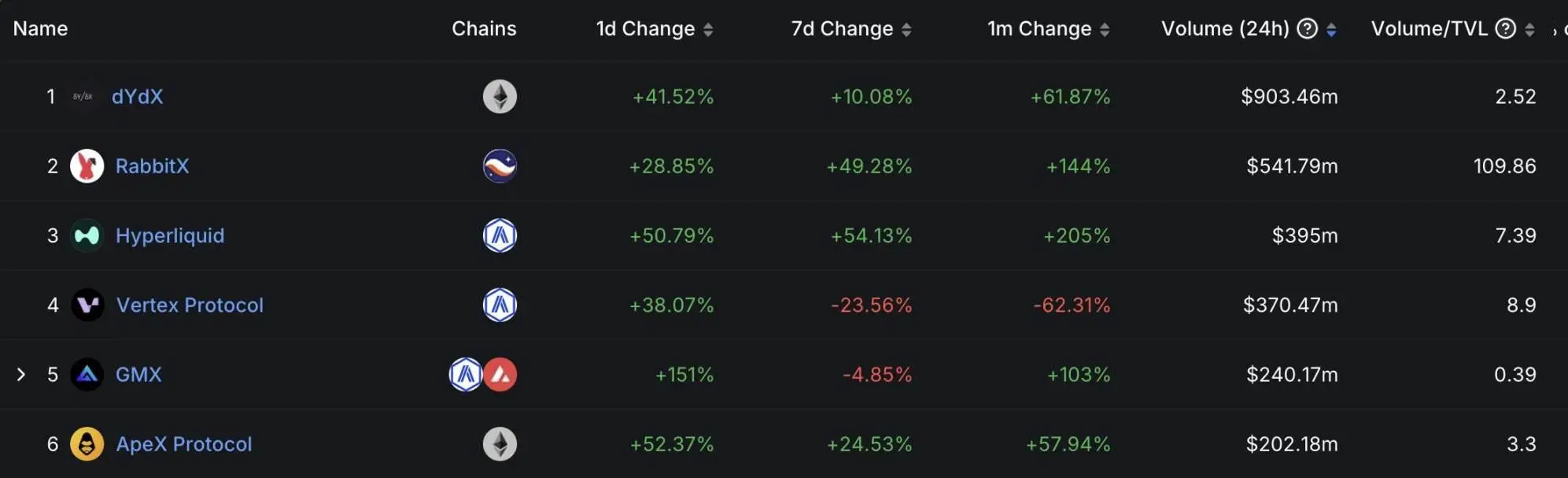
According to the latest data from DeFi Lama, RabbitX is currently the second largest on-chain derivatives trading platform, second only to dYdX.
Liquidation Mechanism
RabbitX provides a good solution for liquidation. The margin requirements of RabbitX are: liquidation margin - 2%, maintenance margin - 3%. Based on this, RabbitX has set up a 3-step waterfall structure to assist in handling liquidation:
- Waterfall 1: When an account’s equity falls below the maintenance margin (3%) requirement, it will undergo partial liquidation until the account returns above the maintenance margin requirement. During the liquidation period, users will not be able to place new orders, cancel orders or withdraw funds.
- Waterfall 2: If the equity of an account is lower than the liquidation margin (2%), the account will be liquidated at a price of zero (a position that sets the account equity to zero).
*Waterfall 3: If the RabbitX insurance fund equity drops below zero, the opposite position will be automatically reduced at the insurance fund zero price. Automatic deleveraging is the final step only when the net value of the insurance fund falls below zero.
Token Mechanism
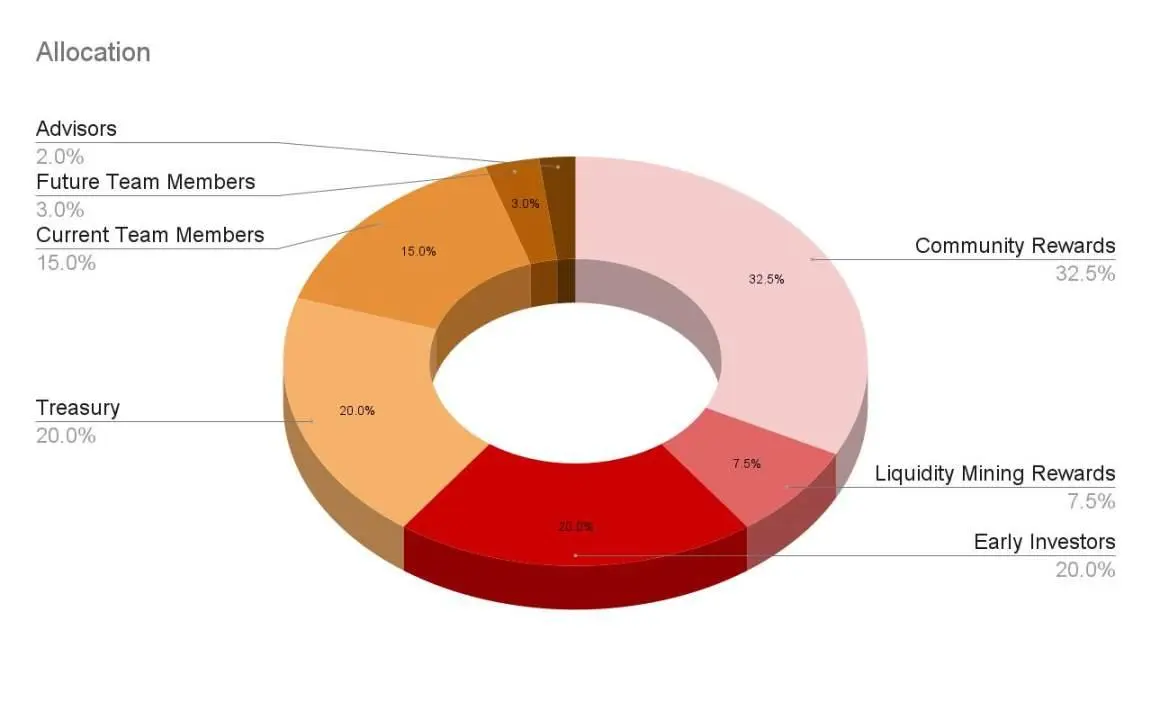
RabbitX issued utility token RBX. The initial supply is 1 billion. The token RBX has been listed. The following is the token distribution mechanism.
- Community rewards account for 32.5%
- Liquidity mining rewards account for 7.5%
- Treasury accounts for 20%
- Investors account for 20%
- Current team accounts for 15%
- Future team members account for 3%
*Consultants account for 2%
In terms of token performance, RBX performed very well, with an increase of 10% in 7 days, an increase of 123% in 30 days, and an increase of 133% in 1 year. The gains over the past 30 days have clearly outperformed the market, and RBX’s current market capitalization is $46.5 million.
Loot Realm
Starknet is a paradise for full-chain games, the typical representative of which is Loot Realm (Realms.World). The Realms ecosystem mainly includes two games: Loot Survivor and Realms: Eternum.
Loot Survivor is a rogue-like survival game where players fight monsters as they travel through the world. When you encounter a monster, you must decide whether to fight or run away, while allocating experience points (XP) to upgrade various attributes in order to prolong your life. survival time.
Realms: Eternum is a sandbox strategy simulation game similar to “Civilization”. Players need to hold at least 1 Realms to play the game. In the game, the royal family needs to build a kingdom and build an army to compete for resources or prevent being plundered by others. Buildings within the domain, etc.
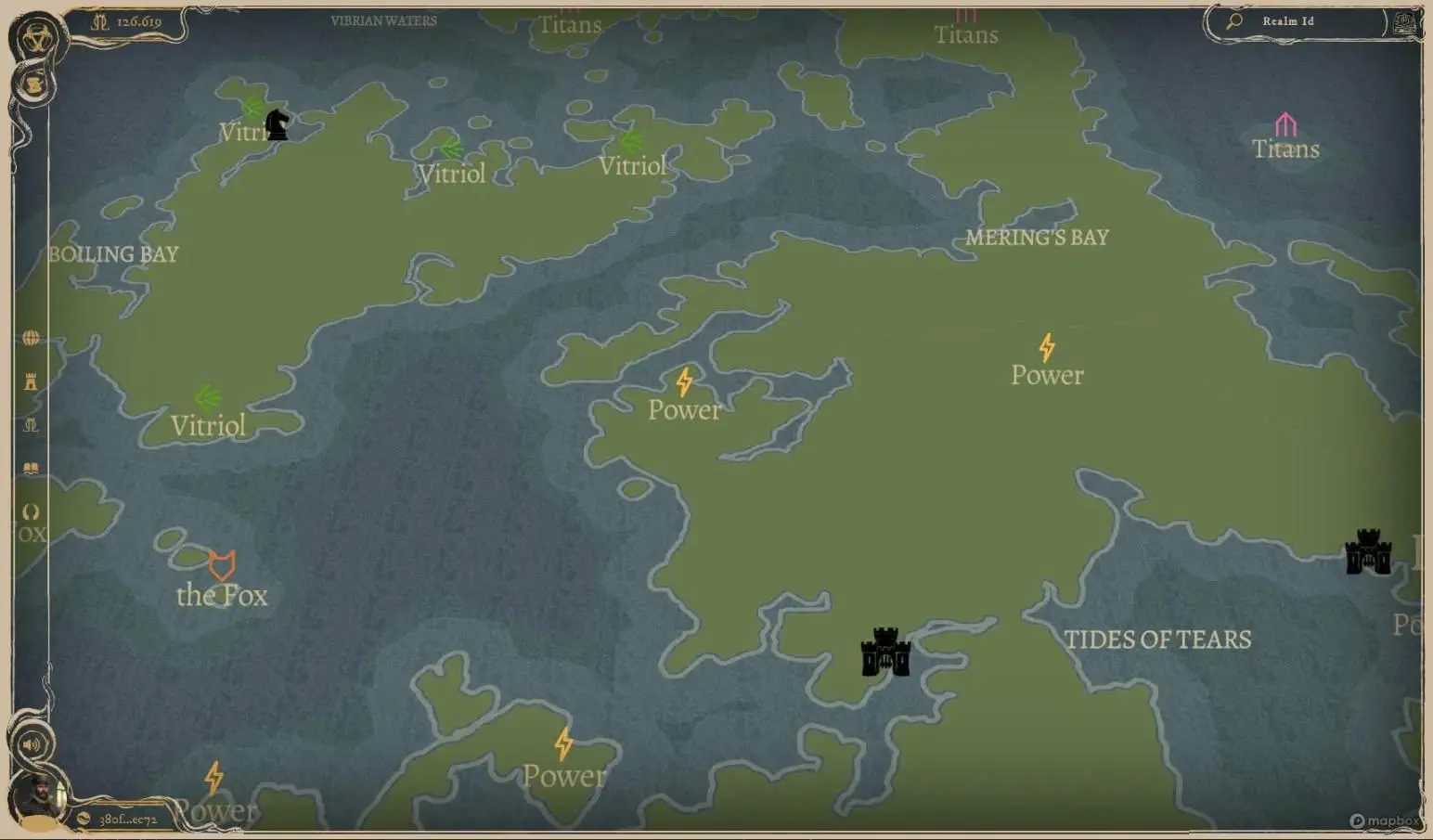
In addition, there are other on-chain games based on the world view and ecology of Realms, such as the survival game Rising Revenant and the time spell game Arcane Assembler.
Loot Realm was born out of the NFT project Loot. As early as 2021, the team began to try to run it on Arbitrum, and then encountered various challenges. It was found that the Ethereum Virtual Machine and Solidity were not very suitable for such a full-chain game ecosystem, and then They discovered Starknet, started programming in Cairo, and rebuilt the game using a modular controller system.
Friends who know games should have heard of the concept of game engine. It is essentially a set of code libraries and tools packaged in modules. Game developers only need to call the interfaces of different parts of the engine to complete graphics rendering, physical simulation, Tasks such as network communication can be simply understood as a type of Saas.
In the field of traditional game engines, the most common ones are Unity and Unreal, and in the field of full-chain games, they also have their own game engines.
MUD is a full-chain game engine on EVM. It was first unveiled at DEVCON in April 2022, and was subsequently officially released by Lattice Studio on November 22, 2022.
The emergence of MUD has inspired the Starknet ecosystem, “If we have EVM, we can also have it.” This coincided with the release of Cario 1.0 by Starknet in November. @lordOfAFew, the core contributor of Loot Realms, and Cartridge, the Starknet ecosystem’s Steam game distribution platform Founders @tarrenceva and founder @sylvechv of Briq (NFT construction protocol) proposed the idea of developing a full-chain game engine on the Starknet network. Until February 2023, Dojo was officially born, a native full-chain game engine of Starknet .
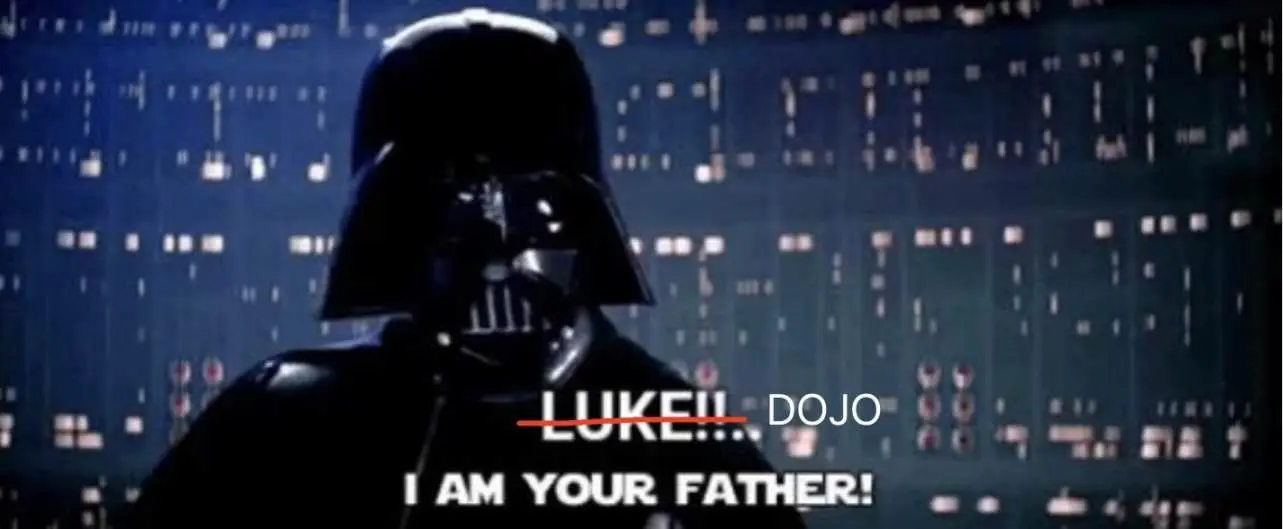
Therefore, what the author wants to express by saying so much is that Realm is not only a full-chain game on Starknet, but also a game ecosystem, and it is the father of the full-chain game engine Dojo.
Token Mechanism
The LORDS token is the ERC20 token that powers Realms.Wrold. The LORDS token can be used to acquire resources, summon armies, build structures, and various other actions in the Realmverse. LORDS can be produced according to different gameplay in the game and used for trading in the resource market.
The total supply of LORDS tokens is fixed at 500 million, and the tokens are distributed as follows:
- Game emissions account for 57.5%;
- Bibliotheca DAO (development studio) accounts for 22.5%;
- Journey contract accounts for 10%
- Development funds account for 5%
- LP incentive accounts for 5%
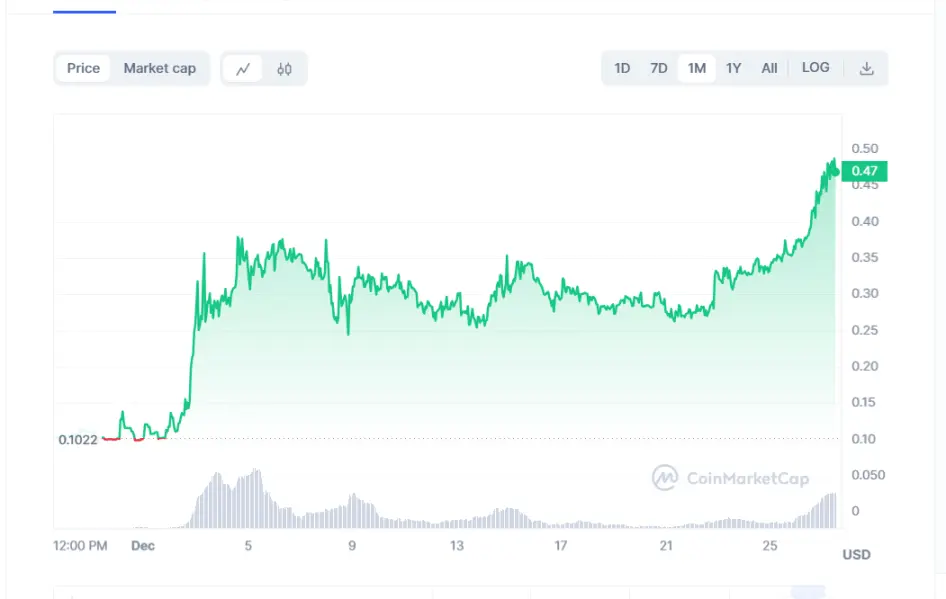
In terms of token performance, LORDS’s growth is equally impressive, with a 7-day increase of 65%, a 30-day increase of 359%, and a 1-year increase of 687%, which is much higher than the market. LORDS currently has a market capitalization of $23.7 million.
Projects that have not issued coins
Except for the above two projects, RabbitX and Realms.Wrold, most of the ecological protocols of the Starknet network are still in a state of unissued coins.
Recently, the official has released the following diagram showing the main applications of Starknet network DeFi. This article refers to the official tweet to introduce specifically what Starknet has from the five tracks of cross-chain bridge, AMM/DEX, aggregator, lending and derivatives. DeFi protocols deserve special attention.
Cross-chain bridge
StarkGate
StarkGate serves as Starknet’s native and official cross-chain bridge, with each supported token associated with L1 and L2 bridge contracts that communicate through Starknet’s messaging mechanism. These bridges communicate through Starknet’s messaging mechanism, helping users transact with ETH and ERC-20 tokens on L1. This is achieved through the Starknet Alpha network and its STARK-based computational compression capabilities.
Currently, five mainstream tokens are supported across chains: $USDC, $USDT, $WBTC, $DAI, $ETH.
Official website link:
Orbiter
Orbiter supports cross-chain assets between Ethereum and multiple L2s, and can be transferred from zkSync, Optimism and other chains to Starknet.
In Orbiter Finance, there are two roles: Sender and Maker. When Sender initiates a transfer, Maker provides liquidity for it. Smart contracts ensure the security of this process. If Maker has bad behavior that causes the transfer to fail, Sender can use Maker’s deposit to initiate an arbitration request to the contract and then receive excess compensation.
However, it is worth mentioning that Orbiter’s currency issuance plan is not yet clear. Its founding team once said that it might issue tokens, but then changed its tune.
Official website link:
layerswap
layerswap supports bridging multiple network chains such as Starknet, zkEVM, ImmutableX, Arbitrum and Optimism. Users can use Layerswap to instantly transfer ETH, USDC and other tokens from centralized exchanges such as Coinbase, Binance, Kraken to all major L2.
Official website link:
AMM/DEX
The Road
Ekubo is an automated market maker built specifically for Starknet, with centralized liquidity, scalability and high capital efficiency. It leverages the Starknet architecture to provide the best exchange execution and liquidity provider returns. In addition, all Ekubo fund pools exist in one contract, reducing storage differences and saving transaction costs.
It is worth noting that Ekubo’s TVL amount is US$8 million, ranking first in the Starknet network.
Official link:
Brine (now renamed tanx.fi)
tanx.fi is a decentralized order book exchange based on StarkEx that provides no gas fees and fast trading capabilities, allowing users to track portfolios, obtain profit and loss analysis, and trade with ease. tanx.fi supports quantitative trading users, CeDeFi exchanges, and institutional trading users.
In the white paper document on the official website, it is clearly mentioned that tanx.fi token $SALT will be launched soon. For more information, please actively follow the official Twitter and website.
Official link:
JediSwap
JediSwap is a permissionless, composable AMM on Starknet that allows users to earn fees by providing liquidity to trading pairs. It supports Swap, add/remove liquidity, and ZAP functions (allowing users to convert any AMM into a single Starknet transaction with just one transaction). Single token swap to any JediSwap LP position)
JediSwap’s TVL amount is US$7 million, ranking second on the Starknet network.
Official website link:
10KSwap
10KSwap is an AMM protocol built using Cairo. 10K aims to revolutionize the performance of AMM protocols by leveraging rollup functionality, bringing lower fees, less friction and ultimately better liquidity to the L2 world and driving DeFi adoption. 10KSwap allows token holders to freely create trading pairs without paying high fees.
Official website link:
SithSwap
SithSwap is the next generation AMM on StarkNet with instant volatility and stable swaps with ultra-low slippage, near-zero fees and the complete security of Ethereum. SithSwap provides stable pools and dynamic pools:
SithSwap dynamic pool uses UniV2 style pool mechanism, which is particularly suitable for asset swaps with high volatility.
SithSwap Stable Pool can optimize low-volatility assets, reduce slippage, allow dynamic pools to achieve higher capital efficiency, and increase traders’ return on assets.
Official website link:
Aggregator
AVNU
AVNU is a decentralized trading protocol and liquidity infrastructure designed to always seek to provide the best execution strategies for traders and dApps on Starknet (and L2s more broadly). The project optimizes trade execution and minimizes slippage by searching for the best trading routes across multiple decentralized exchanges (DEX). Additionally, its request-for-quote (RFQ) system integrates market maker liquidity, optimizes price discovery, eliminates slippage and provides MEV protection.
Official website link:
Fibrous
Fibrous gathers all StarkNet’s AMMs in one place, allowing users to exchange with one click in the cheapest way, matching the best price through the order routing algorithm
In addition, Fibrous integrates multiple projects, such as Ekubo lightning account, mySwap centralized liquidity, etc.
Official website link:
Lending Agreement
zkLend
zkLend is a crypto lending protocol built on StarkNet, combining the scalability of zk-rollup, superior transaction speed, and cost savings with the security of Ethereum. zkLend meets users’ needs for efficient transaction speed and low transaction costs, and supports multiple tokens such as ETH/wBTC/USDC.
The protocol offers a dual solution: a permissioned and compliance-focused solution for institutional clients, and a permissionless service for DeFi users – without sacrificing decentralization.
On the official website, zkLend clearly lists its token supply as 100 million and the corresponding distribution mechanism, which directly indicates that the project will issue coins later. For more information in the future, please actively follow the official Twitter and website.
Official website link:
Our
Nostra is a one-stop Defi solution built on Starknet where users can lend, borrow and trade cryptocurrencies. The Nostra liquidity layer consists of the Nostra money market, UNO (Starknet native stablecoin) and Nostra Swap (Stablecoin DEX). Integrating these three products together gives users permissionless access to liquid crypto assets at any time and for any purpose with minimal impact on price.
The Nostra currency market is the core product of the liquidity layer and can continuously provide liquidity within the ecosystem. It also provides benefits to Nostra Swap and UNO minters.
Nostra Swap is the next generation stablecoin trading platform used to support the peg and growth of UNO. LPs that provide liquidity on Nostra Swap can also earn revenue from lending their stablecoins on the Nostra money market.
UNO is the first Starknet-native stablecoin. It is over-collateralized by ETH with interest, UNO can be used for DeFi, gaming, NFTs, real-world payments, and more.
Official website link:
Hashstack
Hashstack is Starknet’s most capital-efficient low-mortgage lending protocol. Its features are:
- Provide multi-chain interoperability
- Improve the security of the oracle machine and adopt the TWAP mechanism
- Optimize liquidation to reduce risks and recover assets
- Smart loan limits based on dApp liquidity
It is worth mentioning that Hashstack has launched the $HASH token and conducted an airdrop specifically for mainnet V1 users. The event duration is: November 27, 2023 - January 22, 2024. For more information, please follow the official website and official Twitter.
Official website link:
Derivatives
Paradex
Paradex is a cryptocurrency derivatives exchange and the first application chain on Starknet. Paradex will provide perpetual futures trading with deep liquidity, capital efficiency and performance, while remaining transparent and self-custody. All complex business logic in Paradex transactions is verified on L2.
Recently, Paradex’s historical transaction volume has exceeded US$2 billion.
Official website link:
ZKX
ZKX Protocol is a decentralized perpetual futures exchange running on StarkNet. It is built by the community and prioritizes user satisfaction. ZKX Protocol provides CEX with a competitive advantage over other DEXs by leveraging its zk-STARK technology, which provides excellent scalability and on-chain transaction advantages such as account abstraction and low-cost transactions.
Unlike other DEXs, the ZKX protocol introduces a unique risk mitigation tool called “deleveraging” to protect users from sudden market fluctuations. In extreme cases, the platform will trigger liquidation to prevent greater losses.
In addition, its token ZKX will be listed in 2024.
Project official website:
Summarize
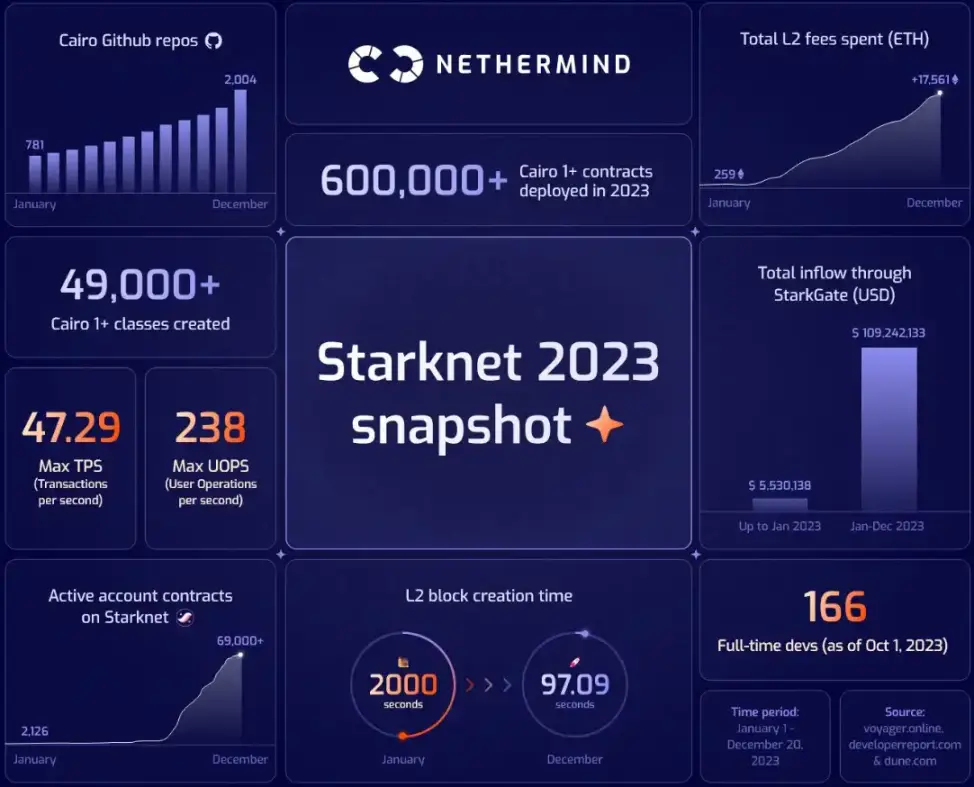
In the midst of a bear market for cryptocurrencies, Starknet has dug in and made considerable progress over the year. We can see from Nethermind’s industry review that Starknet’s relevant indicators have improved in the past 2023:
- Active accounts increased from 2,126 to over 69,000
- Block creation time reduced from 2000 seconds to 97.09 seconds
- Total past cross-chain funding through StarkGate grew from less than $6,000 to $109 million
*The number of full-time developers is 166
Perhaps with the issuance of Starknet’s currency, Starknet’s official incentives for the DeFi protocol in its ecosystem, and the recovery of the overall market, the above figures in 2024 will further increase, and it will also benefit ecological projects in the entire L2.
Let us wait and see how the entire ecology performs after we start researching and observing when no one is paying attention.


