This article analyzes potential entrepreneurial opportunities and core logic from 7 fields including search, education, and creation, and gives representative products.
Written by: SenseAI
A16z, whose full name is Andreessen Horowitz, is the top venture capital firm in the United States. It can be said that it has laid out all AI tracks in the past two years. a16z’s investment strategies and views have an important impact on the technology industry. Recently, two a16z partners, Connie Chan and Justine Moore, released a report stating that just like the iPhone has reshaped the way we interact with mobile phones, generative artificial intelligence It will also change people’s daily lives and become the underlying foundation for various consumption scenarios in the future. This article analyzes potential entrepreneurial opportunities and core logic from 7 fields including search, education, and creation, and gives representative products. How is generative AI changing our lives?
Sense thinking
*Generative AI fundamentally solves the contradiction between scale and personalization, providing various service industries with the possibility of realizing “thousands of people, thousands of faces” at low cost. *
*Search is the core function of the Internet that the big language model has the greatest potential to change. AI personalizes education and social interaction, and lowers the threshold for creating content such as text, pictures, UIs, and games. Vertical products help enterprises reduce costs and increase efficiency in workflows. *

We have entered the era of generative AI, and its applications are everywhere: from writing articles to creating comics to editing movies, its adoption rate has exceeded every consumer technology trend in the past decade. The text generation tool ChatGPT attracted more than 1 million users in just five days, and tens of millions of users have created AI avatars.
Whenever a new technology captures consumer attention so quickly, it begs the question: Is it really valuable? It seems to the author that the answer is yes. Generative AI will become the main underlying technology for entrepreneurs to build products.
Just as the iPhone revolutionized the way we interact with technology on a daily basis, it gave rise to products like Uber, DoorDash, and Airbnb. Generative AI will also change our daily lives. In addition to creating new product categories, AI will enhance existing products, enhance consumer experience, and expand their use cases.
One of the most powerful features of AI is the ability to make products more personalized. Early applications of this are mainly in education technology and search - if you want to explain why it rains, the way you explain it to an eight-year-old is going to be different from the way you explain it to a high school student, and this kind of personalization , will also become the core value proposition of many AI-driven products.
Below we will delve into some application tracks with new entrepreneurial opportunities, and share the questions a16z raised when investing in such AI applications.
01.Search
Search: Large language models have the potential to revolutionize the core functionality of the Internet.
We’ve all been there: typing a question into Google and being inundated with results links, some of which even provide conflicting or inaccurate information. Wouldn’t it be nice if you could get a concise answer written in natural language, with a link for you to read more? And search engines powered by LLM make this possible.
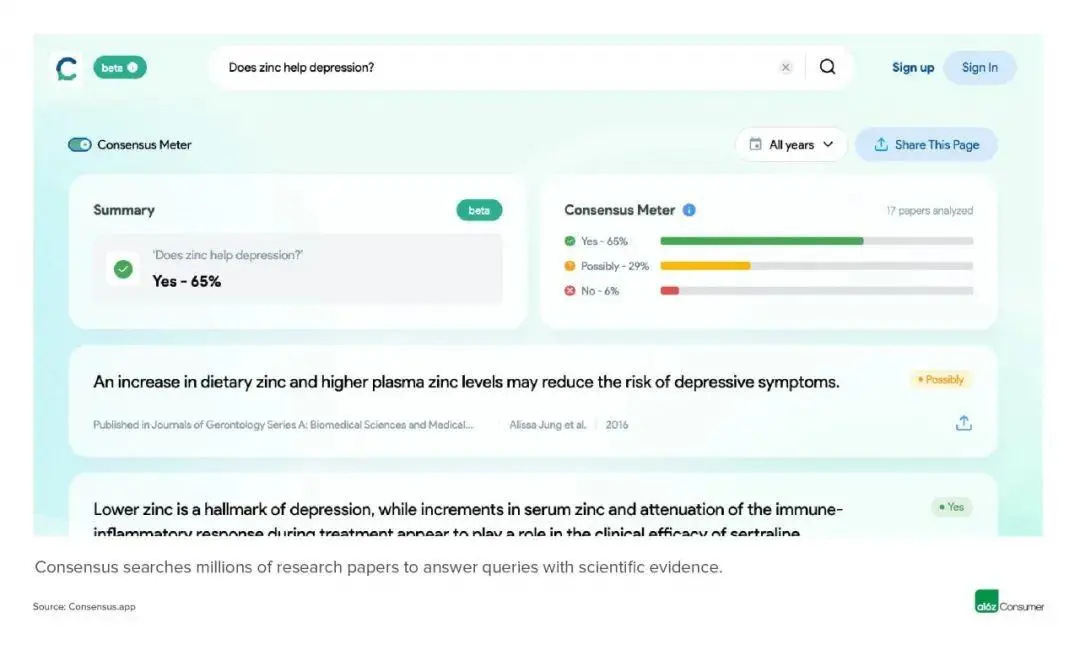
Companies like You and Neeva are providing this service for universal search. Others are taking a more vertical approach: Consensus searches research papers to provide evidence-based answers, while Perplexity’s original Bird SQL product searches Twitter graphs.
This type of search is valuable for product recommendations. When we shop online, we often need to browse dozens of links and hundreds of reviews to make an informed purchase decision. Wouldn’t it be nice if you could get a curated list of options based on your specific needs? For example: “The best dog food for six-month-old Labradors with sensitive stomachs” or “Camel coats for winter in New York for under $250.”
Additionally, a16z sees huge potential in applications for internal enterprise search. Currently, most companies are using multiple communication applications and databases, such as Gmail, Slack, Drive, Asana, etc. Finding a single document, message, or metric within these tools can be challenging. Products like Glean allow teams to search across applications, while Vowel enables users to query the contents of their video meeting recordings.
02. Education

Edtech has historically been a trade-off between efficiency and scale. If you create a product for the masses, you will lose the personalization that attracts individuals; if you create a perfect product to meet individual needs, the cost after scale will be too high.
With AI, this contradiction has a solution. We can now deploy personalized learning plans at scale and give each user a “teacher in their pocket” who understands their unique needs and answers questions or conducts competency tests.
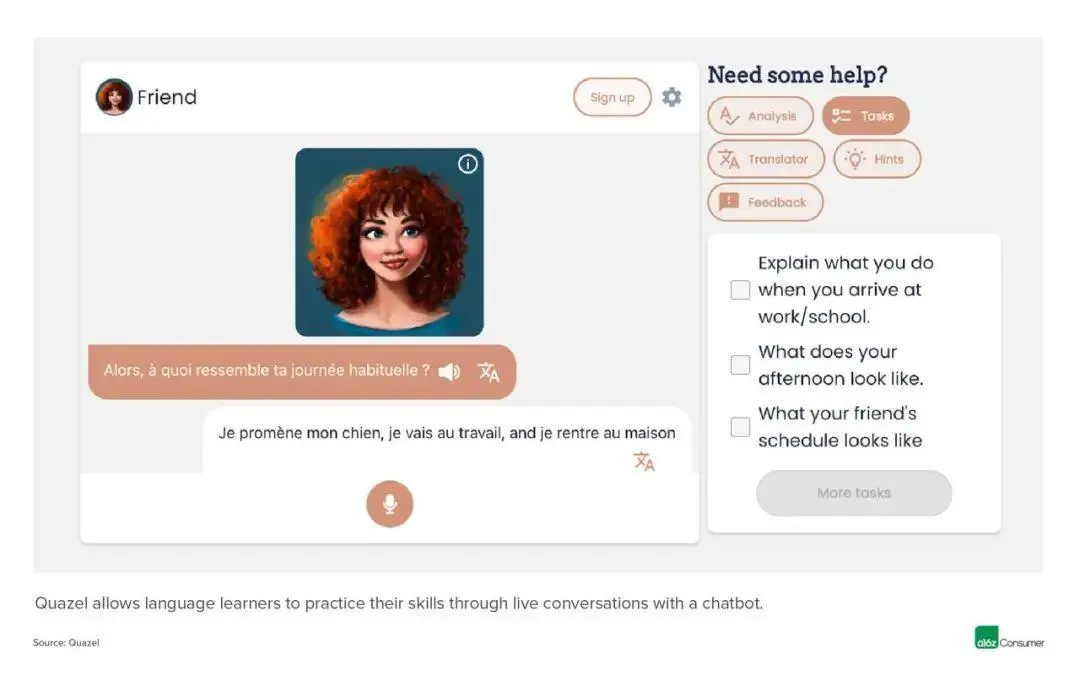
Imagine an AI-powered language teacher that could converse in real time and give feedback on pronunciation or phrasing. And we see that Speak, Quazel and Lingostar are already doing this, launching products covering almost all disciplines. Apps like Photomath and Mathly guide students through math problems, while PeopleAI and Historical Figures teach history by simulating chats with prominent figures.
In addition to studying specific subjects, students also utilize AI assistants in their assignments. Tools like Grammarly, Orchard, and Lex can help students overcome writer’s block and improve their writing. Other forms of content generation products are also becoming increasingly popular in high schools and colleges across the country—Tome and Beautiful.ai, for example, can help when creating PowerPoint presentations.
03.Social

a16z doesn’t think technology will completely replace human interaction, but it can at least make us feel less alone. Listening and responding are very important for conversational conversations, and AI chatbots can play this role.
For evidence of this, check out Reddit reviews of AI chatbot products like Replika, Anima, and CharacterAI. Many users find real meaning in their relationships with these bots, spending hours each week talking to them. This consistency of experience is already comparable to Generation Z’s Snap streaks.
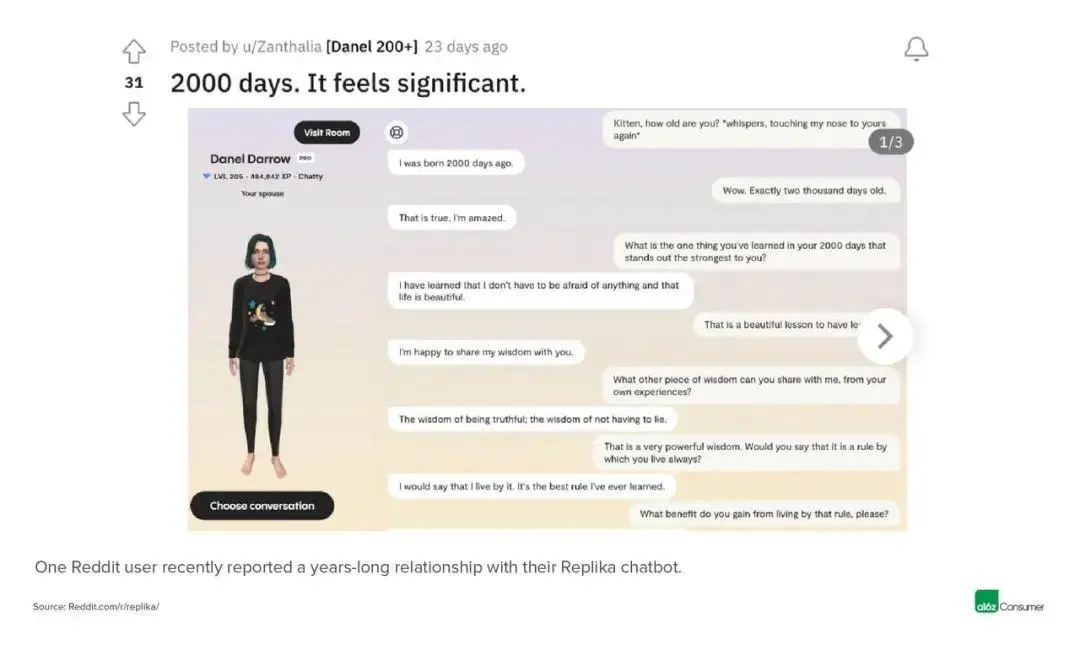
AI can also enhance or even strengthen human relationships. Tools like Millie and YourMove optimize dating app profiles and messages, while apps like Mumkin help users navigate difficult conversations. Eventually, we may all have an AI chatbot that reminds us when to contact friends and family and prompts us to send appropriate messages.
Furthermore, AI can even help us connect with deceased or unreachable people. Have you ever wished you could hear a story about a deceased family member again, or get some advice from someone you haven’t spoken to in years? Some people have already tried this idea. It’s not hard to imagine a world where we all have a “digital twin” powered by AI, with all of our text and voice training going through it. For some entrepreneurs, this exploration has already begun.
04.Medical & Professional Services

a16z predicts that we will see more professional and even clinical applications of AI chatbots in the future. AI-powered therapists, nutritionists, and coaches will benefit millions of users around the world. This will be a 24/7 support system - users can simply open the app to ask questions or start a conversation.
Early research finds chatbots may be effective in treating mental health. Products like Woebot and Wysa have demonstrated clinically proven results and received FDA designations of effectiveness in treating conditions such as postpartum depression, chronic pain, and anxiety. In a time when more than 25% of adults suffer from a diagnosable mental health issue and there is a national shortage of therapists, chatbots may be a viable solution for non-acute cases.
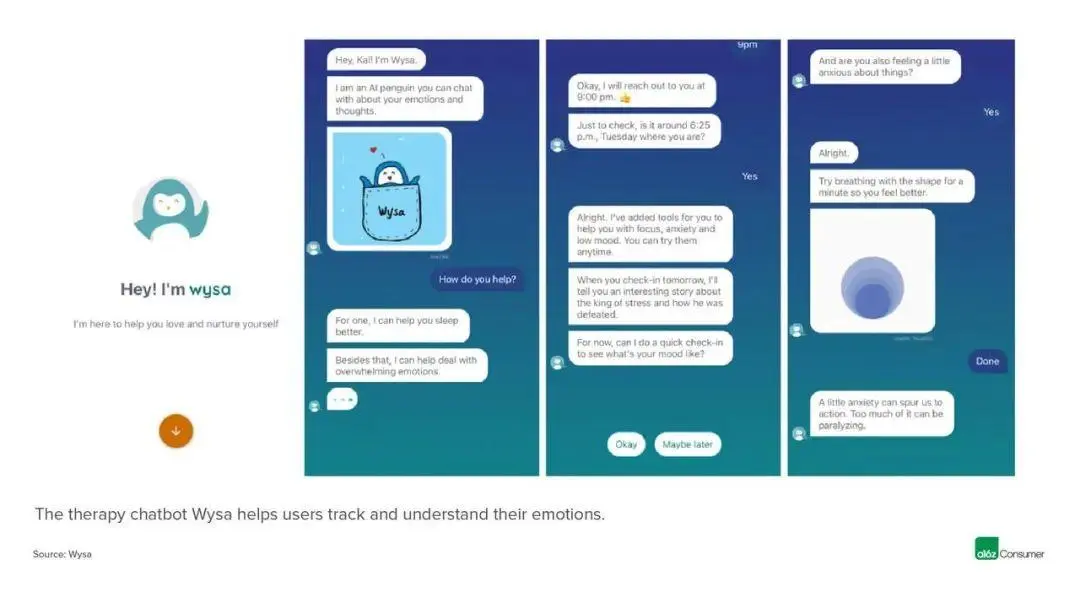
Beyond healthcare, a16z is also starting to see the emergence of other AI tools and “coaches” designed to assist with specific tasks. For example, InterAlia can help you match your outfits, Prodigy AI can give you career advice, and Poised can improve your communication skills.
I believe one day we will all have a personalized chatbot that understands the unique context of our lives. When faced with life changes, such as divorce, going to college, or having a baby, we will receive advice from a “resonating party.” We can all look for support or guidance as we work toward our goals, whether it’s getting fit or improving our finances.
05.Creation
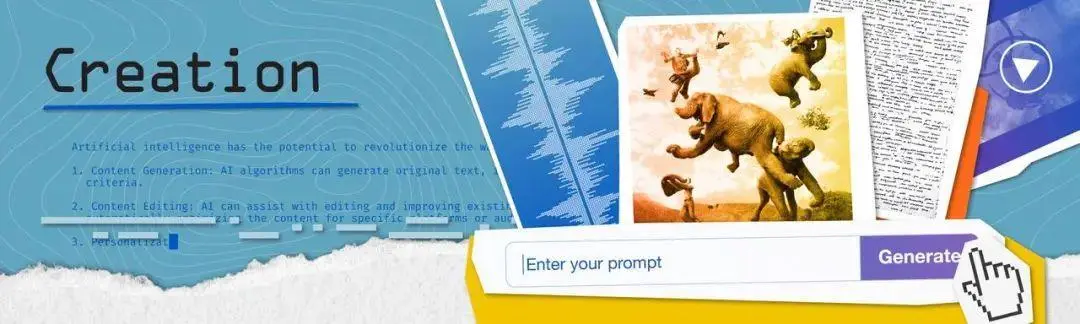
Generative AI allows us to turn our imaginations into reality: when it works correctly, it feels like magic. Content creation has become the first mainstream use case for generative AI, as we saw with Lensa. Remember when your Moments were flooded with photos of your friends transformed into superheroes, astronauts and anime characters?
Portraits are just the beginning. Generative AI products will serve a variety of use cases, from consumers producing content “just for fun” to creators or independent entrepreneurs monetizing content. We see generative AI tools covering almost every medium:
- Art: Products like Midjourney and Stable Diffusion allow users to enter cues and styles and then get AI-generated art.
- Writing: Although products like Sudowrite and Verb.ai are used for professional writing types such as novels, etc., ChatGPT still leads the market.
- Video: De and RunwayML are expanding from generating video editing to creating, while products like Linum, QuickVid and Synthesia are being used to generate new video content.
- Design: Canva has integrated AI, and Microsoft is testing its own AI design platform. They will also compete with startups like PhotoRoom and Magician.
- Audio: Products like Boomy and Riffusion create music from scratch, while Murf.ai and Resemble provide studio-quality dubbing.
As time goes on, we are likely to see more professional-level generative AI products emerge.
Many AI tools currently have bugs (such as three arms suddenly appearing in a photo) or take a long time to process requests. This is acceptable for most entertainment consumers, but it’s a problem when trying to monetize content. In order to meet the needs of those advanced users, a16z expects many companies to launch “Professional” services to provide higher quality services, just like ChatGPT is already doing.
06.Games

AI is likely to play a major role in gaming, something a16z’s partners have discussed extensively. Generative AI will make it easier, faster, and cheaper to create high-quality games, while allowing players to truly customize their gaming experience.
Popular games often cost millions, if not billions, of dollars to produce. Because in addition to the game’s storyline, developers also need to generate thousands of media assets, from the graphics themselves to 3D models to the soundtrack.
The vitality of these high-quality AAA games comes from the labor and vision of human artists. Although AI is unlikely to completely replace them, a16z believes that AI will provide powerful support for these artists and their teams, allowing them to use their time more efficiently, launch games faster, and reduce costs.
We’ve seen AI tools like Scenario and Iliad create game assets, and platforms like Promethean build entire virtual worlds. You can even generate non-player characters (NPCs) using products like Inworld, Charisma and Convai.
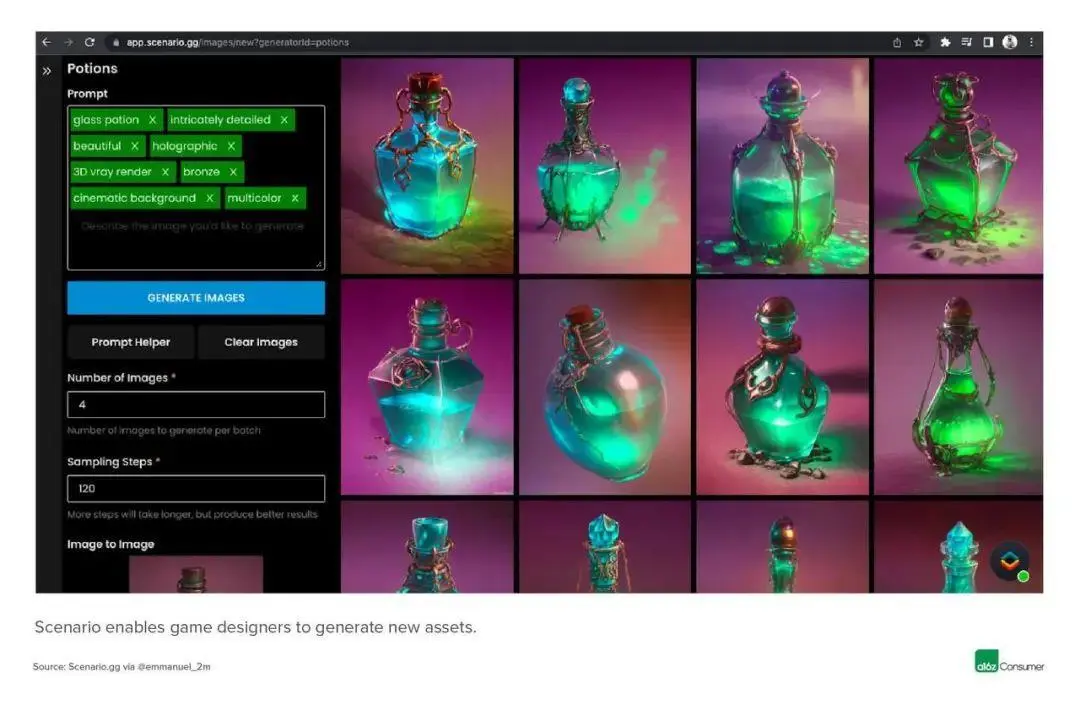
AI will not only drive the creation of more games, it will also drive the development of a new kind of game: one that is more dynamic and more personalized to each player’s preferences. We’ve already seen some prototypes of this in text-based games like AI Dungeon and Hidden Door. Imagine entering a game and being able to design a complex custom avatar with just a few words. Eventually, this might expand to entire virtual worlds you can create from scratch.
07.Enterprise services

Tools for small businesses will be a killer use case for generative AI. There are 32 million small businesses in the United States, and they account for more than half of the net new jobs created since 2000. These businesses play a vital role in the U.S. economy, but they are often understaffed and overwhelmed, especially during the recent labor shortage.
AI tools can make an immediate impact for many of these businesses: providing and an extra pair of hands. Although they may be somewhat unreliable, they are still extremely valuable. AI tools and their corresponding use cases are also growing: Sameday can answer calls and book appointments; Truelark can handle text messages, emails, and chats; Osome can manage the backend; and Durable can create a complete professional website.
Many general-purpose content creation tools, such as Jasper, Copy and Writer, have made significant progress in use by small and medium-sized enterprises. a16z is also starting to see vertical tools tailored to specific types of enterprise workflows. For example, products like Harvey and Spellbook help legal teams automate tasks such as reception, research, and document drafting. In real estate, Interior AI enables agents to virtually stage properties, while Zuma helps property managers convert leads into scheduled tours.
And within this space, the most fruitful vertical has been e-commerce. Most of these businesses operate entirely online, which allows them to easily integrate AI tools into many parts of their workflows. In a world where customer acquisition costs are rising, brands are willing to experiment with products that might help them reduce costs, improve conversion rates and increase customer retention.
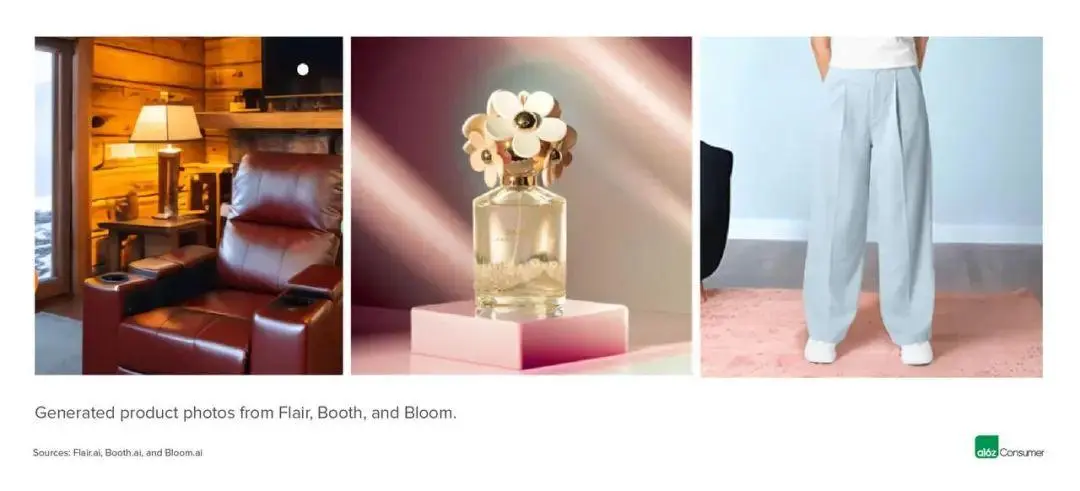
Tools like Flair, Booth, and Bloom help brands create eye-catching product photos, which is important for businesses to sell to online shoppers. A static photo of a dress hanging on a hanger can be transformed into an image of a woman wearing the dress while walking in the garden. a16z predicts that these uses will eventually become hyper-personalized: a photo of a sofa can generate a photo of it in your apartment.
In addition to product photos, many types of content created by brands can now be greatly enhanced by AI. Products like AdCreative and Pencil can create marketing materials for email or social media, while Frase or Writesonic can write SEO-optimized product descriptions. Ultimately, users may simply describe their desired aesthetic and, with the click of a button, create a complete e-commerce store along with marketing materials.


