DePIN is an imaginative track that can both “put old wine in new bottles” and completely break through industry boundaries.
Written by: MIIX
What is the biggest surprise in the encryption world in 2023? The answer must be ETF, Inscription and DePIN, among which DePIN is a new sprout from an old tree. Helium, established in 2021, has created the biggest surprise so far.
1. The DePIN track is spreading hotly
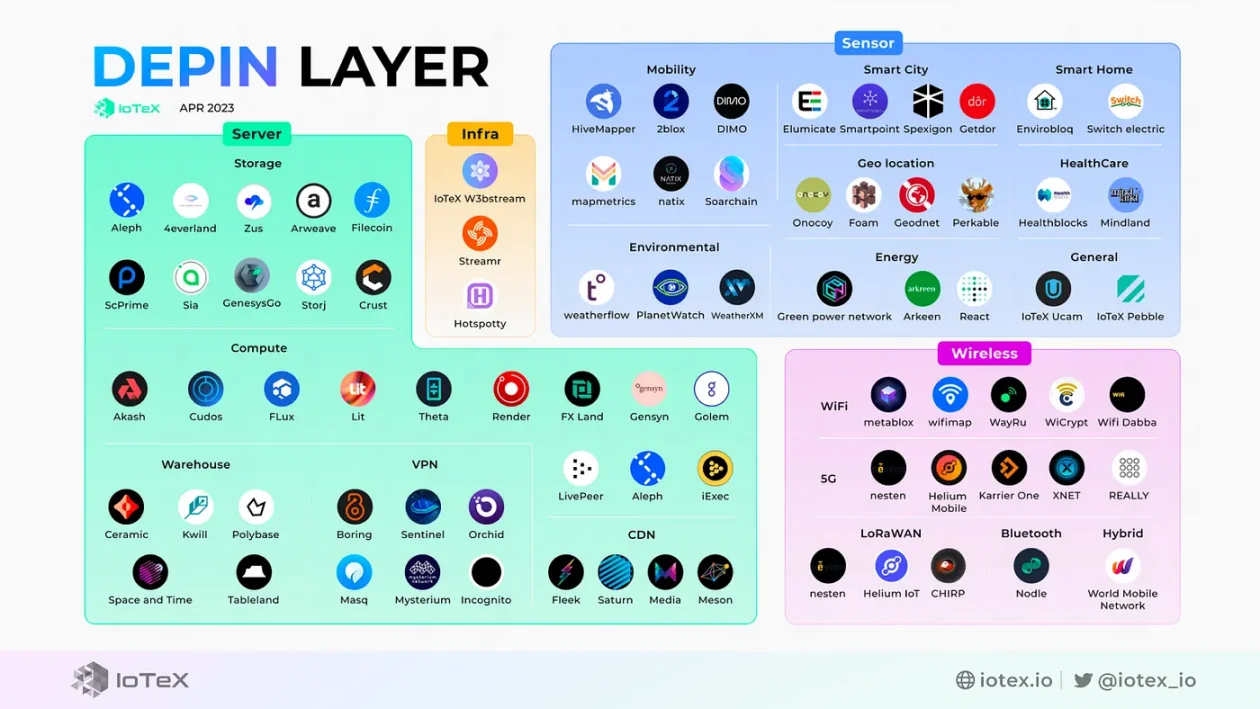
DePIN covers a wide range of areas, including server networks, wireless networks, sensor networks and energy networks. According to predictions by encryption research institution Messari, the overall DePIN industry size is currently approximately US$2.2 trillion and is expected to grow to US$3.5 trillion by 2028.
As the topics of Mobile and Honey sweep the entire Internet, old projects such as Fil and Storj have also returned to the field of vision, and the popularity of the DePIN track has spread rapidly. In the DePIN growth rankings, MOBILE, IOT and HNT have always performed well. Streamer Network’s DATA token also performed well, with a seven-day maximum increase of more than 215%. This seems to tell us that DePIN has become a hot topic on the current track and will occupy an extremely important position in the new cycle.
2. Solana and DePIN go in both directions
The market value of the DePIN ecosystem on Solana is second only to Ethereum, reaching US$2.7 billion, only one step away from Ethereum’s US$3 billion. In the past year, both Solana and DePIN have shown significant growth, allowing us to witness the synergistic power of the combination of the Solana blockchain and the DePIN protocol.
Helium Bundle Solana Narrative
In September 2022, Helium developer Nova Labs announced that it had signed a mobile virtual network operator (MVNO) agreement with telecom giant T-Mobile and will launch commercial mobile smartphone services under the Helium Mobile brand in the first quarter of 2023.
In November 2022, Nova Labs said it would provide a SIM card and a free trial to users of Solana Labs’ new Saga phone (the Saga phone is Solana’s flagship Android device and is tightly integrated with the Solana blockchain).
In early 2023, Helium successfully completed the migration to Solana, proving the feasibility of building a DePIN business on Solana and triggering the growth of the entire DePIN sector.
Under the dual superposition of Solana’s empowerment and DePIN’s narrative, the price of $MOBILE has been rising all the way, and achieved an intraday increase of 110% in December, leading the increase in the DePIN track-related tokens in a single day, comprehensively driving and assisting the development of the DePIN track. Heat grows.
Solana Ecosystem strongly promotes DePIN
The focus of the Solana ecosystem is mainly focused on DeFi, Memecoin and DePIN. Kuleen Nimkar, head of DePIN at the Solana Foundation, once pointed out in an interview with The Block: “The DePIN projects on Solana (including Helium, Render, Hivemapper, etc.) demonstrate the potential of decentralized physical infrastructure networks to elevate the gig economy to a new level. At the same time, Helium, as the head DePIN project of Solana’s ecosystem, is also one of Solana’s core strategic focuses in 2024.”
Kuleen believes that contributors to the DePIN network can earn considerable income by supporting the network early, and the tokens earned will subsequently appreciate in value as the network develops: "This has never happened in the web2 gig economy, and early Uber drivers didn’t see the huge benefits of supporting Uber until it became a giant.”
It can be seen that Solana also hopes to cooperate more with DePIN to form a strong binding relationship similar to DeFi and Ethereum, Inscription and Bitcoin, and build its own unique ecosystem. Along with the general rise in Solana’s DePIN track tokens, it just helps us prove that Solana attaches great importance to DePIN and the positive market effect it brings.
3. Advantages and obstacles coexist for a long time
Resource sharing and efficient utilization
The most essential core of DePIN is resource integration, which incentivizes users to share resources through tokens so that resources can efficiently flow to the hands of demanders. Therefore, the characteristics of DePIN are also clear at a glance:
- Crowdsourced hardware - more cost-effective
- Collective ownership — aligns with and rewards users
- Democratic access – an open and unrestricted network environment
- Decentralized — permissionless and censorship-resistant
DePIN and traditional infrastructure, just like DeFi and CeFi, reduce the role of middlemen to some extent, making resources more unimpeded between the supply side and the demand side.
The flywheel effect of DePIN mode
As a result of using the token, the DePIN project can benefit from a positive flywheel effect, where increased usage (demand) increases the token price through burns or buybacks, which then provides additional incentives for contributors to continue building the network as they earn The dollar value of the token increases.
As the network grew, investors became increasingly interested and began supporting the project with funds. If a project is open source or provides contributor/user data to the public, developers can build dapps on top of the data to create additional value in the ecosystem, thus attracting more users and contributors. The image below shows an example of how this flywheel works on today’s market.
Technology and models are not mature enough
What DePIN aims to achieve is the democratization of infrastructure. By allowing individuals and small businesses to participate in the deployment and operation of infrastructure networks, DePIN can provide more equitable access to basic services and resources. Therefore, DePIN is an imaginative track that can both “put old wine in new bottles” and completely break through industry boundaries.
The core of DePIN is a complete infrastructure system built with a token incentive system, but currently it is more of a miner model similar to Filecoin, which has the problem of excessive initial rewards and unsustainable scale effects in the later period. We have yet to see a token economic model that can support the growth and maturity of the DePIN ecosystem. And most DePIN projects focus on how to motivate participants to purchase hardware, and only a few projects try to solve the financialization model that drives demand.
Whether it is from a technical perspective, from a cost perspective, or from a financial model optimization perspective, DePIN still has a long way to go. The author believes that the maturity of the DePIN track requires at least 10 times of growth space before it can get rid of the short-term enthusiasm and enter the long-term development path.
4. Summary
The number of DePIN track projects is increasing day by day, especially the recent hot market trend, which illustrates the market’s recognition of this track. However, the DePIN track is relatively new, and the absolute value of growth is not very high. As a result, it is relatively niche in the entire web3 market and needs more attention and resources, including more investors starting to pay attention to this direction, so that more people Community developers are willing to join this track and develop and deepen applications together.
In 2024, with the rotation of a new market cycle, DePIN will inevitably participate in it, but whether it will become DePIN’s big year is more unknown. Once an excellent or even revolutionary financial model emerges in the field of DePIN, all this will no longer be a problem. The DePIN flywheel will spontaneously drive to solve all technical and cost issues.
However, in the long run, the maturation of DePIN will inevitably require long-term investment and operational development by the market, institutions and developers, in order to gradually penetrate into people’s lives and applications, and from being complementary to existing infrastructure, to being parallel to it, and then to to substitute.


