The Dencun upgrade will be deployed in March or April 2024. Through EIP-4844, the gas cost of Ethereum L2 will be greatly reduced, and the scalability of Ethereum will be improved.
Written by: Ebunker
ETH/BTC exchange rate & on-chain data comparison
Since October, BTC has gained 57.5% as of December 15, while ETH has gained 48.34%. Although the difference is not huge, ETH price has been underperforming BTC for almost a year now.
The strong performance of BTC mainly comes from the expectations of BTC spot ETF, the approaching production halving cycle and the recent rise of BTC ecology. Although there are no similar positive expectations for ETH in the short term, the on-chain data still shows relatively positive signals.
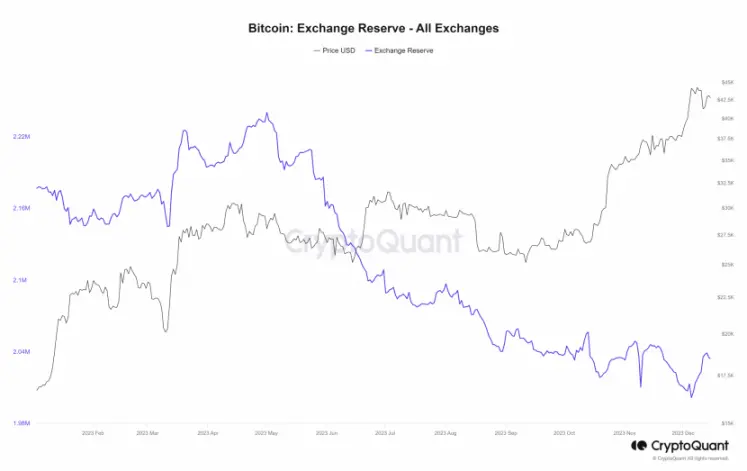
First of all, judging from the most intuitive selling pressure, the balance of BTC on the trading platform has continued to decline since June, but there were obvious signs of rebound from December 5 to December 12. After this peak, the price of BTC fell from as low as $41,000.
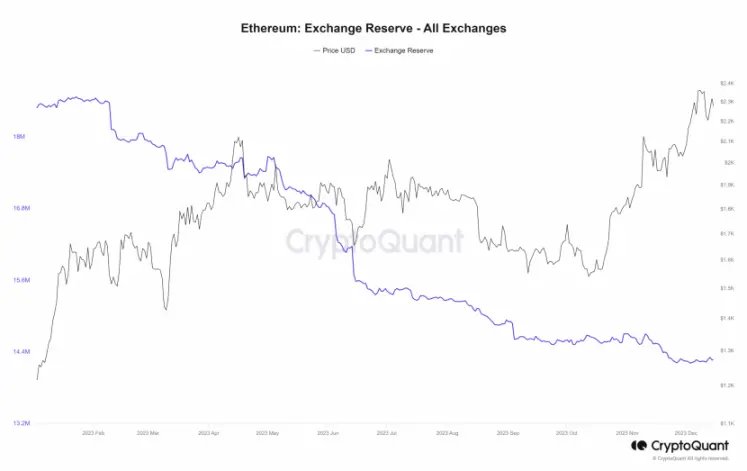
Compared with BTC, ETH’s balance on the trading platform is less volatile. Since February 2023, the balance of ETH on the trading platform has been on a downward trend. ETH’s balance on the trading platform also rebounded slightly between December 11 and 13, but the rebound occurred during and after market price declines.
This shows that some investors choose to transfer ETH to the trading platform for cash after a short-term market decline.
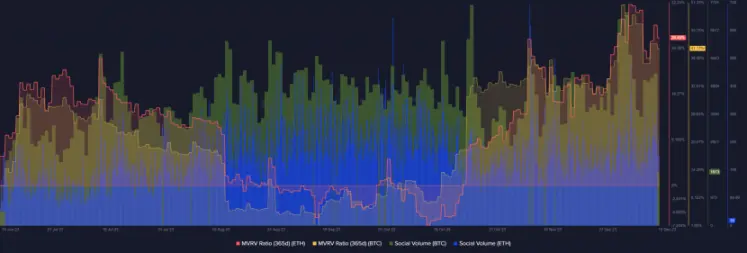
In addition, according to data from the Santiment website, in terms of social popularity, the overall trends of the two are similar, but the popularity of BTC is significantly higher than that of ETH. In terms of MVRV (the ratio of liquid market value to realized market value, often used to evaluate buying and selling pressure), the overall trends of the two are similar, but the magnitude is quite different. As of December 15, BTC was 41.17%, while ETH was 26.45%. Both values were at 6-month highs.
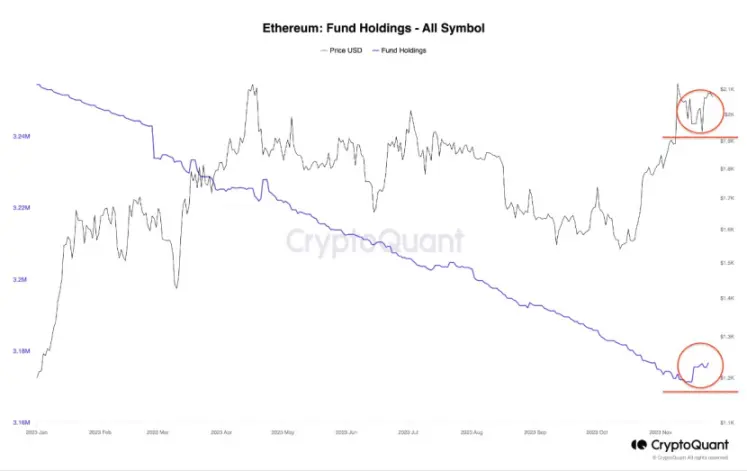
Although Ethereum has not risen as much as Bitcoin recently, it is still worth noting the trend change in the Ethereum market in terms of institutional interest, which will become more obvious after November 2023.
According to a chart from the on-chain data website Cryptoquant, some time ago, when the price of Ethereum stabilized between $1,800 and $1,900, there was a significant rebound in ETH held by institutions.
Cryptoquant believes that the recent surge in the number of institutional holdings of ETH indicates the growth of institutional investors’ interest and recognition of Ethereum’s long-term value and market growth potential. The reason behind this phenomenon is not only the price stability of ETH and the potential expectations of the ETH spot ETF, but also the solid fundamentals and technical upgrade of Ethereum.
JP Morgan took a stance on the cryptocurrency industry in its recently released Financial Outlook 2024 report. The report pointed out that although BTC is approaching a production reduction cycle, ETH is expected to perform better than BTC next year. JP Morgan believes that the upcoming EIP-4844 upgrade (Proto-dank sharding) is a potential catalyst for its performance. This upgrade will improve Ethereum’s network efficiency and scalability, thereby gaining an advantage in the market.
On the other hand, the positive factors of BTC production reduction have been realized in advance into the current price. The BTC block reward halving is expected to increase production costs and potentially cause its hash rate to drop by 20%. According to JP Morgan, this could result in higher operating costs for miners and drive less efficient miners out of the market.
Key steps to start before Dencun upgrade
At the end of 2023, Ethereum developers finally enabled the key steps before the Dencun upgrade, according to a report from the core developer consensus call. Ethereum developers said that they will launch the Goerli shadow fork with all clients in the next one to two weeks to test the Cancun/Deneb upgrade.
Cancun/Deneb upgrade testing on Devnet 12 is in progress. Currently, all Execution Layer (EL) and Consensus Layer (CL) client combinations (including PRYSM clients) have been loaded into Devnet 12. MEV-BOOST software has been activated for most client combinations (except the PRYSM client combination).
The Ethereum Dencun upgrade will bring changes to the two mainnet layers of Ethereum (execution layer and consensus layer). The upgrade of the execution layer is called Cancun upgrade, and the upgrade of consensus layer is called Deneb upgrade, so they are collectively called Dencun upgrade.
The Dencun upgrade will further expand capacity for ETH and L2 by implementing an improvement proposal called EIP-4844. **The Dencun upgrade represents an important milestone in Ethereum’s roadmap. Once the upgrade is completed, L2 fees will be even more competitive. **
Return L2 functionality to L1 by encapsulating zkEVM
Because the L2 network can package transactions together for off-chain processing before bringing them back to the main chain, it is a method that can improve Ethereum’s scalability, which was also the focus of Vitalik Buterin’s 2020 conference (at the time Fees on the Ethereum network are skyrocketing).
Recently, Ethereum co-founder Vitalik Buterin believes that as “light clients” become more powerful, returning L2 functions to L1 by encapsulating zkEVM will be the next step for Ethereum. Vitalik Buterin proposed returning some functions of the L2 network or rollup to the Ethereum main chain. This method of “encapsulating zkEVM” (zero-knowledge Ethereum Virtual Machine) is consistent with his move of computing load from the Ethereum main chain to the L2 network a few years ago. The opposite view.
In a recent blog post, Vitalik Buterin pointed out the importance of light clients, light nodes that strip away the client software. These light clients only request data on demand, rather than independently verifying changes to blockchain data by retaining a copy of their data. Typically, light clients or light nodes primarily process block headers and only occasionally download the actual block content.
Vitalik Buterin believes that as their functionality and data increase, these light clients will become more powerful and can even fully verify L1 transactions like L2 networks. At that point, the Ethereum network will effectively have ZK-EVM built-in.
**ZK Zero-knowledge proof is a cryptographic protocol that allows one party to prove the correctness of a transaction to another party without providing any specific transaction details. On the other hand, EVM is the virtual machine of Ethereum. Just like a computer is used to execute programs, EVM is actually responsible for executing smart contracts. **
Currently, L2 networks (such as Polygon, Scroll, Matter Labs) are using zero-knowledge proofs, and these platforms are the main stakeholders in DeFi. Therefore, Vitalik Buterin’s approach to encapsulating zkEVM may take away some steam from these platforms. So, if zkEVM is encapsulated and becomes part of the original Ethereum protocol, how will the functionality of L2 change?
According to Vitalik Buterin, these L2 projects will still be responsible for many important functions. Some of these features include rapid pre-qualification, MEV mitigation strategies, and extensions to EVM. In addition, the method of encapsulating ZKEVM will also address user and developer-oriented convenience.
He believes that “the L2 team has done a lot of work to attract users and projects into its ecosystem and make them feel welcome; by capturing MEV and transaction congestion fees in the network, L2 can obtain certain profit compensation. This kind of The relationship will continue."
The main highlights of ETH in 2024
The Dencun upgrade will be deployed in March or April 2024. Through EIP-4844, the gas cost of Ethereum L2 will be greatly reduced and the scalability of Ethereum will be improved.
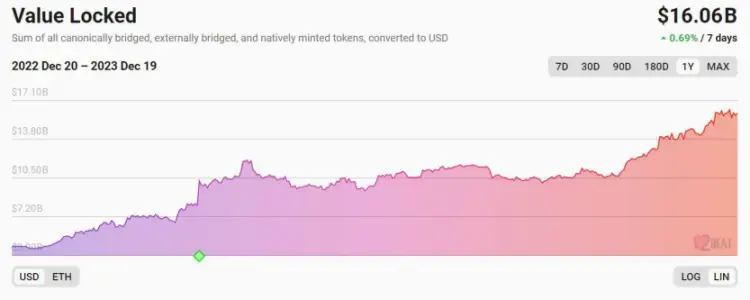
Ethereum L2 activity is continuing to grow and has now reached an all-time high. According to recent data from L2Beat, the total value of the entire ecosystem is $16 billion.
**The current L2 is mainly EVM compatible, such as Arb, OP, Metis, etc. In addition, non-EVM L2s such as Eclipse and Flyent are being launched, bringing new types of applications and developers. **Crypto games will be mainly based on the L2 ecosystem, and wallet user experience will continue to improve, allowing the Ethereum ecosystem to absorb more new users.
Finally, the tokenization of real-world assets has been gaining momentum, bringing more “old world” financial products to the Ethereum blockchain.


