Author: Daniel Li, CoinVoice
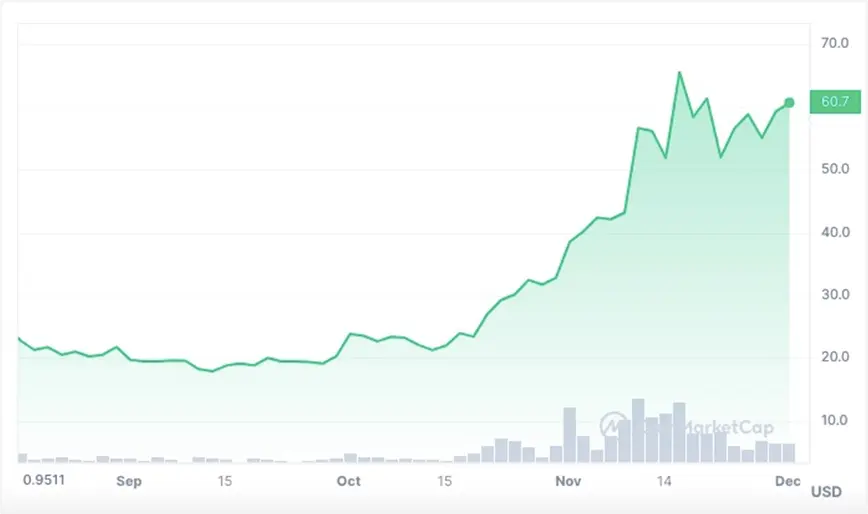
 As a representative of the old public chain, Solana is slowly recovering from the blow of FTX, and with this wave of BTC, the Solana token SOL has also begun to rise strongly, with an increase of 69.96% in the past 30 days, and its rise has exceeded 90% of the tokens. According to CoinCodex’s forecasts, optimistic estimates of SOL are that its price is expected to reach triple digits by the end of 2024.
Solana’s strong rise is partly due to its heavily battered past, with the token price falling from more than $200 to $10 and a severely undervalued market capitalization, and as the impact of the FTX incident slowly fades, Solana has been steadily building up its high-performance blockchain infrastructure, which has reinvigorated investor interest. In addition, the recent outbreak of airdrops in the Solana ecosystem project has also attracted unprecedented attention in the market, and investors are generally optimistic about Solana’s prospects, and Solana may be expected to take advantage of this wave of market to return to the peak of the past.
Solana Sleeping Giant’s Jedi Strikes Back
2022 has been a heavy blow to the entire crypto industry. Countless crypto institutions have frequently thundered, and Solana, as a veteran public chain, has not been spared. Throughout 2022, Solana has faced challenges such as network outages and the collapse of FTX. Solana’s market cap plummeted by about 93%, and the total value locked (TVL) of the network fell by 96%. The price of SOL currency has also experienced a cliff-like decline. Coupled with the recession of the entire cryptocurrency market, the price of SOL fell as low as $8 before barely stabilizing and rebounding. By the end of 2022, people seemed to have lost hope for Solana’s future prospects, with widespread speculation that Solana was about to fall into a death spiral.
However, after entering 2023, Solana did not fall into a death spiral as the public expected, but with a wave of rally in early BTC, SOL stabilized from a low of $7.85 and gradually climbed. In the first quarter, SOL stabilized above $20. Although there has been a sharp pullback in the BTC since then, the price of SOL has been stable around $20. It wasn’t until October that the market entered a large-scale rally, and the SOL began to continue to rise, with its increase once exceeding $60 and rising as high as $68.25. The price of the SOL has increased almost 8 times compared to the low of $7.85 at the beginning of the year, and the price of the SOL token is currently $61.
 The strong resurgence of the Solana token has also caused investors who had no expectations for Solana to turn to a frenzied hoarding of SOL. In this wave of rise, Koreans, a group of people who are keen to speculate on coins, also played an important role. According to reports, in the past few months, the South Korean won has been in second place behind the US dollar in SOL fiat currency trading pairs, with 12.3%. And on the Korean exchanges Bithumb and Upbit, SOL are quoted at $64.34 and $63.61, respectively, both higher than the global average price of $61.80 per unit. This shows the crazy enthusiasm of Koreans for buying SOL. SOL once held the No. 1 position in the trading volume of Upbit, the largest crypto exchange in South Korea, accounting for 7.65% of the exchange’s total trading volume.
The change in the market’s attitude towards Solana, in addition to the amazing increase in its token over the past year, is more about seeing a series of measures taken by the project party to revive Solana in the past year. These measures have put the market back on Solana and attracted the attention of investors who had lost their expectations for it.
Why Solana is on the rise again
Solana’s strong recovery is inextricably linked to its strong leadership. Solana’s co-founder, Anatoly Yakovenko, has nearly two decades of experience building high-performance operating systems, and his technical expertise has built a solid foundation for Solana’s success. Yakovenko has been widely praised for developing “PoH (Proof of History)”. Another co-founder, Solana Raj Gokal, is also a well-known figure in the tech industry. They all have confidence in Solana and believe that it has the potential to become the “Apple” of the crypto world.
It is precisely because the founders of Solana are full of confidence in its future and still insist on promoting Solana’s continuous improvement and innovation in the field of technology when the market is no longer optimistic about Solana, which has led to the current strong recovery of Solana.
 **In 2023, Solana has introduced a range of new technologies to boost its blockchain performance and advance applications. **
State Compression Technology: Solana introduced state compression technology with the aim of improving the performance of blockchains, reducing transaction fees, and enhancing the tradability of NFTs. The technology hashes the transaction data in the Solana ledger and validates the Merkle tree account for application in smart contracts. This means that compressed NFTs can be created on-chain in a similar way, but at a fraction of the cost. The state compression technology provides Solana with higher throughput and lower transaction costs, attracting more interest from users and developers.
Compressed NFT Technology: Solana has launched compressed NFTs, a technology that will change the way the crypto market thinks about NFTs and bring new use cases that previously seemed impossible. By compressing NFTs, NFT creators only need to mint 100 million NFTs at a price of 50 SOL. This has significant implications for market participants. In fact, compressed NFTs make it easier for game studios to mint every item or character in a game into an NFT, and social media platforms can also more easily distribute NFTs to each user. In the future, we may see billions of physical assets circulating on the blockchain. The introduction of compressed NFT technology has driven the growth of the NFT marketplace and expanded the application of the Solana ecosystem.
Neon EVM: Solana has launched Neon EVM, a ETH-based Virtual Machine (EVM)-compatible solution that enables developers to run ETH-based smart contracts in the Solana ecosystem. The introduction of the Neon EVM gives ETH developers more choice and flexibility to run their smart contracts directly on Solana without changing code. This has facilitated the migration of developers and the growth of the Solana ecosystem.
Solang: Solana has also launched Solang, a tool for writing smart contracts on the Solana blockchain. Solang supports programming languages such as Rust and C, giving developers more options. Developers can use Solang to write efficient and secure smart contracts and deploy them on the Solana blockchain. The launch of Solang further improves Solana’s developer friendliness and usability, attracting more developers to the Solana ecosystem.
In addition to continuous innovation in the field of technology, Solana has invested more energy and money than ever before to promote the innovation and development of ecological projects. In 2023, the Solana Foundation launched a series of growth programs, such as Convertible Grants and AI Grant Funds, to provide support and investment to projects within the Solana ecosystem. Through these programs, the Solana Foundation encourages and incentivizes the development of innovative projects and provides them with funding and resources.
In addition, the Solana community is playing an active role, with community members promoting Solana’s growth by promoting, participating, and contributing to the code. The increased community focus has attracted more developers and users to Solana and contributed to the growth of the ecosystem.
In addition, Solana has also begun to focus on strengthening its partnerships with key players in the crypto ecosystem, providing diverse use cases for the ecosystem through strategic alliances, and driving further innovation in the cryptocurrency space. In 2023, Solana has added several new strategic alliances, including Chainlink (LINK), Serum (SRM), ChainSafe, Sabre Lab, Bonfida, Raydium (RAY), and more. The establishment of these strategic alliances has brought more opportunities for Solana to collaborate, expand its reach in the cryptocurrency space, and provide more support and synergies for the development of the ecosystem.
Airdrop is coming, the Solana ecosystem may usher in an explosion
Solana’s strong recovery has sparked investors’ desire for the SOL of its token, but this strong demand has not led to an explosion of liquidity in the Solana ecosystem. Compared to SOL’s staggering increase, Solana’s total value locked (TVL) increase was not satisfactory. Solana’s dollar-denominated total value locked (TVL) is up 200%, which looks impressive, but is still below the $10 billion trough before the collapse of FTX, and for SOL-denominated TVL, it’s actually down 45% this year, highlighting the limited liquidity of the project’s ecosystem.
Liquidity is crucial to the development of the ecosystem, after realizing the problem of insufficient liquidity, the Solana ecosystem has also taken a series of measures, just in the past month, a number of important projects have announced airdrop plans, airdrops are undoubtedly the most direct way to attract traffic, the following is a brief introduction to these projects:
Jupiter
Jupiter is the first transaction aggregator on the Solana chain and aims to provide users with the best exchange rates and the best DeFi exchange experience for users and developers by integrating all major liquidity markets on the Solana blockchain. The project was launched on the Jupiter mainnet on October 13, 2021, and has been continuously optimized and improved based on user feedback and experience since its launch, adding more DEX paths on the Solana chain. At present, Jupiter’s official website has supported mainstream DEXs on Solana chains such as Orca, Raydium, Serum, Mercurial, Saber, and Dexla.
 On November 22, 2023, Jupiter Exchange launched a community airdrop program for JUP tokens. The program will airdrop a total of 1 billion JUP tokens to eligible 955,000 Solana wallets. The airdrop will take place via a Solana wallet address, and each eligible Solana wallet will receive 1,050 JUP tokens. Jupiter Exchange plans to conduct 4 rounds of airdrops, and the number and proportion of tokens in each round will be adjusted based on community feedback and market conditions. In addition, Jupiter Exchange also announced that it will give away exclusive NFTs to early members of the project, and will prioritize the distribution of tokens to Jupiter’s users and early supporters of the community at the time of token issuance.
With the launch of the airdrop program and the issuance of NFTs, Jupiter Exchange is poised to further build its community and create a thriving ecosystem around the project. With a focus on community engagement and user experience, the project is expected to drive widespread adoption and become a leader in the Solana-based DEX space. Through continuous development and innovation, Jupiter Exchange will make an important contribution to the development and promotion of the Solana ecosystem.
Jito
Jito is an important project in the Solana ecosystem that aims to solve the MEV (Best Executor Value) problem on the Solana chain and reduce failures caused by congestion on the Solana chain. It offers a staking product, but unlike other liquid staking protocols, Jito not only offers staking rewards, but also additionally rewards MEV. Jito’s team also focuses on the MEV track, and has launched a third-party validator client Jito-Solana on Solana, which can effectively obtain MEV benefits in the Solana network, reduce invalid transaction dust attacks, and reduce the risk of failure of the entire public chain of Solana.
 On November 28, Jito announced that it would launch a token airdrop on January 1, 2024. According to the plan, Jito will issue the governance token JTO and use 10% of the total amount for community retroactive airdrops. This airdrop will play a key role in Jito’s community governance. Users who hold JTO tokens can participate in setting fees for the JitoSOL stake pool, control the StakeNet parameter update delegation strategy, manage the JTO token’s DAO vault and JitoSOL’s earnings, and contribute to the enhancement of the Jito Network.
The total amount of JTO is 1 billion, of which 10% will be airdropped retroactively by the community. The airdrop targets include users who hold JitoSOL, Solana validators running the Jito-Solana MEV client, and users who actively use Jito Network’s MEV program. The breakdown of the distribution is as follows: community growth (34.3%), ecosystem development (25%), investors (16.2%), and core contributors (24.5%).
This airdrop plan is of great significance to Jito. First, it strengthens Jito’s community governance, allowing token holders to participate in important decisions and drive the project’s growth and growth. Second, the airdrop program attracts more users and validators to Jito, increasing the project’s community engagement and security. In addition, Jito’s airdrop also has a positive impact on the Solana ecosystem. It plays an important role in facilitating liquidity and trading activity on the Solana chain, providing users with better staking yields and additional MEV rewards. This will further promote the development of the Solana ecosystem, attract more projects and users to join, and increase the prosperity of the entire ecosystem.
Pyth Network
Pyth Network is a decentralized oracle project built on the Solana blockchain. Its goal is to aggregate off-chain financial data onto the blockchain, providing high-quality and high-fidelity data for the DeFi and traditional financial sectors. The project has received support from numerous institutional investors and has worked with some top partners such as GTS, the largest market maker on the New York Stock Exchange, institutional trading platforms LMAX, FTX, and Chicago Exchange, among others.
 In order to promote the development and decentralization of Pyth Network, the project announced an airdrop plan on November 20, 2023. The airdrop will last for 90 days, and the open collection time is 22:00 on November 20, 2023, and the airdrop collection page is valid until February 18, 2024. The airdrop program is an extensive cross-chain airdrop that covers more than 90,000 wallet addresses on 27 chains. All community members who contribute to the Pyth Network ecosystem, as well as individual users who use Pyth data, are eligible to participate.
Pyth Network’s airdrop program will incentivize the community to participate in on-chain governance and drive the project towards a decentralized, self-sustainable, and permissionless state. As an oracle network in the Solana ecosystem, the growth of Pyth Network will also improve the sustainability and decentralization of the Solana ecosystem, attracting more participation and attention.
Source: CoinVoice Original


