Bitcoin ETF As an asset that tracks the price of Bitcoin, there is no need to go through the process of buying Bitcoin, such as registering on a trading platform and passing various verifications, by investing in a Bitcoin ETF, users can profit from the gains of Bitcoin. The first Bitcoin ETF was a futures ETF, the ProShares Bitcoin Strategy ETF (BITO). There are no real Bitcoin spot ETFs yet.
Grayscale filed an application to convert GBTC to a Bitcoin spot ETF with the SEC through NYSE Arca last October. Its CEO, Michael Sonneshein, has said that if the Bitcoin spot ETF application is rejected by the SEC, there is a good chance that the SEC will take legal action. The reason for this is that Grayscale’s "Bitcoin spot ETF is no different from the Teucrium Bitcoin Futures ETF that has been approved by the SEC. The SEC’s approval principles should not be inconsistent. 」
As the July 6 deadline for the U.S. SEC to approve or reject Grayscale’s Bitcoin spot ETF application approaches, Grayscale CEO Michael Sonnenshein has issued an open letter to investors hiring former U.S. Deputy Attorney General Donald B. Verrilli, Jr. as a senior legal strategist. Grayscale also said at the Consensus 2022 conference in Austin, Texas, that they are optimistic that the spot bitcoin ETF will eventually receive SEC approval soon.
Today, however, the SEC has denied Grayscale’s application to convert its GBTC to a Bitcoin spot ETF, saying that the application failed to answer the SEC’s questions about fraud and manipulation prevention, among other concerns.
FTX. U.S. CEO Brett Harrison talks about the reasons for the rejection
FTX. The US CEO conducted an analysis of the reasons for the SEC’s rejection of the Grayscale spot ETF application:
The SEC has approved BITO, Proshares, and other futures ETFs,**These Chicago Mercantile Exchange (CME)-based futures ETFs have adequate anti-manipulation protections. **
CME’s Bitcoin futures settle at the CF benchmark Bitcoin Reference Rate (BRR), which is made up of the spot price of Bitcoin on eight global cryptocurrency exchanges. However, the SEC rejected spot ETFs that used the same BRR to calculate NAV due to manipulation concerns. The reality is paradoxical: the U.S. Commodity Futures Trading Commission (CFTC) has approved BRR-based BTC futures, and the SEC has approved BRR-based futures ETFs, but the SEC has refused to allow ETFs to settle directly on BRR.
The SEC has broadly rejected spot ETFs,** because the spot market is not licensed under the U.S. federal regulatory regime. There are three main situations:**
· ETFs such as EWJ (iShares MSCI Japan) contain financial instruments that are regulated in non-US jurisdictions. Bitcoin is regulated in many non-US jurisdictions and is traded on regulated exchanges in non-US jurisdictions.
· ETFs such as HYG (iShares High Yield Corporate Bonds) contain debt instruments that are not traded on any licensed exchange.
· ETFs such as FXE (Invesco Euro Trust) contain fiat currencies and do not have a market regulator.
**The SEC has raised concerns in past spot ETF rejection decisions that the spot market does not yet have sufficient liquidity or trading volume. **However, many corporate bond ETFs, such as HYG, have a median trading volume of single digits per day.
Ironically, approving a spot Bitcoin ETF will bring greater regulation to the Bitcoin spot market and help achieve many of the SEC’s stated goals for spot cryptocurrency. **A significant portion of the liquidity of existing institutions, as well as the capital of a large number of new participants, will go into these investment vehicles that are primarily traded on SEC-regulated securities trading platforms. The oversight-sharing agreement between the fund issuer and the spot trading platform will also allow the SEC to exercise greater oversight of market activity, further ensuring the integrity and proper functioning of the spot order book.
Discussions on Grayscale Bitcoin Spot ETF and Regulation
Bloomberg crypto columnist Katherine Greifeld
Bloomberg’s crypto columnist Katherine Greifeld writes that Grayscale is doomed to fail regardless of whether the SEC approves its application for a GBTC-to-spot ETF (which the SEC has not vetoed at the time of publication). Because even if the SEC agrees, GBTC’s current 2% user management fee will not work in the ETF market, in the case of the ProShares Bitcoin Strategy ETF (BITO), which has an expense ratio of 0.95%. And once Grayscale gets caught up in a price war, its annual management fee income of about $230 million will be greatly reduced.
Perianne, Founder, Chamber of Digital Commerce
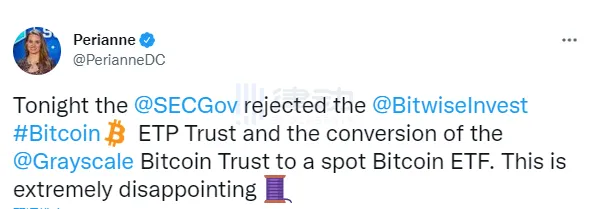
Perianne, founder of Chamber of Digital Commerce, said that over the past few years, the SEC has received a large amount of data proving that a substantial and regulated market surveillance framework has developed around BTC transactions. With an estimated 16% of Americans holding cryptocurrency, the BTC spot ETF will provide U.S. investors with the opportunity to invest in Bitcoin under the protection of U.S. securities laws. Moreover, well-regulated jurisdictions like Canada and Australia have adopted BTC spot ETFs for retail investors. The SEC’s decision is really “disappointing”.
Ryan Selkis, founder of Messari
Ryan Selkis, founder of Messari, said that a “winning” lawsuit and eventual ETF conversion would reduce Grayscale’s revenue by more than 50%. ETFs will imply an open redemption window and potentially lower fees to preserve AUM. This means that DCG will lose more than $200 million in profits per year.
Selkis believes that the SEC is unlikely to agree to Grayscale’s conversion of GBTC to an ETF at least during Gary Gensler’s tenure. This is partly related to the premium harvest transactions that occurred when GBTC was trading at a premium rather than at a discount, when Three Arrows Capital took advantage of extremely high leverage.
Interestingly, the chances of the SEC blocking Grayscale out of sheer malice are not zero, as they don’t want to reward what they perceive as bad behavior. The bad grayscale trade, which was the first step on Three Arrows’ path to bankruptcy, held a large stake in GBTC in a leveraged manner – at one point as much as 6% of the trust. The most prudent and realistic way to “fix” GBTC is through the so-called Regulation M exemption.
Disclaimer: The information on this page may come from third parties and does not represent the views or opinions of Gate. The content displayed on this page is for reference only and does not constitute any financial, investment, or legal advice. Gate does not guarantee the accuracy or completeness of the information and shall not be liable for any losses arising from the use of this information. Virtual asset investments carry high risks and are subject to significant price volatility. You may lose all of your invested principal. Please fully understand the relevant risks and make prudent decisions based on your own financial situation and risk tolerance. For details, please refer to
Disclaimer.


