BlackRock, one of the world’s largest asset management giants, filed a filing application for a spot bitcoin ETF with the SEC this morning through its subsidiary iShares, which shows that the fund is named “iShares Bitcoin Trust” and its assets are “primarily composed of bitcoin held on behalf of the trust’s custodian”.
Some people believe that BlackRock is applying for a trust, but it is different from the trust fund issued by Grayscale, it is more flexible and can be redeemed, and another view is that BlackRock is applying for an alternative structure ETF, which represents a publicly listed Bitcoin trust fund stock, which is completely different from a financial instrument like GBTC, but more like A number of well-known ETF funds managed by GLD and BlackRock’s iShares.
Is BlackRock applying for a spot ETF or a trust, what are the arguments of analysts, investors, and professionals from the crypto industry?and what are the definitions, key differences, investment risks, and pros and cons of ETFs and trusts from a traditional financial perspective?
Is BlackRock applying for a trust?
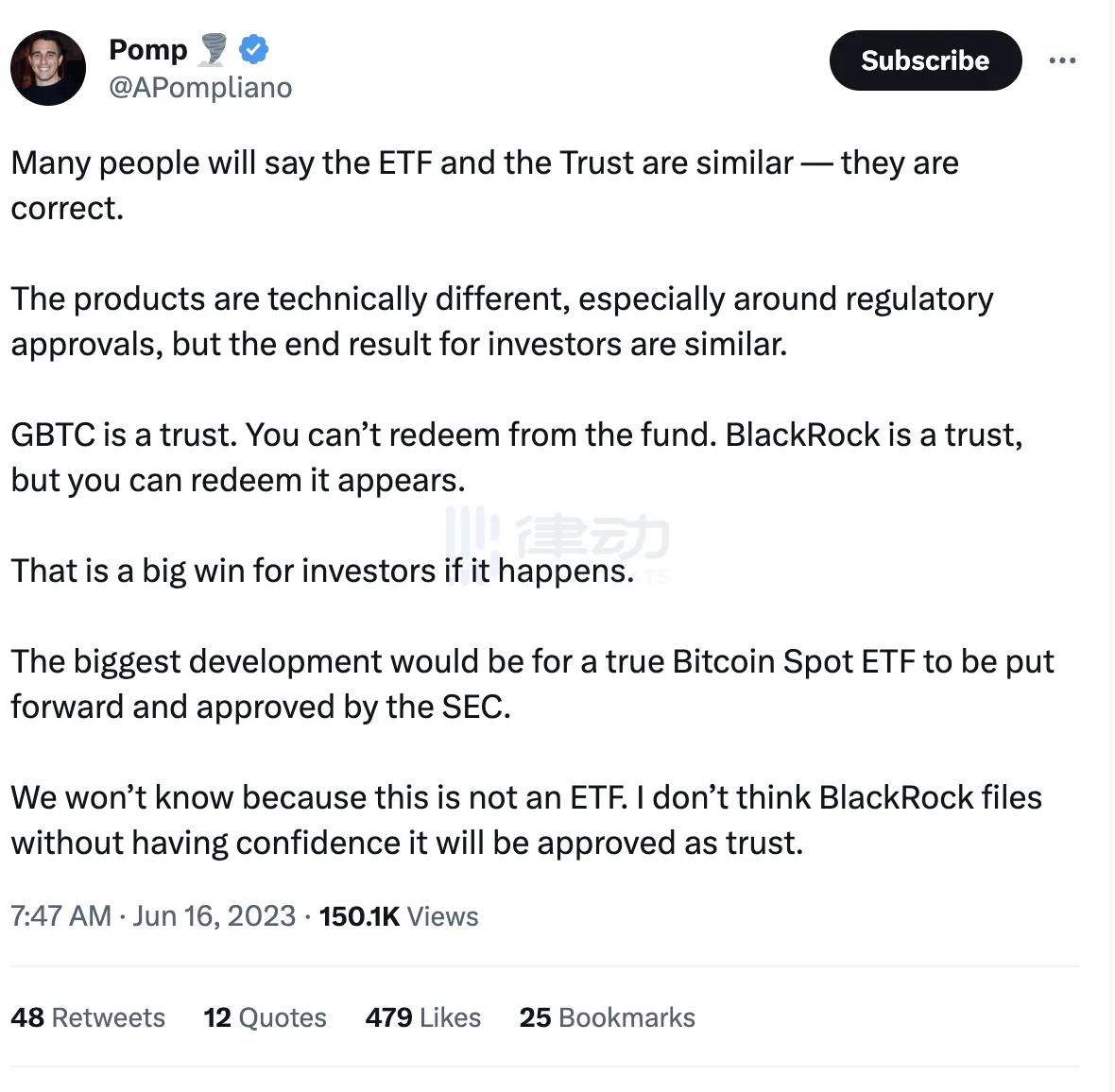
Anthony Pompliano, an investor at Pomp Investments, believes BlackRock is applying for a trust, not a Bitcoin ETF. While the two are technically different, especially when it comes to the regulatory approval aspect, for investors, the outcome is the same. Anthony Pompliano tweeted that GBTC is a type of trust, so you can’t redeem it from a fund. BlackRock is also a type of trust, but you can redeem it. If the application is approved, it is a huge win for the investor. The biggest upside, though, remains that a genuine Bitcoin spot ETF has been approved by the SEC.
Joey Campbell, account manager at SCRIB3, a Web3 technology marketing studio, also believes that BlackRock is submitting a trust, tweeting, "At the moment some of us are shocked by the nomenclature of ‘trust’ and ‘ETF’, and some say it doesn’t make a difference. The reason the “trust” keeps everyone on high alert is because Grayscale’s Bitcoin trust is currently trading well below its net asset value. This is because investors cannot redeem their own holdings for BTC. Non-redemption means that it cannot be bought at a discount in the market and arbitrage cannot be sold. This is different from BlackRock’s trust fund. 」

"As described in this prospectus, you’ll see Authorized Participants (APs), one of the main participants in the redemption mechanism of exchange-traded funds (ETFs), which are essentially providers of ETF liquidity and can change the supply of ETF shares in the market. ) provides block fund shares for continuous redemption/creation, which means that the trust’s APs can redeem/create the fund at any time throughout the day. 」
"For example, if 40,000 BTC (1 “block”) is worth $40 million based on the current price of BTC, the fund shares are calculated as 40,000 BTC and about $39 million. Then, the AP authorized participants can make a profit of 1 million by buying the shares, redeeming the 40,000 BTC held by the trust, and then selling them. 」
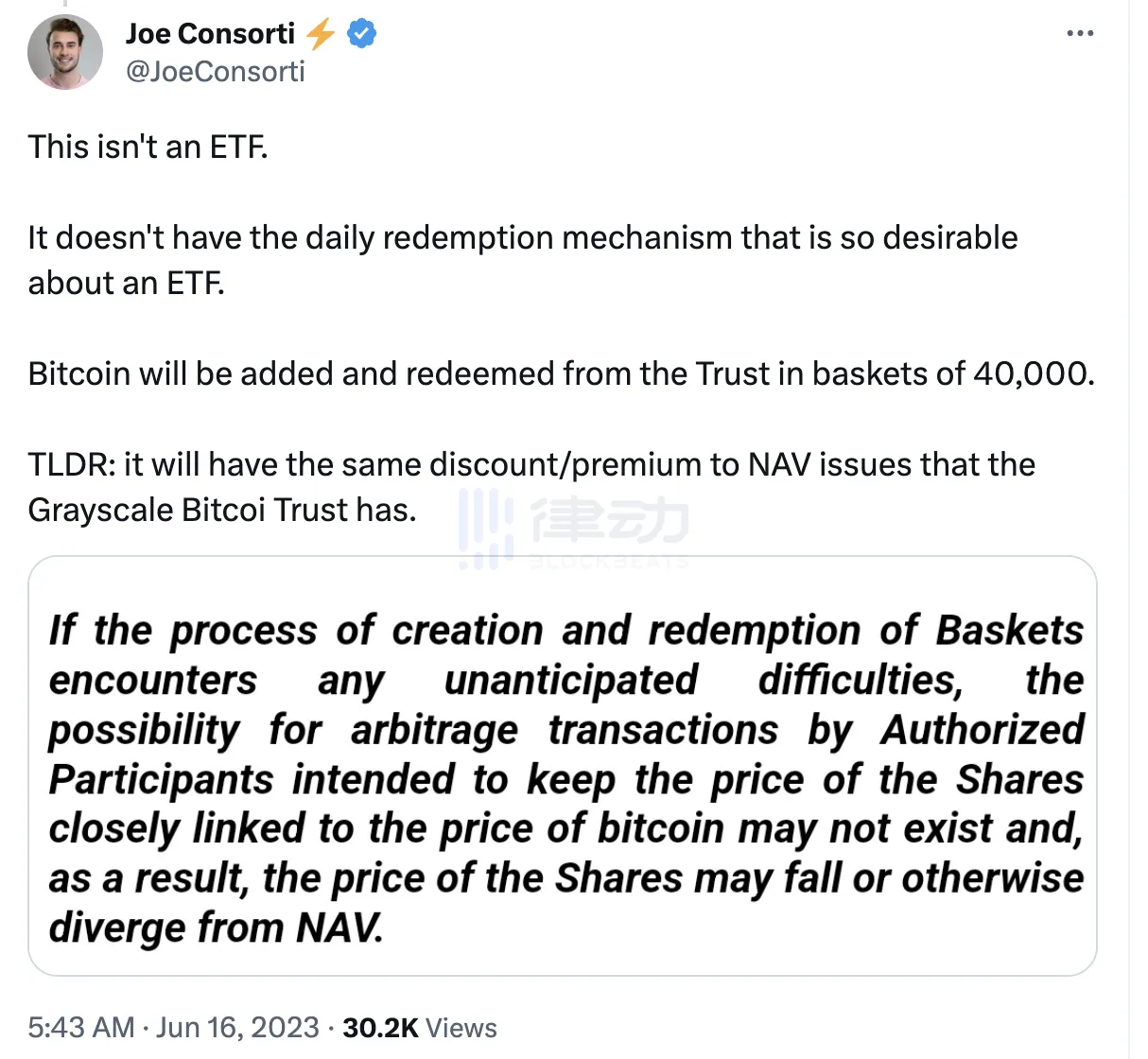
Another person who held the same view was Joe Consorti, market analyst at The Bitcoin Layer, who tweeted, "This is not an ETF, it’s a trust. Because it does not have the daily redemption mechanism that an ETF has, it will be added and redeemed from the trust in the form of 40,000 BTC per basket. It creates similar NAV premiums and discounts to the Grayscale Bitcoin Trust. 」
Another view: BlackRock is an ETF
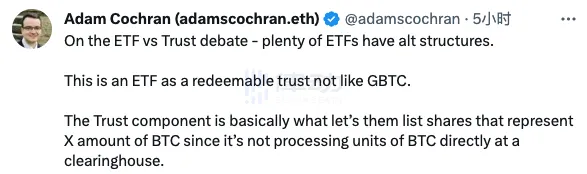
Adam Cochran, a partner at CEHV, believes that BlackRock is applying for an ETF, but many ETFs have alternative structures. Unlike GBTC, BlackRock is applying for an ETF in the form of a redeemable trust, which represents a publicly listed share of a Bitcoin trust, rather than dealing with units of a Bitcoin asset directly through liquidation.
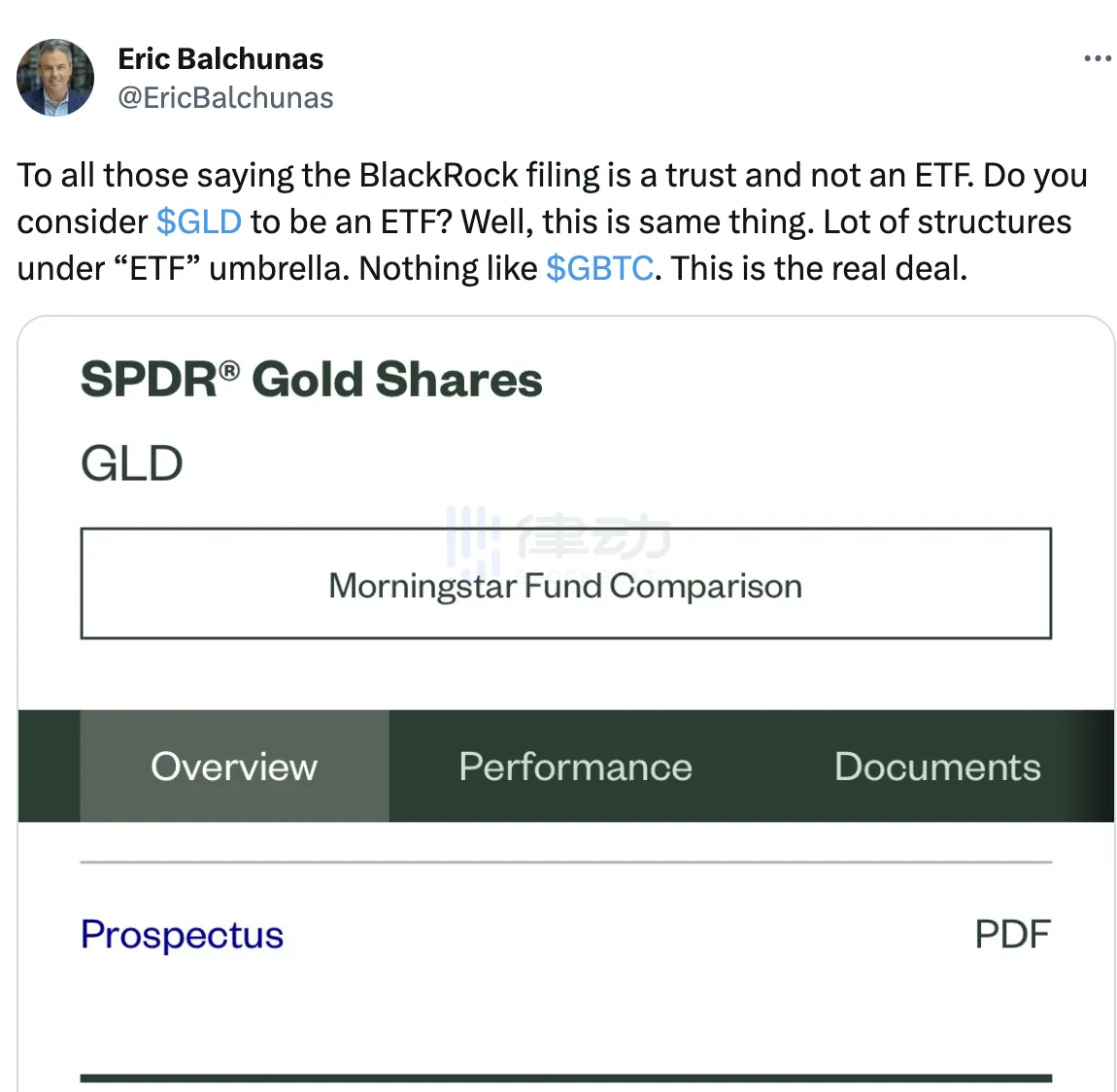
Eric Balchunas, a senior ETF analyst at Bloomberg, believes it’s an ETF and tweeted, "For those of you who think BlackRock is applying for a trust and not an ETF, I want to ask, do you think $GLD is an ETF? There are many different structures under the “ETF” asset class. It’s not at all the same as $GBTC. 」
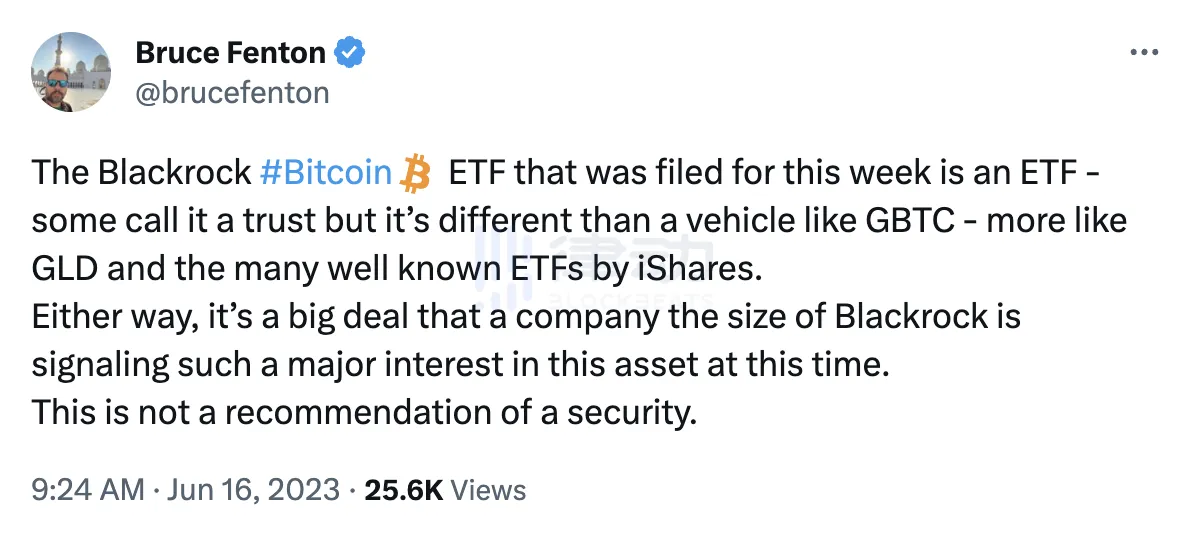
Bruce Fenton, CEO of Watchdog Capital, an SEC-registered broker-dealer, believes that BlackRock is an ETF, which some people think is a trust, but it is different from financial instruments such as GBTC, and is more like a number of well-known ETF funds managed by GLD and BlackRock’s iShares.
Considering that BlackRock is not applying for a trust in the traditional sense, and does not fully meet the definition of an ETF, we will list the customizations and key differences between an ETF and a trust below.
What is the difference between an ETF and a trust?
An ETF is an investment fund that trades on a stock exchange like a single stock and is a type of security that holds an underlying investment such as a commodity, stock, or bond. It is often similar to a mutual fund in that it is jointly managed by the issuer. ETFs are designed to track the performance of a specific market index, sector, or asset. When investors buy ETFs, they are buying shares in the underlying portfolio of assets such as stocks, bonds, or commodities. One of the benefits of investing in ETFs is that they have easy access to a diversified basket of securities. ETFs are also typically low in cost compared to other types of investment vehicles.
Whereas, an investment trust is a closed-end investment fund that is listed on a stock exchange. These trusts are managed by a professional fund manager who is responsible for the funds held in the investment trust. The fund manager will use the money to buy a portfolio of assets such as stocks, bonds, or property. The stock price of an investment trust is determined by the value of the assets held in the trust.
Overall, one of the main differences between ETFs and investment trusts is their structure. ETFs are open-ended, which means that the number of shares available can increase or decrease depending on demand. Investment trusts, on the other hand, are closed-ended, which means that there is a fixed number of shares available.
In addition, ETFs can be bought and sold on the stock exchange throughout the trading day, just like individual stocks. However, investment trusts only trade once a day at the end of the trading day. At the same time, the cost structure of ETFs and investment trusts is different. ETFs typically cost less than investment trusts because they are designed to track an index and require less active management. Investment trusts, on the other hand, are actively managed, so they may have higher fees.
In the crypto space, Grayscale’s GBTC Trust is the absolute leader in the cryptocurrency market, with over $35 billion in assets under management. The structure of the investment trust is corporate – at least in regulatory form – and is a “closed-end fund”. As a result, the number of stocks available is limited, and their supply and demand largely determine their price.
GBTC shares are not easy to create and do not have an aggressive redemption plan. This tends to have a significant price difference from its net asset value. ETFs, by contrast, allow market makers to create and redeem shares at will. Therefore, if there is sufficient liquidity, there will usually be no premium or discount. ETF instruments are more acceptable to mutual funds and pension funds because it takes on much less risk than closed-end trusts like GBTC.


