Stablecoin issued by PayPal
On Monday, PayPal launched its latest ERC-20 stablecoin, PYUSD. Like major stablecoins, PYUSD is pegged to the U.S. dollar, can be exchanged 1:1 with the U.S. dollar, is backed by short-term U.S. Treasuries, cash, and other equivalents, and is subject to monthly reserve reports that are audited by accountants. According to PayPal, this asset is mainly to simplify online virtual transactions and make it easier for developers to receive funds directly. This attempt marks the first exploration of this aspect by a major U.S. financial firm.
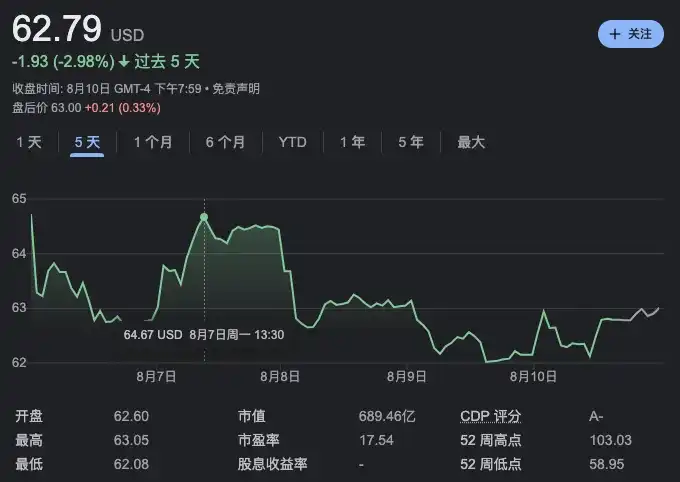
After the news was made public, PayPal’s stock price rose more than 2% to a high of nearly $65, but the next day, the stock quickly fell from around $65 to $62.65 and is now trading at $62.79.
According to PayPal’s website, eligible US PayPal PayPal customers will be able to:
Transfer PayPal USD between PayPal and compatible external wallets;
Peer-to-peer payments with PYUSD;
Choose to pay with PayPal USD at checkout;
Convert between any cryptocurrency supported by PayPal and PayPal USD.
Dan Schulman, President and CEO of PayPal, said: "The shift to digital currencies requires a stable tool that is both digitally native and easily linked to fiat currencies such as the US dollar. Our commitment to responsible innovation and compliance, as well as our proven track record of delivering new experiences to our customers, provide the necessary foundation for PayPal USD to drive digital payments growth. 」
Code for PayPal stablecoin
This week, there has been a lot of talk about PYUSD’s “commercial impact and impact on existing stablecoins”. Here, Odaily would like to take a closer look at PYUSD from the point of view of its technical characteristics.
After PayPal’s news release, Bitcoin’s official Twitter account @Bitcoin posted a message: What do you guys think of this code in PayPal’s stablecoin?
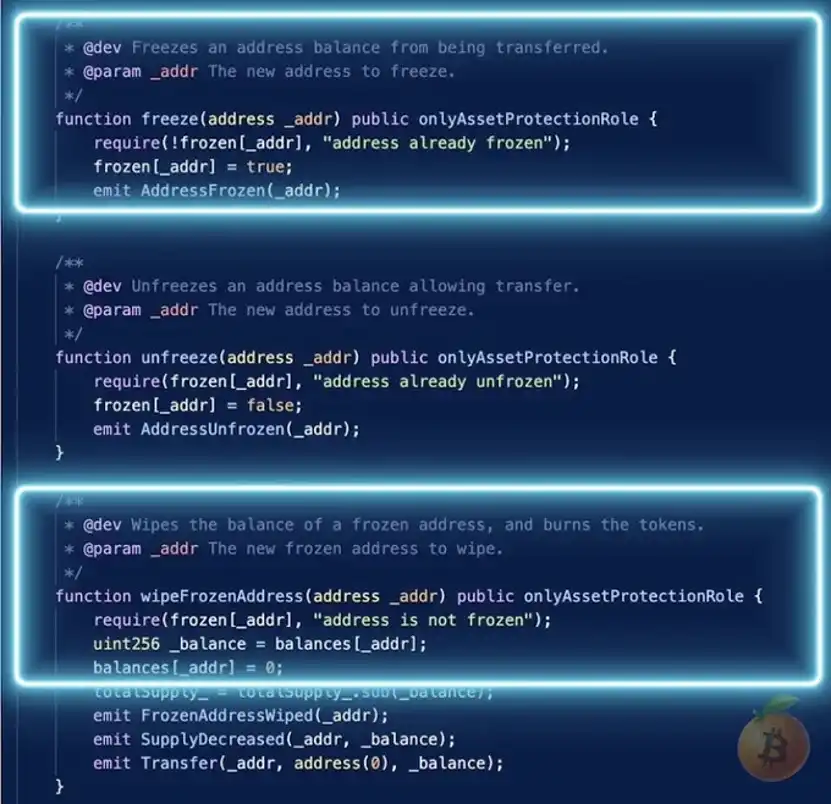
As you can see, in the highlighted part of the diagram, two functions appear: Freeze and wipeFrozenAddress. That is to say, PayPal can officially freeze or unfreeze the wallet address that the company believes is malicious through centralized operations, and can also clear all assets in this address. Although block generation cannot be changed, PayPal can still use this code to effectively prohibit certain transactions or freeze assets in certain addresses.
In other words, centralized authorities can do a lot of things that were previously impossible on the blockchain, and even though this permission can avoid many scams and hacks in the crypto world, this is traditionally seen as a violation of the decentralized spirit of the blockchain and the crypto world.
Similarly, Twitter user @0x Cygaar posted a tweet revealing more about the centralization of the PayPal stablecoin:
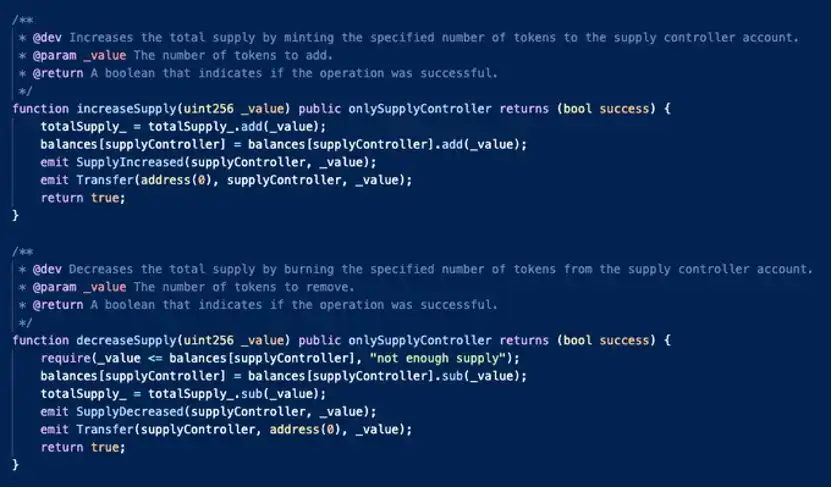
"So this PayPal stablecoin contract:
Written in a very old version of Solidity;
Allow the owner to suspend all transfers;
Allow the owner to freeze the address to block the operation;
Allow administrators to increase/decrease supply at will;
At least centralized, but fairly transparent. 」
For a long time, the cryptocurrency world has advocated the principle of decentralization, believing that digital currencies should be free from the central control in the traditional financial system and achieve true freedom and justice.
Looking at the above functions of PYUSD, it may be reasonable to increase or decrease the maximum supply: if users continue to buy or mint more PYUSD with more USD assets until the maximum supply is exceeded, then there should be an increase or decrease in supply. However, compared with similar compliant stablecoins such as USDC, PayPal’s dual role as an issuer and trading platform gives it the ability to tentatively transfer and freeze addresses.
Reactions
The related review of the PayPal stablecoin code has caused quite a wave in the crypto world. In the comments section of the two tweets mentioned above, many crypto users expressed their concerns, with many commenting that “this is how classic Web2 companies work”, and keywords about regulation and centralization kept appearing.
Twitter user @mdhaf.eth said: "PayPal has long been known for its actions to freeze accounts without user permission, often because of internal policies or outside influences. This (PYUSD) may make more people aware of crypto assets, but most people don’t think deeply about the code behind them or the ethical standards of the company. This is not surprising, but it is indeed disappointing. 」
But at the same time, a significant number of people disagreed: user @LawLingo said, "It’s a common thing. $UDST, $USDC, and $USDD also have this feature. Any acceptance of cryptocurrencies is good. She believes that there should be mass adoption before decentralization can be realized. Upon review, Circle wrote in the terms on its official website that under certain circumstances, USDC may refuse to process a transaction or suspend a user’s service “if we reasonably believe that the transaction is suspicious and may involve fraud or misconduct.” However, Circle also explicitly states that “all transactions made through the USDC service are irreversible and non-refundable.” In contrast, PayPal’s authority over PYUSD and control over the PayPal platform is significantly greater and more centralized.
Disclaimer: The information on this page may come from third parties and does not represent the views or opinions of Gate. The content displayed on this page is for reference only and does not constitute any financial, investment, or legal advice. Gate does not guarantee the accuracy or completeness of the information and shall not be liable for any losses arising from the use of this information. Virtual asset investments carry high risks and are subject to significant price volatility. You may lose all of your invested principal. Please fully understand the relevant risks and make prudent decisions based on your own financial situation and risk tolerance. For details, please refer to
Disclaimer.


