The explosion of Kaspa has made many people pay attention to the POW track again, and with the narrative bonus of BTC halving next year, the increase in the POW track can be said to be one of the strongest in this cycle.
In this issue, Biteye will bring you [Introduction to Seven Related Projects of the POW Track], so don’t miss it if you’re interested
1Kaspa
2Bittensor
3Dynex
4Conflux
5Zephyr
6Clore. AI
7LiquidLayer
Project: Kaspa
Token:$KAS
MC:$2.87B
@KaspaCurrency is a decentralized Layer1 project based on PoW, with a good team background, the founder is a postdoctoral fellow at Harvard, and his research direction is transaction sequencing and MEV.
Kaspa’s blockchain structure is different from BTC in that it is not a single-chain structure, but a directed acyclic graph (DAG) structure, which can maintain a faster block production speed.
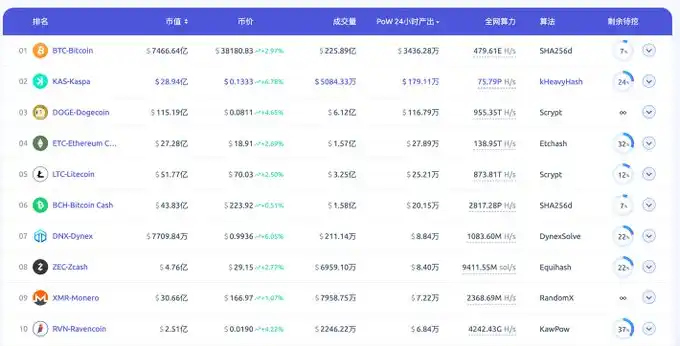
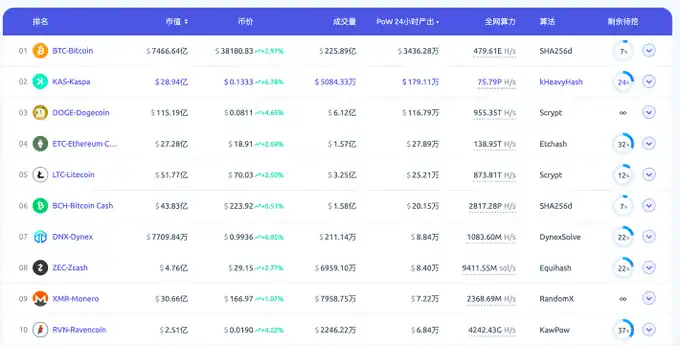
The KAS mining algorithm is kHeavyHash, which supports ASIC mining machine mining.
Due to its recent surge in token price, it currently ranks second in terms of daily output token value, and plans to develop its own Layer1 ecosystem in the future.
Project: Bittensor
Token:$TAO
MC:$1.29B
@bittensor aims to drive the development of AI through a blockchain-powered incentive structure. In this ecosystem, contributors are rewarded with $TAO for their efforts. The network combines a hybrid consensus mechanism of proof-of-work (PoW) and proof-of-stake (PoS) elements.
Bittensor combines PoW with AI, and uses PoW for mining and AI model computation to form a decentralized network of large models.
Miners in Bittensor host AI models and feed them to the network, and validators rank miners based on their “smart contributions”. The network has a 1$TAO reward per block, which is divided equally between miners and validators through mining and validation.
Project: Dynex
Token:$DNX
MC:$78.3M
@dynexcoin is a neuromorphic supercomputing blockchain based on the DynexSolve chip algorithm, proposing a Useful Proof-of-Work (PoUW) method to improve the speed and efficiency of decentralized networks.
Dynex network nodes are made up of PoUW miners, allowing any miner to perform Dynex chip calculations and earn the native token $DNX in return.
It currently ranks 7th in F2Pool in terms of daily output token value.
The project’s token, DNX, uses the DynexSolve mining algorithm and supports GPU mining.
Mining equipment: GPU (NVIDIA & AMD, mainstream GPU (video memory of at least 3GB) is acceptable.
Operating system: Windows, Linux.
Note: The background of this project is somewhat controversial, and its founder’s other projects have been charged by the SEC in 2019.
Project: Conflux
Token:$CFX
MC:$521.4M
@Conflux_Network blockchain is committed to solving the blockchain trilemma using a hybrid consensus mechanism that combines PoW and PoS. By leveraging the strengths of both mechanisms, Conflux is able to achieve a higher level of scalability and security while keeping the network decentralized.
Conflux is also EVM compatible, making it easier for developers to build dApps on the platform.
Conflux ranks 13th in F2Pool in terms of daily output token value.
$CFX The mining algorithm is Octopus, which supports GPU mining, RTX 4090, RTX 3060, GTX 1660Ti, RTX 3070, etc.
Mining equipment: GPU (supports NVIDIA and AMD graphics cards), video memory is recommended to be more than 6GB (the required video memory space increases linearly, increasing by 1~1.5GB per year).
Operating system: Windows, Linux.

Project: Zephyr
Token:$ZEPH
MC:$56.3M
The @zephyr_org protocol is built by Monero and allows each native asset (ZEPH, ZephUSD, and ZephRSV) to inherit Monero’s privacy features. This ensures hidden transaction destinations and amounts, resulting in a private stablecoin protocol.
The Zephyr protocol runs on the RandomX proof-of-work (PoW) algorithm, which aims to optimize general-purpose CPUs and support decentralized and egalitarian mining, with three tokens in its ecosystem: a base coin (ZEPH), a stablecoin (ZephUSD), and a reserve coin (ZephRSV), with which users can mint the latter two. The base coin ZEPH is mined through the PoW algorithm.
Mining tutorial: _started
Projects:
Token:$CLORE
Project: Clore.AI
Token:$CLORE
MC:$31.6M
Clore.AI is an emerging GPU computing power rental platform, and its dual narrative of POW and AI has recently attracted a lot of attention in the market.
Its business model includes artificial intelligence training, movie rendering, VPN, cryptocurrency mining, and other fields, and users can earn $CLORE tokens by renting computing power or providing computing power.
The project adopts the kawpow algorithm and is resistant to ASIC mining. There is no pre-mining and ICO of tokens, 50% of each block is allocated to miners, 40% to lessers, and 10% to teams, and a proof-of-holding system (POH) is proposed to incentivize token holders. In the future, Clore plans to launch more new features such as Clore Storage, VPN service, and more.
Project: LiquidLayer
Token:$LILA
MC:$8.2M
@LiquidLayer is a highly scalable PoW blockchain with an integrated Liquid-Stake-Derivative Bridge, a POW+LSD bonding protocol.
The protocol creates a unique LSD bridge that allows users to transfer funds from Ethereum and earn APY by bridging assets. 90% of the proceeds are returned to bridge tokens and $LILA holders on LiquidLayer.
LiquidLayer’s LSD bridge is designed to seamlessly transfer assets between Ethereum and the LiquidLayer chain.
Assets are transferred to various vaults and stability pools, such as Lido, Frax, RocketPool, and Aave, and are integrated into liquidity providers to optimize yields while maintaining liquidity. Earnings will be automatically transferred to the user’s Ethereum web wallet in the form of USDC.
Those who are interested in the POW track can check the POW token information through the Cryptohunt website below: