Solana’s airdrop season has arrived.
Earlier this month, Oracle network Pyth and DEX aggregator Jupiter launched airdrops, while Solana’s largest tokenless protocol, liquid staking platform Jito, also announced its token on Monday.

These airdrop programs provide wealth to Solana’s DeFi ecosystem, aiming to reactivate the TVL of its Solana ecosystem.
Today, we’re going to talk about the impact of these airdrops and explore whether this is just the beginning of Solana’s airdrop frenzy.
Underperforming TVL
Despite SOL’s 500% price increase this year, Solana’s TVL performance has been relatively weak.
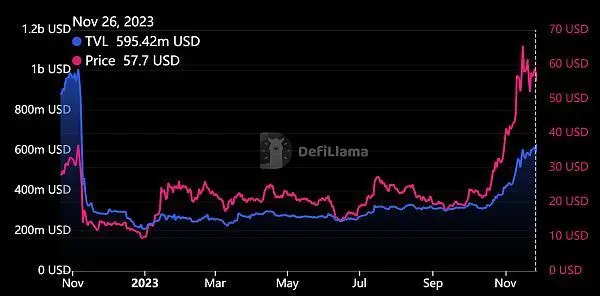
Solana’s dollar-denominated TVL is up 200%, which may seem impressive, but it’s still below pre-FTX levels and has instead fallen 45% this year relative to SOL-denominated TVL.
Solana’s next chapter
The top Solana protocol will distribute tokens to the most active on-chain users via airdrops. As newly acquired token liquidity is injected throughout Solana, the resulting TVL injection will help boost the valuation of the entire Solana ecosystem.
The arrival of the airdrop may not allow TVL to outpace the price increase as the two metrics are positively correlated, but it should exert an upward momentum on both numbers and may be the force that will actually drive SOL-denominated TVL to grow in 2024.
The airdrop’s ability to attract TVL was demonstrated in the rise of Blast, which surpassed Solana’s TVL shortly after the project went live.
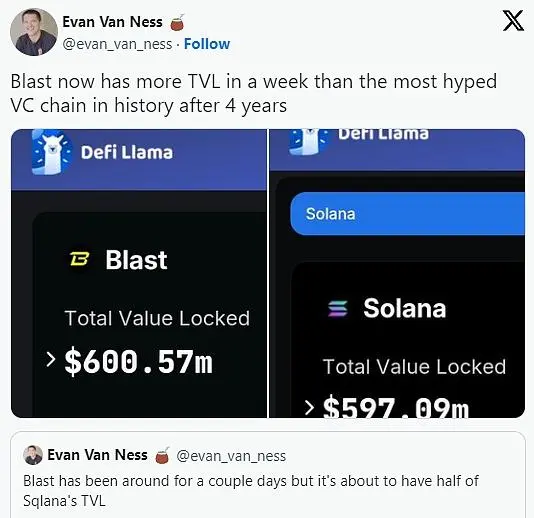
The arrival of the airdrop is a key component of launching Solana Supercycle and one of the easiest ways to onboard users.
Users of the EVM chain are eligible to participate in Pyth’s airdrop. But to claim it, they must download the Solana native wallet to receive their Solana-native assets, which can then be used in the Solana-native DeFi protocol. EVM recipients of PYTH airdrops may represent new users of Solana.
Airdropping tokens can also help bring the project to attention, reminding users and developers that there are great applications on the chain. This goes a long way in seeing Solana as a viable ecosystem and an alternative to Ethereum.
Essentials
Solana’s airdrop season may be the beginning of a rebirth for its DeFi ecosystem, but the outcome is far from certain, and while top projects may be preparing for large-scale airdrops, the number of successful and innovative Solana protocols that can airdrop tokens is handful.
For now, liquidity is still stuck on Ethereum, and protocols like Blast are able to attract hundreds of millions of TVL simply through vague promises and dubious innovations of an airdrop, thus incentivizing developers to develop there. As a result, Solana will have an uphill battle over protocols, liquidity, and user scramble.
With its low-fee environment, global state machine, and ability to provide consensus at the speed of light, Solana promises to open up new application areas that are not possible with Ethereum.
While the hype cycle of the airdrop, and the wealth effect it brings, may be enough to attract new ecosystem participants to Solana and support key stats, to succeed from the airdrop, Solana must nurture its own DeFi ecosystem and be ready to conduct various protocols for airdropping tokens.
Perhaps the airdrop will be the driving force behind another wave of Solana protocols, however, sadly, the depth of the current network, but currently token-free protocols, is quite limited, which significantly diminishes the potential benefits of airdrops to the Solana ecosystem.
Source: Golden Finance
Disclaimer: The information on this page may come from third parties and does not represent the views or opinions of Gate. The content displayed on this page is for reference only and does not constitute any financial, investment, or legal advice. Gate does not guarantee the accuracy or completeness of the information and shall not be liable for any losses arising from the use of this information. Virtual asset investments carry high risks and are subject to significant price volatility. You may lose all of your invested principal. Please fully understand the relevant risks and make prudent decisions based on your own financial situation and risk tolerance. For details, please refer to
Disclaimer.


