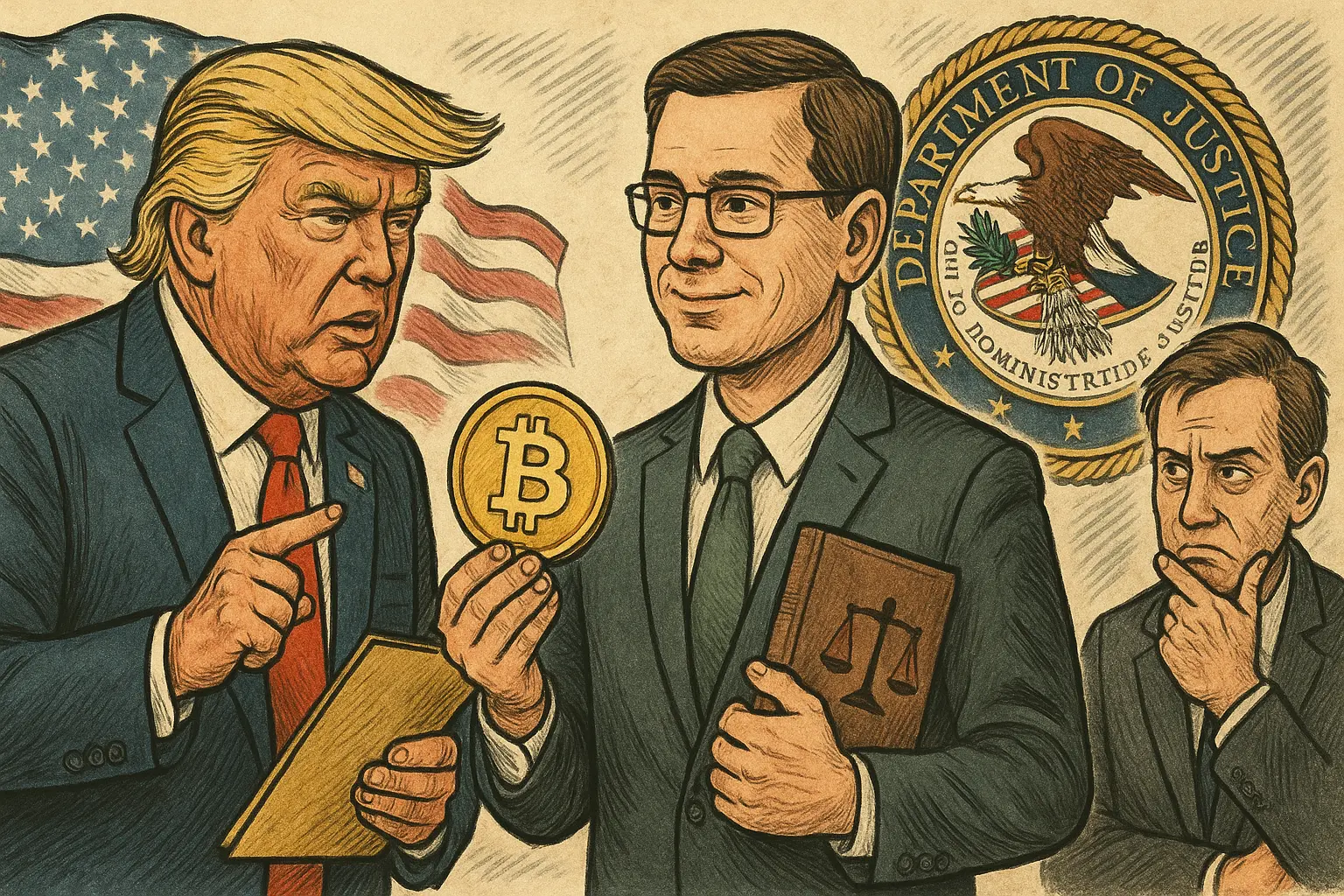
On April 3, U.S. President Trump appointed Deputy Attorney General Todd Blanche (Todd Blanche) as Acting Attorney General. During Blanche’s tenure as Deputy Attorney General, he took the lead in dissolving the Department of Justice’s National Cryptocurrency Enforcement Team, and signed a memorandum instructing that violations of regulatory oversight in the crypto industry would no longer be pursued. At the time he signed the memorandum, Blanche still held crypto assets worth between $159,000 and $485,000, which appears to have violated federal ethics rules and his prior written divestment commitments.
Blanche’s Dual Role: Trump’s Former Private Lawyer and a Driving Force in Crypto Policy
Before Trump’s win in the 2024 presidential election, Todd Blanche had long served as Trump’s private criminal defense attorney, handling multiple criminal prosecutions for Trump in New York. After Trump’s re-election, he appointed Blanche as Deputy Attorney General, and Blanche immediately pushed two policy decisions with far-reaching implications for the crypto industry:
Dissolving the NCET: Ordered the rescinding of the Department of Justice’s National Cryptocurrency Enforcement Team established by the Biden administration in 2022, effectively removing a dedicated federal-level crypto enforcement body
Issuing an enforcement memorandum: Signed a four-page memorandum that clearly instructed federal prosecutors not to pursue enforcement-misconduct cases involving regulatory violations by the crypto industry, providing the industry with policy-level non-pursuit protection as a whole
The above memorandum was directly cited in the case in which the U.S. Attorney’s Office for the Southern District of New York (SDNY) prosecuted Tornado Cash developer Roman Storm, ultimately resulting in one of the charges being dismissed. Storm was still convicted for another offense, but faced a retrial on two other charges.
Signing Enforcement Orders While Holding Crypto: A Timeline of the Ethics Controversy
The core of the ethics controversy centers on a key point in time. When Blanche signed the aforementioned crypto enforcement memorandum, he still held multiple crypto assets, with a total holdings value of roughly between $159,000 and $485,000. The holdings included BTC (Bitcoin), ETH (Ethereum), SOL (Solana), ADA (Cardano), MATIC (Polygon), and QNT (Quant), as well as Coinbase (COIN) stock.
ProPublica’s investigation found that this violated federal ethics rules, as well as Blanche’s prior written commitments to regulators—promising that he would complete the divestment of relevant assets before handling any crypto-related matters.
According to Blanche’s latest U.S. government ethics disclosure filing submitted on July 10, 2025, he had transferred the aforementioned crypto assets to the names of his children and grandchildren. Legal scholars noted that whether transferring assets to immediate family members constitutes “effective divestment” remains a legal gray area under conflict-of-interest determinations.
Frequently Asked Questions
Why did Trump remove Bondy from the position of U.S. Attorney General and appoint Blanche to replace him?
The government has not yet released specific reasons. Blanche assumed the role in an acting capacity; his long-standing private legal relationship with Trump and his strong record of pushing crypto enforcement policies are widely viewed as key background factors for his appointment.
What practical impact did Blanche’s dissolution of the NCET have on the crypto industry?
The NCET (National Cryptocurrency Enforcement Team) is a federal law enforcement agency established by the Biden administration in 2022 that specializes in investigating crypto-related criminal cases. After Blanche dissolved the agency and issued an enforcement memorandum, it effectively reduced the federal enforcement intensity toward regulatory violations in the crypto industry, directly affecting the trajectory of ongoing crypto cases; the Tornado Cash case is a typical example.
Does issuing relevant enforcement orders while holding crypto assets constitute an ethics violation?
According to ProPublica’s report, while holding crypto, Blanche signed an enforcement memorandum involving the crypto industry, violating federal ethics rules and his written divestment commitments. After that, whether transferring the assets to the names of immediate family members constitutes a substantive conflict-of-interest recusal remains to be further clarified at the legal level.
Disclaimer: The information on this page may come from third parties and does not represent the views or opinions of Gate. The content displayed on this page is for reference only and does not constitute any financial, investment, or legal advice. Gate does not guarantee the accuracy or completeness of the information and shall not be liable for any losses arising from the use of this information. Virtual asset investments carry high risks and are subject to significant price volatility. You may lose all of your invested principal. Please fully understand the relevant risks and make prudent decisions based on your own financial situation and risk tolerance. For details, please refer to
Disclaimer.


