Trump gave a speech saying the U.S.-Iran war is an investment in future generations, and he预告 it will end in 2 to 3 weeks. However, oil prices are still surging past $100, and experts are further questioning its lack of a withdrawal plan. With fighting still raging in the Middle East, a global energy crisis may be hard to resolve.
Trump declares the U.S.-Iran war will soon end, but oil prices keep rising
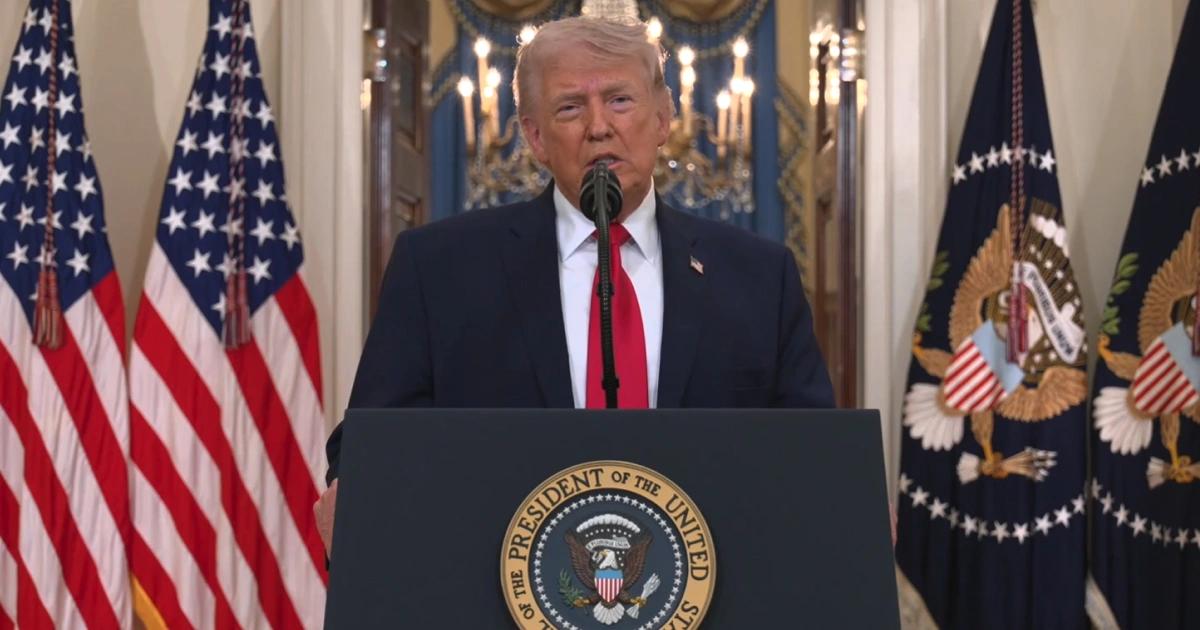
Today earlier (4/2) in Taiwan time, U.S. President Trump delivered a speech at the White House, reaffirming that the key strategic objectives for striking Iran are close to being completed, and he expects military action to end within the next 2 to 3 weeks.
He emphasized that this war is a real investment for America’s future generations, and said Iran’s naval and air forces have been destroyed. At the start of his speech, Trump also congratulated the successful launch of the Artemis II rocket by NASA, and mourned 13 U.S. service members killed in action.
Regarding the soaring oil prices, Trump placed the blame entirely on Iran’s attacks on merchant ships. On the issue of a blockade of the Strait of Hormuz that has drawn worldwide attention, he clearly stated that the United States does not need Middle East oil, and urged that the allies relying on that shipping route should shoulder the military responsibility for protecting and reopening the strait themselves.
However, Trump’s remarks did not reassure global oil markets. During the speech, the benchmark Brent crude price continued to climb, rising by more than 4% to $105.38 per barrel, and West Texas Intermediate also reached $104.21 per barrel. The average domestic gasoline price in the U.S. even broke above the $4 per gallon mark.
After Trump’s speech, major Asian stock market indexes also fell. Japan’s Nikkei 225 fell 1.5%, South Korea’s Kospi fell 2.6%, Hong Kong’s Hang Seng index fell 1%, and Taiwan’s weighted index also dropped 1.57%. Since late February when the Iran war broke out, Asian stock markets have remained volatile, because Asia that depends on energy supplies from the Middle East is particularly susceptible to the Middle East’s geopolitical conflict.
Experts question Trump’s lack of a clear plan, offering little help to ease the energy crisis
Even if Trump is adamant, experts don’t seem to buy it.
According to a report by 《BBC》, Melissa Toufanian, a senior adviser to former U.S. Secretary of State Antony Blinken, believes that after hearing the speech, the U.S. audience will only be even more confused. The public cannot feel that the government has a clear exit plan and timeline at all.
Council on Foreign Relations expert Imran Bayoumi said the war against Iran is extremely unpopular within the United States. The subsequent negative economic impacts will directly affect the midterm elections later this year. Also, by deliberately not proposing clearly defined war objectives, Trump can announce victory and withdraw troops unilaterally at any time.
According to a report by 《CNN》, energy market experts also warned that if the U.S. ends the war without reopening the Strait of Hormuz, it will not be able to resolve the current global energy crisis.
The U.S.-Iran conflict with a three-party dimension continues; Tehran and Lebanon face fierce airstrikes
In the past 8 hours, military conflict in the Middle East has remained intense. Kamal Kharazi, a senior adviser to Iran’s supreme leader, was seriously injured in airstrikes by the U.S.-Israel coalition targeting Tehran, and his wife was killed in the attack. At the same time, the U.S. military has recently carried out intensive airstrikes in western Iraq’s Anbar province, targeting infrastructure of militia groups aligned with Iran.
In Lebanon, Israel’s bombing has already caused more than 1 million people there to be displaced. At the same time, an Israeli military official confirmed that Israel’s air defense system intercepted 10 missiles from Iran on the first day of Passover, marking the largest-scale strike operation launched by Iran since the outbreak of hostilities.
The United Arab Emirates also urgently activated its air defense system to intercept incoming threats from missiles and drones.
Pakistan mediates actively; Israel may be stuck in the morass of war
Recently, Pakistan has been actively mediating the U.S.-Iran conflict. Council on Foreign Relations researcher Michael Kugelman analyzes that Pakistan is highly dependent on imported oil flowing through the Strait of Hormuz, so it has strong incentives to bring regional tensions down. Pakistan Army Chief of Staff Asim Munir is favored by Trump, and recently also transferred suspected perpetrators of terror attacks to the U.S., successfully earning trust in Washington for him.
By contrast, India has been completely sidelined in this diplomatic mediation, and India’s Foreign Minister S. Jaishankar has even downgraded Pakistan’s role to a mere intermediary.
As for Israel, which is in close conflict with Iran, its regional strategy has fully shifted toward preemption, and it is attempting to establish a broad buffer zone along the borders of Gaza, Syria, and Lebanon. Former Israeli National Security Adviser Tzachi Hanegbi said that even if the U.S. exits the Iran battlefield, Israel will continue to advance the war in Lebanon.
Dahlia Scheindlin, a think tank researcher, warned that Prime Minister Benjamin Netanyahu has not fulfilled the promise to destroy the enemy. The country is mired in a permanent war situation, making it difficult to turn short-term military advantages into lasting regional peace.
Further reading:
Trump threatens the UK: watching from the other side—Iran has basically been destroyed, the U.S. won’t help anymore; if you want the oil, go get it yourself!
Disclaimer: The information on this page may come from third parties and does not represent the views or opinions of Gate. The content displayed on this page is for reference only and does not constitute any financial, investment, or legal advice. Gate does not guarantee the accuracy or completeness of the information and shall not be liable for any losses arising from the use of this information. Virtual asset investments carry high risks and are subject to significant price volatility. You may lose all of your invested principal. Please fully understand the relevant risks and make prudent decisions based on your own financial situation and risk tolerance. For details, please refer to
Disclaimer.


