
Castle Island Ventures Founding Partner Nic Carter issued a stern warning on X platform Thursday: Bitcoin developers are still adopting a “ostrich mentality” when it comes to strengthening resistance against quantum attacks, while Ethereum has developed a detailed post-quantum roadmap through 2029 and has made it a “top strategic priority.”
Carter’s Core Argument: The End of the Era of Elliptic Curve Cryptography
Carter pointed out that the elliptic curve cryptography (ECC) widely used in Bitcoin is about to become obsolete—it’s only a matter of time. “Whether it’s 3 years or 10 years, it’s already outdated. We have to accept that,” he said. “The only thing that matters is how quickly blockchain developers realize they need to build cryptographic agility into their networks.”
Carter believes that the current system’s hardcoded cryptography needs to be “rethought entirely”—cryptographic techniques must be designed to be flexible for future upgrades, rather than fixed at the protocol level. According to a report by ARK Invest released on March 11, about one-third of Bitcoin addresses are at risk of quantum attack due to exposed public keys, but the report characterizes this as a “long-term risk.”
Bitcoin vs Ethereum: Fundamental Differences in Post-Quantum Upgrade Roadmaps
(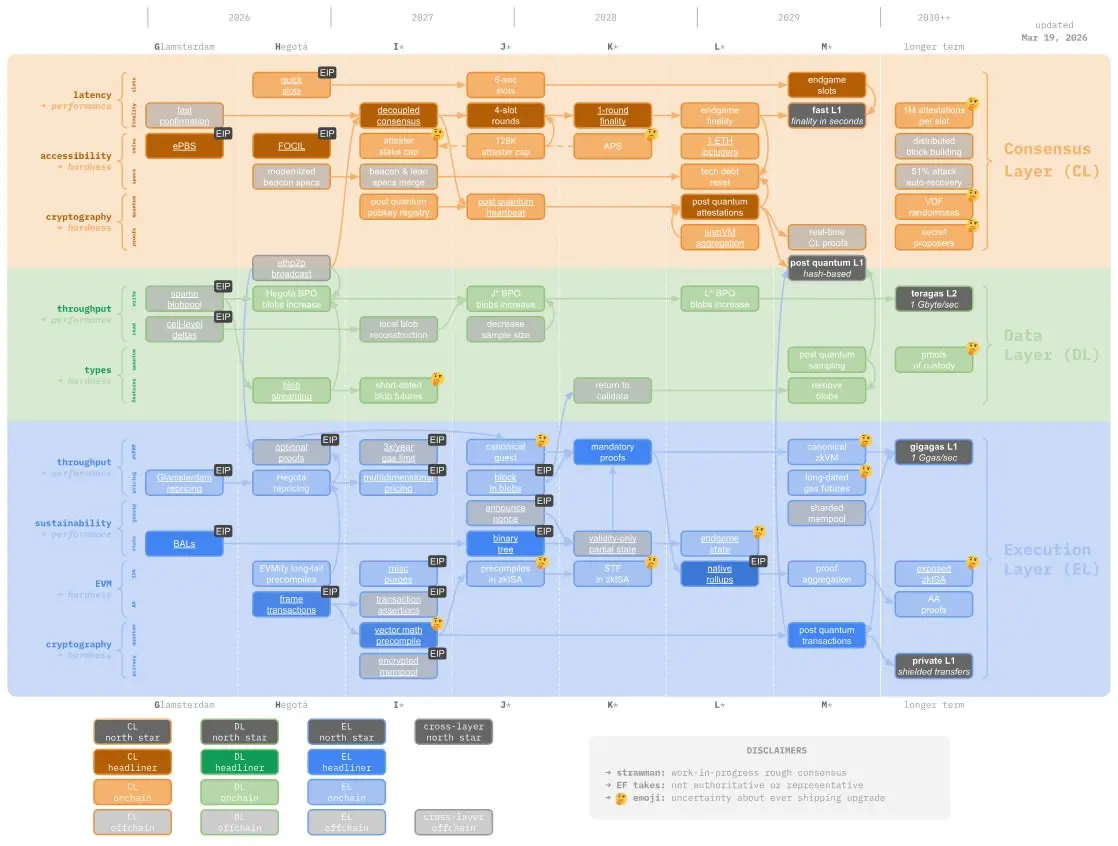 )
)
(Source: Strawmap)
Comparison of the Two Major Networks’ Approaches to Quantum Resistance
Ethereum: Vitalik Buterin proposed a post-quantum roadmap in late February, covering validator signatures, accounts, and data storage; the Ethereum development community has formed a new security team, aiming to complete detailed plans by 2029, and has made it a “top strategic priority.”
Bitcoin: Carter accuses Bitcoin core developers of long-term neglect of quantum-related proposals (such as BIP-360), adopting attitudes of “denial, gaslighting, setting thresholds, ostrich mentality,” and “refusing to accept community feedback.”
Bitcoin Community’s Response: Co-author of BIP-360 Ethan Heilman responded that core contributors have been actively participating in proposal reviews, and BIP-360 has received more feedback than any other Bitcoin Improvement Proposal in history.
Carter bluntly states: “Ethereum users are already aware of this, while others seem to be terrified. Unless the situation changes rapidly, the ETH/BTC price trend will reflect this divergence in priorities.”
Google’s 2029 Deadline: Quantum Threat Enters Mainstream Agenda
Coinciding with Carter’s statement, Google announced on Wednesday that the deadline for migrating to post-quantum cryptography is set for 2029, warning that quantum computers will pose a “significant threat” to current encryption standards, especially for encryption and digital signatures. This is Google’s first public commitment to a specific post-quantum cryptography migration timeline, further confirming the urgency of quantum threats.
Whether it’s elliptic curve cryptography in Bitcoin, account security in Ethereum, or enterprise digital signatures, all fall within the scope of the quantum attack risks highlighted by Google.
Frequently Asked Questions
What potential risks does quantum resistance pose to Bitcoin?
Quantum computers could theoretically crack the elliptic curve cryptography (ECC) used by Bitcoin, jeopardizing the security of private keys and transaction signatures. According to ARK Invest, about one-third of Bitcoin addresses are at potential risk due to exposed public keys.
How much ahead is Ethereum’s post-quantum roadmap compared to Bitcoin?
The Ethereum Foundation has prioritized post-quantum upgrades, with Vitalik Buterin proposing a roadmap covering multiple protocol layers in February, aiming for completion by 2029. Bitcoin’s BIP-360 proposal is still under community discussion and has not yet reached consensus or been prioritized.
What does Google’s 2029 post-quantum cryptography deadline mean for blockchain security?
Google’s deadline indicates that major tech organizations recognize quantum threats will become a practical issue by 2029. For blockchain networks relying on public key cryptography, this serves as a clear external warning and provides additional external support for Ethereum’s 2029 post-quantum upgrade goal.
Disclaimer: The information on this page may come from third parties and does not represent the views or opinions of Gate. The content displayed on this page is for reference only and does not constitute any financial, investment, or legal advice. Gate does not guarantee the accuracy or completeness of the information and shall not be liable for any losses arising from the use of this information. Virtual asset investments carry high risks and are subject to significant price volatility. You may lose all of your invested principal. Please fully understand the relevant risks and make prudent decisions based on your own financial situation and risk tolerance. For details, please refer to
Disclaimer.


