Key Takeaways
-
Pi Network has reminded Mainnet node operators to upgrade their software to maintain compatibility and avoid disruptions.
-
Failure to upgrade could result in node disconnection, reduced participation, or operational issues within the Pi ecosystem.
-
The upgrade signals ongoing infrastructure improvements as Pi Network prepares for broader adoption and ecosystem expansion.
The Pi Network Core Team has issued an important reminder to all Mainnet node operators as the project’s blockchain protocol undergoes a structured, multi-step upgrade process. Operators are being urged to act promptly to ensure their nodes remain connected, functional, and eligible to participate in the network’s consensus layer.
According to the official announcement shared through Pi Network’s verified channels, including Telegram and X, the Mainnet blockchain is currently transitioning through a sequence of protocol upgrades designed to strengthen network stability, performance, and long-term scalability. These updates represent a critical step in preparing Pi Network’s infrastructure for future ecosystem growth, deeper decentralization, and expanded functionality.
Second Upgrade Deadline Set for March 1, 2026
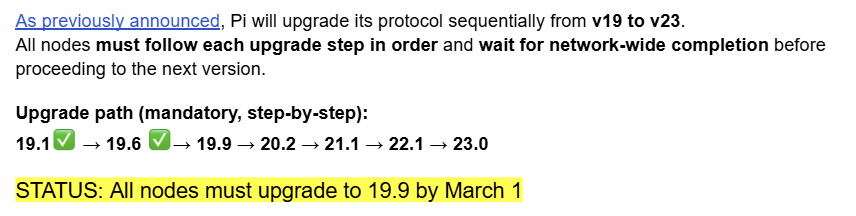
Following the successful completion of the first upgrade phase—from version 19.1 to version 19.6—on February 15, 2026, the Core Team has now activated the second stage of the transition. This step moves Mainnet nodes from version 19.6 to version 19.9 and carries a firm deadline of March 1, 2026.
Source: minepi
Nodes that do not complete this upgrade by the specified date risk being disconnected from the network. Disconnected nodes will no longer be able to participate in essential blockchain operations, including consensus validation, transaction processing, and maintaining synchronization with the Mainnet.
“All Mainnet nodes must complete this step to remain connected to the network,” the Core Team emphasized in its official guidance.
The upgrade roadmap indicates that the migration from version 19.6 to 19.9 is currently marked as active and may take several hours to complete. Operators are advised to divert traffic temporarily during the upgrade to avoid disruptions and ensure a smooth transition.
Pi Node Protocol Upgrade Roadmap
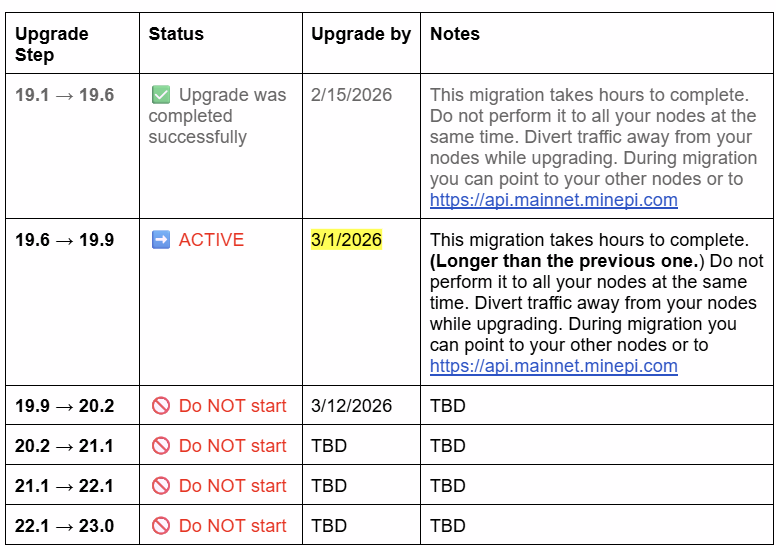
Unlike routine software updates, this protocol shift is part of a carefully structured, sequential upgrade path that cannot be skipped. Each Mainnet node must follow the prescribed order:
-
v19.1 → v19.6 (Completed: February 15, 2026)
-
v19.6 → v19.9 (Active: Deadline March 1, 2026)
-
v19.9 → v20.2 (Scheduled: Deadline March 12, 2026)
-
Additional steps leading to Protocol v23 (Timeline to be announced)
Source: Source: minepi
Each phase builds upon the previous version, ensuring network continuity, compatibility, and security. Attempting to skip stages or delaying upgrades could result in node incompatibility or temporary exclusion from the Mainnet.
Why This Upgrade Is Critical
This protocol upgrade cycle is more than a routine maintenance procedure—it represents a foundational step in Pi Network’s long-term roadmap.
-
Enhanced Network Security: The update strengthens core infrastructure protections, reducing vulnerabilities and improving resilience as the network continues to grow. With over 16 million users already migrated to Mainnet, maintaining robust security standards is essential.
-
Improved Performance and Scalability: Upgraded protocol versions enhance node efficiency, improve transaction processing speed, and increase throughput. These improvements are crucial to support the expanding ecosystem of decentralized applications (dApps) being built within the Pi platform.
-
Preparation for Advanced Protocol Integration: The transition moves Pi Network closer to full alignment with advanced Stellar-based protocol standards, paving the way for improved consensus efficiency, smarter infrastructure capabilities, and readiness for broader Open Network expansion.
Strategic Importance for Pi Network’s 2026 Roadmap
The ongoing upgrade sequence reflects Pi Network’s broader strategic priorities for 2026, including strengthening decentralization, improving network reliability, and preparing the infrastructure for increased adoption and developer activity.
As more applications, services, and ecosystem participants join the network, maintaining a modern, scalable protocol is essential. These upgrades ensure that Mainnet nodes can support future technical advancements and increased network demand.
The Core Team’s structured rollout also demonstrates a cautious and stability-focused approach, minimizing disruptions while ensuring every node remains synchronized with the evolving protocol.
Immediate Action Required for Node Operators
All Mainnet node operators are strongly advised to initiate the upgrade process immediately to avoid missing the March 1, 2026 deadline.
Operators should:
-
Download the latest node software from the official Pi Node portal
-
Follow the step-by-step upgrade instructions
-
Allow sufficient time for migration completion
-
Ensure their node remains online and properly synchronized
Completing the upgrade on time will ensure uninterrupted participation in consensus operations and continued contribution to the network’s decentralization.
As Pi Network continues to evolve its Mainnet infrastructure, timely participation from node operators remains essential. These coordinated upgrades represent a key step toward a more scalable, secure, and fully decentralized blockchain ecosystem.
For detailed instructions and to download the latest software, node operators should visit the official page: Pi Node Technical Guide.
Disclaimer: The views and analysis presented in this article are for informational purposes only and reflect the author’s perspective, not financial advice. Technical patterns and indicators discussed are subject to market volatility and may or may not yield the anticipated results. Investors are advised to exercise caution, conduct independent research, and make decisions aligned with their individual risk tolerance.
About Author: Nilesh Hembade is the Founder and Lead Author of Coinsprobe, with over 5 years of experience in the cryptocurrency and blockchain industry. Since launching Coinsprobe in 2023, he has been providing daily, research-driven insights through in-depth market analysis, on-chain data, and technical research.
Disclaimer: The information on this page may come from third parties and does not represent the views or opinions of Gate. The content displayed on this page is for reference only and does not constitute any financial, investment, or legal advice. Gate does not guarantee the accuracy or completeness of the information and shall not be liable for any losses arising from the use of this information. Virtual asset investments carry high risks and are subject to significant price volatility. You may lose all of your invested principal. Please fully understand the relevant risks and make prudent decisions based on your own financial situation and risk tolerance. For details, please refer to
Disclaimer.
Related Articles
Pi Network’s PI Token Dumps 13% Weekly as Team Announces Crucial Deadline Ahead
The Core Team behind the controversial blockchain project has outlined the deadline for the completion of the next major upgrade, which should take place in the next week or so.
However, the protocol’s native token continues to bleed, dropping over 3% in the past day and dumping by double-digits we
CryptoPotato9h ago
Pi Network launches a developer-only RPC server to speed up smart contract testing
Pi Network launches new RPC servers, providing standardized tools for developers, supporting smart contract testing and simulation, and improving development security and efficiency. This marks its transition toward practical functionality, which may attract more developers and help advance the ecosystem, even though it still faces some challenges.
GateNews13h ago
Pi Network testnet RPC server is ready, and the smart contract ecosystem deployment is underway
Pi Network successfully deployed a testnet RPC server on April 1, marking an important step forward in smart contract simulation and testing. The upcoming v21 release will officially enable smart contracts, allowing developers to validate logic in a sandbox environment and support applications such as NFTs, managed services, and subscription systems. However, despite technological progress, PI Coin’s market performance is still facing setbacks, and future token unlocks may further intensify sell pressure.
MarketWhisper13h ago
Major Pi Network Announcement for Developers, Users, Investors: Details
Despite the growing criticism online, the Pi Network Core Team continues to introduce new features that are aimed at enhancing its overall performance and providing new features and capabilities for users.
The latest announcement, made just hours ago, was regarding a crucial step taken to
CryptoPotato13h ago
Pi Network Launches RPC Server on Testnet for Developers
Pi Network has introduced a new RPC server on its Testnet. This marks a key step in its technical growth. The update allows developers to interact directly with the network in a simple and structured way. With this launch, developers can now test, simulate and prepare smart contracts before they
Coinfomania14h ago
Pi Network mainnet expansion is imminent, cross-chain bridge integrates KYB and smart contracts
Pi Network is developing a cross-chain bridge to connect its blockchain with other major networks, and to conduct smart contract testing and security audits. Its core features include using KYB identity verification to ensure compliance, and allowing businesses to enter the ecosystem. This series of measures is intended to improve the system’s transaction efficiency and security, and to expand the use cases for the PI token.
MarketWhisper17h ago


