Author: Black Lobster, Deep Tide TechFlow
In the summer of 1858, a copper-core cable crossed the Atlantic Ocean floor, connecting London and New York.
The significance of this event was never about transmission speed, but about power structures—who laid the submarine cable could siphon off the flow of information. The British Empire, through this global telegraph network, held the intelligence of colonies, cotton prices, and war news in its hands.
The empire’s strength was not only its fleet but also that cable.
Over 160 years later, this logic is being reenacted in an unexpected way.
By 2026, China’s large models are quietly consuming the global developer market. According to the latest data from OpenRouter, Chinese models account for 61% of token consumption among the top ten models on the platform, with the top three all from China. Developers in San Francisco, Berlin, and Singapore send API requests daily across the Pacific Ocean via submarine cables to Chinese data centers, where computing power is consumed, electricity flows, and results are returned.
The electricity never leaves China’s power grid, but its value is delivered across borders through tokens.
The Great Migration of AI Models
On February 24, 2026, OpenRouter released weekly data: the top ten models on the platform consumed about 87 trillion tokens in total, with Chinese models dominating at 53 trillion tokens, accounting for 61%. MiniMax M2.5 led with 2.45 trillion tokens, followed by Kimi K2.5 and Zhipu GLM-5—all from China.
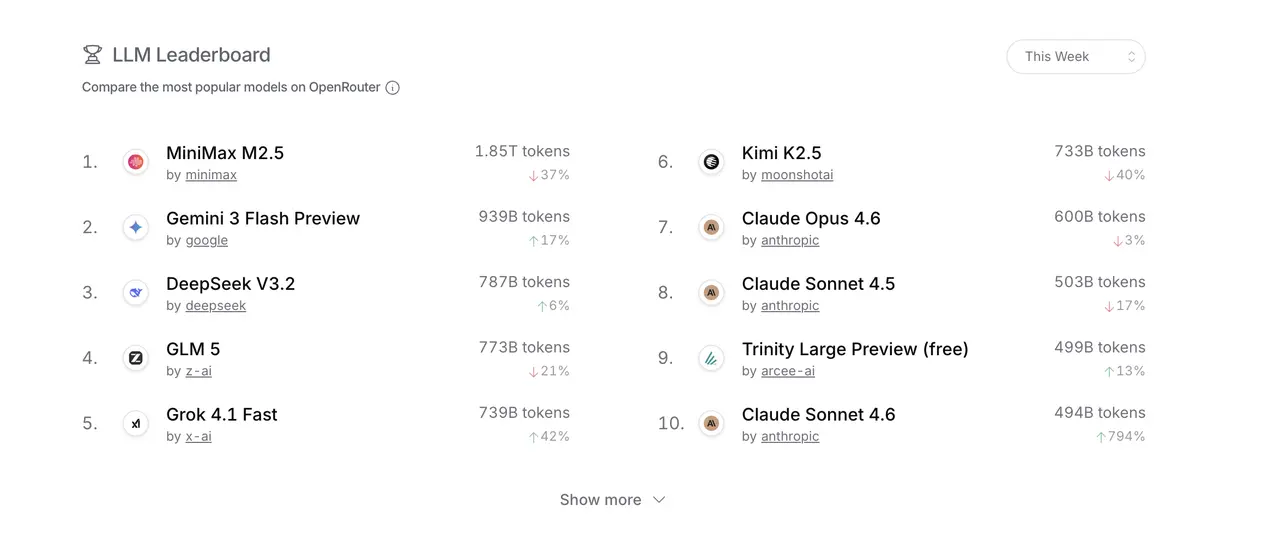
Latest data as of February 26
This is no coincidence; a spark ignited everything.
Earlier this year, OpenClaw emerged—a truly open-source tool that allows AI to “do work” directly by controlling computers, executing commands, and parallelizing complex workflows. Within weeks, it surpassed 210,000 stars on GitHub.
Financial professional John was among the first to install OpenClaw, connecting it to the Anthropic API. He began automatically monitoring stock market information and promptly reporting trading signals. A few hours later, he stared at his account balance in disbelief: just a few dollars, gone.
This is the new reality brought by OpenClaw. Previously, chatting with AI involved a few thousand tokens per conversation, with negligible costs. After integrating OpenClaw, AI runs multiple sub-tasks in the background, repeatedly calling context and looping iterations, causing token consumption to grow exponentially rather than linearly. The bill accelerates like a car with its hood open, the fuel gauge dropping rapidly, unstoppable.
A “trick” quickly circulated among developer communities: using OAuth tokens to connect Anthropic or Google subscription accounts directly to OpenClaw, turning the monthly “unlimited” quota into free fuel for AI agents—this is a common approach among many developers.
Official countermeasures soon followed.
On February 19, Anthropic updated its terms, explicitly prohibiting the use of Claude subscription credentials with third-party tools like OpenClaw. To access Claude’s features, API billing must be used. Google also broadly banned subscription accounts accessing Antigravity and Gemini AI Ultra via OpenClaw.
“Long have the people suffered under Qin,” John then embraced domestic large models.
On OpenRouter, domestic large models like MiniMax M2.5 scored 80.2% on software engineering tasks, while Claude Opus scored 80.8%. The difference is negligible. But the prices are worlds apart: the former costs $0.3 per million tokens at input, while the latter costs $5—a 17-fold difference.
John switched over, workflows continued, and bills shrank by an order of magnitude. This migration is happening globally in parallel.
OpenRouter’s COO Chris Clark stated plainly, “The reason Chinese open-source models capture such a large market share is because they are disproportionately used in agent workflows run by American developers.”
Power Going Overseas
To understand the essence of token export, one must first grasp the cost structure of a token.
It appears lightweight—roughly 0.75 English words per token. A typical conversation with AI consumes only a few thousand tokens. But when these tokens stack into trillions, the physical reality becomes heavy.
Breaking down token costs, there are only two core components: computing power and electricity.
Computing power is the depreciation of GPUs. Buying a Nvidia H100 costs about $30,000, and its lifespan amortized per inference is the depreciation cost. Electricity is the fuel for data center operation. When GPUs are fully loaded, each consumes about 700 watts, plus cooling costs. A large AI data center’s annual electricity bill can easily exceed hundreds of millions of dollars.
Now, map this physical process.
An American developer in San Francisco sends an API request. Data travels from California via submarine cable across the Pacific to a Chinese data center. GPU clusters start working, electricity flows from China’s grid to the chips, inference completes, and results are sent back. The entire process may only take one or two seconds.
Electricity, never leaving China’s grid, but its value is delivered across borders through tokens.
Here’s a magical aspect that surpasses ordinary trade: tokens have no physical form, no customs, no tariffs, and are not counted in current trade statistics. China exports vast amounts of computing and electrical services, yet in official trade data, it remains almost invisible.
Tokens have become derivatives of electricity; token export is fundamentally electricity export.
This is also thanks to China’s relatively low electricity prices—about 40% lower than the US—an inherent physical cost advantage that competitors can easily replicate.
Moreover, Chinese AI large models have algorithmic and “involution” advantages.
DeepSeek V3’s MoE architecture activates only parts of the model during inference. Independent tests show its inference cost is about 36% lower than GPT-4o. MiniMax M2.5, with 229 billion total parameters, activates only 10 billion.
At the top level is involution—companies like Alibaba, ByteDance, Baidu, Tencent, Moon’s Shadow, Zhipu, MiniMax… over a dozen firms compete fiercely on the same track. Prices have long fallen below reasonable profit margins; losing money to gain market share has become industry norm.
In essence, this mirrors China’s manufacturing export strategy—leveraging supply chain advantages and industry involution to push token prices down aggressively.
From Bitcoin to Tokens
Before tokens, there was another form of electricity export.
Around 2015, power plant operators in Sichuan, Yunnan, and Xinjiang began welcoming a peculiar clientele.
They rented abandoned factories, packed in dense machines, running 24/7. These machines produced nothing but kept solving an endless math problem. Occasionally, from this infinite math problem, a Bitcoin was mined.
This was the first form of electricity export: using cheap hydro and wind power, through mining rigs’ hashing computations, to convert into globally circulating digital assets, then cash out on exchanges for dollars.
Electricity never crossed borders, but its value, via Bitcoin, flowed into global markets.
In those years, China’s hash rate accounted for over 70% of global Bitcoin mining. China’s hydro and coal power, through this circuitous route, participated in a global redistribution of capital.
In 2021, all this abruptly stopped. Regulatory crackdown scattered miners, and hash power migrated to Kazakhstan, Texas, and Canada.
But the logic itself never disappeared—only waiting for a new shell. When ChatGPT emerged, large models became the new battleground. Former Bitcoin mining farms transformed into AI data centers; mining rigs became GPUs; Bitcoin turned into tokens. Only electricity remains unchanged.
Bitcoin’s overseas expansion and token export are structurally homologous, but tokens now hold greater commercial value.
Mining is purely mathematical computation; the Bitcoin produced is a financial asset. Its value derives from scarcity and market consensus, unrelated to “what it computes.” Computing power itself is non-productive, more like a trust mechanism byproduct.
Large model inference, however, is different. GPUs consume electricity to produce real cognitive services—code, analysis, translation, creativity. The value of tokens directly stems from their utility to users. This is a deeper embedding: once a developer’s workflow depends on a model, switching costs grow exponentially over time.
Another key difference: Bitcoin mining was expelled from China, but token export is actively chosen by developers worldwide.
The Token War
The submarine cable laid in 1858 symbolized the British Empire’s sovereignty over the information highway—who owns the infrastructure can set the rules.
Token export is similarly a war without declared combat, facing heavy resistance.
Data sovereignty is the first barrier. An API request from a US developer processed by a Chinese data center physically traverses China. For individual developers and small applications, this isn’t a problem. But for enterprise-sensitive data, financial information, government compliance scenarios, it’s a hard barrier. That’s why Chinese models have the highest penetration in developer tools and personal applications, but are almost absent in core enterprise systems.
Chip bans are the second barrier. China’s AI development faces export controls on high-end Nvidia GPUs. MoE architectures and algorithmic optimizations can partially offset this disadvantage, but a ceiling remains.
But these obstacles are only the beginning. A larger battlefield is forming.
Tokens and AI models have become a new strategic arena between China and the US—comparable to the semiconductor and internet wars of the 20th century, or even closer to an ancient metaphor: space race.
In 1957, the Soviet Union launched Sputnik, shocking the US, which then launched the Apollo program, investing hundreds of billions of dollars today, determined not to lose the space race.
The logic of AI competition is eerily similar, but the intensity will far surpass the space race. Space is physical and intangible to most people; AI infiltrates the economic capillaries—every line of code, every contract, every government decision system may run a large model from some country. Whose model becomes the default infrastructure for global developers? Who gains invisible influence over the global digital economy?
This is precisely what makes China’s token export deeply unsettling for Washington.
When a developer’s codebase, agent workflows, and product logic revolve around a Chinese model’s API, the migration cost grows exponentially over time. Even if US legislation restricts it, developers will resist fiercely—just as today no programmer can abandon GitHub.
Today’s token export may only be the beginning of this long game. China’s large models have not claimed to overthrow anything; they simply deliver services at lower prices to every developer worldwide with an API key.
This time, the cables are laid by engineers coding in Hangzhou, Beijing, Shanghai, and GPU clusters running day and night in some southern province.
There’s no countdown to this war; it’s ongoing 24/7, measured in tokens, fought on every developer’s terminal.


