
On February 24, U.S. President Trump delivered the State of the Union address at Capitol Hill, with markets expecting him to reaffirm his crypto-friendly economic policy stance; meanwhile, on-chain analyst James Check pointed out that Bitcoin has formed textbook-style bottom patterns across multiple mean reversion indicators, and historical data suggests such levels often precede significant rebounds.
Trump’s State of the Union: Renewed Market Confidence with Crypto Policy Expectations
Trump promised that this speech would heavily focus on economic issues and planned to criticize the Supreme Court’s rulings on his tariff policies, while also outlining alternative ways to bypass these rulings without relying on Congress. From the crypto community’s perspective, the overall crypto-friendly policy stance of the Trump administration—covering progress in stablecoin regulation, removing banking barriers for businesses, and supporting digital asset innovation—remains an important macro support for Bitcoin.
During the address, markets paid close attention to any potential crypto-related statements from Trump. Although such political signals do not directly impact on-chain supply and demand, in a subdued market sentiment environment, clear policy signals often help re-attract cautious capital, providing marginal support for short-term prices.
Bottom Pattern Indicators: On-Chain Signals and ETF Oversold Convergence
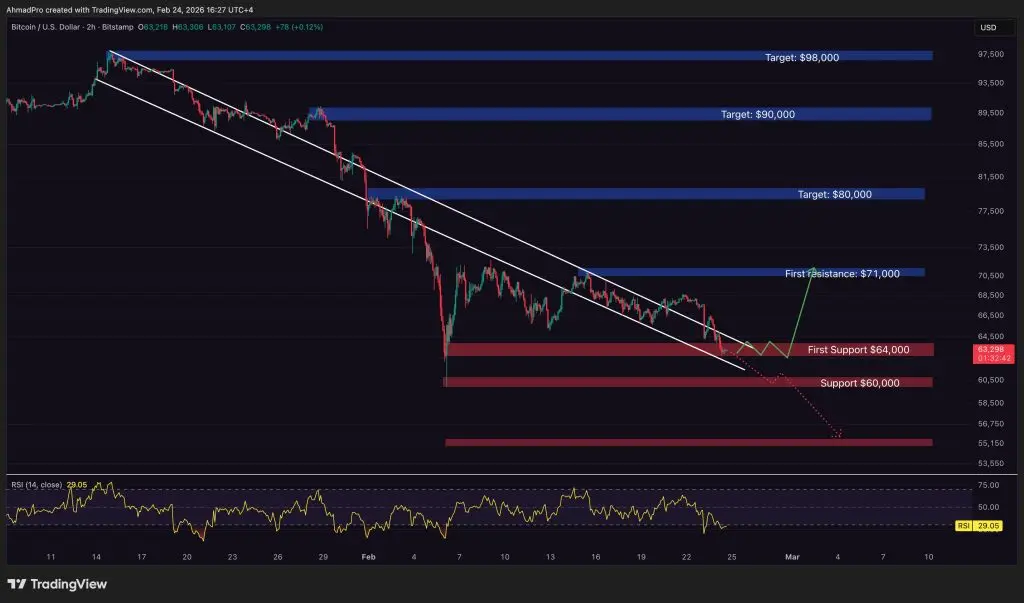
(Source: TradingView)
Another reason for Bitcoin’s rise today comes from on-chain bottom confirmation signals. James Check noted that as Bitcoin tested near $63,000, approaching the panic low of $60,000 on February 5, all mean reversion models—ranging from technical analysis to on-chain indicators—were operating near levels seen at historical lows, similar to key cycle lows in December 2018 and June 2022.
He also reminded that bottom formation is a gradual process. The actual bottom in 2022 was around $17,600, but before liquidity fully returned, the market remained sideways for several months. “For bulls, time may be more testing than price,” Check said.
Key Support Factors for Today’s Bitcoin Rise
- Trump’s State of the Union: Market expects Trump to reaffirm crypto-friendly policies, boosting short-term sentiment on political signals
- On-Chain Bottom Indicators Confirmed: James Check points out multiple mean reversion models indicate Bitcoin is in a historical bottom formation zone, historically signaling a significant rebound
- Inverse Signal from ETF Outflows: The US spot Bitcoin ETF has experienced net outflows exceeding $3.8 billion over five consecutive weeks, which some analysts view as a potential contrarian buy signal
- $60,000 Macro Support Maintained: Bitcoin is trading around $64,000, still above the key bottom line of the long-term bullish structure, with overall technical framework intact
Check summarized: “If you’re not actively accumulating Bitcoin now, when will you?”
FAQs
How does Trump’s State of the Union address influence Bitcoin price trends?
The speech content itself does not directly alter Bitcoin’s on-chain supply and demand. However, Trump’s reaffirmation of crypto-friendly policies—such as advancing stablecoin regulation and combating de-banking—may improve short-term policy expectations, encouraging cautious capital to flow back into crypto assets.
What indicators does James Check use for bottom pattern judgment?
James Check’s mean reversion models include on-chain metrics such as realized price levels, historical cycle lows, and current holding cost structures. These indicators showed similar patterns at cycle lows in December 2018 and June 2022, but the rebound after bottom confirmation can take from several weeks to months.
Does the continuous outflow from US spot Bitcoin ETFs indicate institutional abandonment of Bitcoin?
The over $3.8 billion net outflow over five weeks reflects short-term risk-off adjustments by institutions. BlackRock’s IBIT and Fidelity’s FBTC have seen significant outflows. However, some analysts suggest that persistent oversold outflows can be a contrarian indicator, and there are no signs of systemic liquidation yet; the $60,000 macro support remains intact.
Disclaimer: The information on this page may come from third parties and does not represent the views or opinions of Gate. The content displayed on this page is for reference only and does not constitute any financial, investment, or legal advice. Gate does not guarantee the accuracy or completeness of the information and shall not be liable for any losses arising from the use of this information. Virtual asset investments carry high risks and are subject to significant price volatility. You may lose all of your invested principal. Please fully understand the relevant risks and make prudent decisions based on your own financial situation and risk tolerance. For details, please refer to
Disclaimer.
Related Articles
BTC falls below 70000 USDT, intraday decline of 0.09%
Gate News, on March 20th, according to market data, Bitcoin broke below the 70,000 USDT level, currently trading at 69,991.06 USDT, with a daily decline of 0.09%.
GateNews2h ago
IPO Dreams Shattered! Gemini Hit with Class Action Lawsuit for "Misleading Investors," Stock Price Plummets 80% with 25% Layoffs and Exit from Multiple Countries
Gemini cryptocurrency exchange is facing its biggest crisis since its IPO, as it has been accused of providing false information in its listing documents, causing its stock price to plummet 80% and significant losses. The company has announced a 25% workforce reduction and withdrawal from multiple international markets, sparking serious market concerns about its operations. This incident may also impact the listing process of future crypto enterprises.
動區BlockTempo3h ago
Evernorth Discloses XRP Reserves Depreciated by $233.7 Million Last Year, Plans to Boost Returns Through DeFi Strategy
Evernorth Holdings disclosed in its S-4 filing an anticipated XRP impairment of approximately $233.7 million by 2025, primarily due to differences between the purchase cost and market price. Evernorth plans to actively manage its XRP reserves and introduce the RLUSD stablecoin to participate in decentralized finance transactions to enhance asset returns.
GateNews3h ago
BlackRock "Ethereum Staking ETF" Makes a Splash! First Day Trading Volume Exceeds $15.5 Million
BlackRock's "iShares Staked Ethereum Trust ETF (ETHB)" had a trading volume of over $15.5 million on its first day of listing, showcasing strong performance and highlighting the potential for institutional capital to flow into Ethereum. ETHB will directly hold Ether and participate in staking; in addition to benefiting from price fluctuations, investors can earn staking rewards, with 82% of the yields distributed to holders on a monthly basis.
区块客4h ago


