 Trusted Editorial content, reviewed by leading industry experts and seasoned editors. Ad Disclosure
Ethereum continues to struggle below the $2,000 level as persistent selling pressure and elevated uncertainty weigh on broader crypto market sentiment. Despite occasional rebound attempts, price action remains fragile, with volatility still elevated after months of corrective momentum. The inability to decisively reclaim this psychological threshold has reinforced caution among traders, particularly as liquidity conditions tighten and macro uncertainty continues to influence risk appetite across digital assets.
Trusted Editorial content, reviewed by leading industry experts and seasoned editors. Ad Disclosure
Ethereum continues to struggle below the $2,000 level as persistent selling pressure and elevated uncertainty weigh on broader crypto market sentiment. Despite occasional rebound attempts, price action remains fragile, with volatility still elevated after months of corrective momentum. The inability to decisively reclaim this psychological threshold has reinforced caution among traders, particularly as liquidity conditions tighten and macro uncertainty continues to influence risk appetite across digital assets.
Related Reading: Wall Street’s Bitcoin Exit Door: How Institutional Depth Allowed LTH To Distribute Record SupplyRecent analysis from Darkfost adds further context to the current market structure. According to the data, the ongoing correction is now affecting all investor cohorts, including Ethereum’s largest holders. Notably, the unrealized profit ratio for whale groups has shifted into negative territory across the board. Wallets holding between 1,000 and 10,000 ETH show an unrealized profit ratio of approximately -0.21, while those with 10,000 to 100,000 ETH stand near -0.18. Even the largest cohort — addresses holding more than 100,000 ETH — has slipped into negative territory around -0.08.
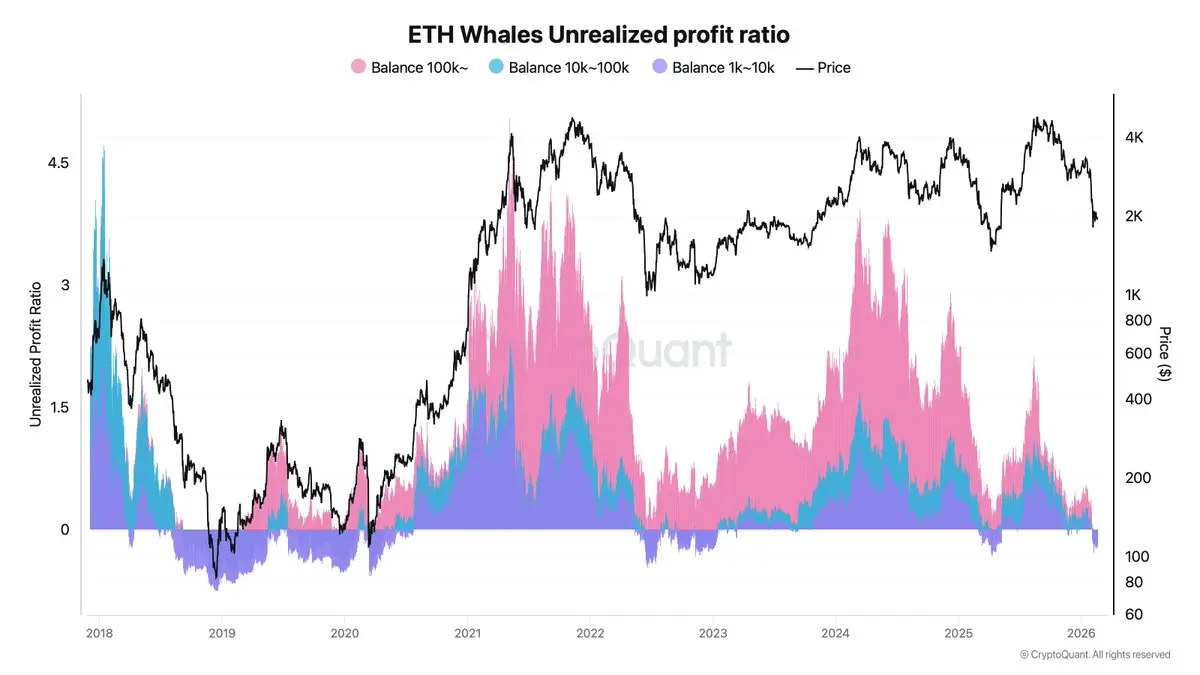 Ethereum Whales Unrealized profit ratio | Source: CryptoQuantThis development is notable because Ethereum has not yet revisited its April lows, suggesting the depth of unrealized losses is expanding earlier than in some previous corrective phases. Such conditions can increase market sensitivity, as even traditionally resilient holders may reassess positioning amid prolonged volatility.
Whale Stress Raises Capitulation Risk While Bottom Formation Signals Emerge
Darkfost further notes that if Ethereum extends its decline, large holders could face increasing financial pressure. Sustained downside would deepen unrealized losses across whale cohorts, potentially forcing some participants to reduce exposure or liquidate portions of their holdings. Historically, such capitulation events among large investors tend to amplify short-term volatility, particularly when liquidity conditions are already fragile.
However, despite the negative profit ratios now visible across whale groups, Ethereum has so far managed to stabilize above recent local support zones. This relative resilience suggests that, while sentiment remains cautious, immediate large-scale distribution from whales has not yet materialized. The distinction is important because unrealized losses alone do not necessarily trigger selling unless accompanied by liquidity stress, leverage pressure, or broader market shocks.
Related Reading: Crypto Whales Build A ‘Fortress Floor’ As Retail Panic Sells The Altcoin SectorPeriods in which major holders experience stress have often coincided with medium-term bottom formation phases in previous cycles. As weaker hands exit and leverage unwinds, markets sometimes transition into accumulation regimes characterized by lower volatility and gradual stabilization.
Still, this interpretation should be approached cautiously. Whale positioning is only one element of market structure, and confirmation typically requires improving liquidity, stronger spot demand, and supportive macro conditions before a sustained recovery can take hold.
Ethereum Price Structure Remains Fragile Below Key Averages
Ethereum continues to trade under clear technical pressure, with the weekly chart showing a sustained inability to reclaim the $2,000 region decisively. Following the sharp rejection from the 2025 highs near the $4,800 zone, price action has transitioned into a sequence of lower highs and weakening rebounds, typically associated with corrective market phases rather than accumulation-led recoveries.
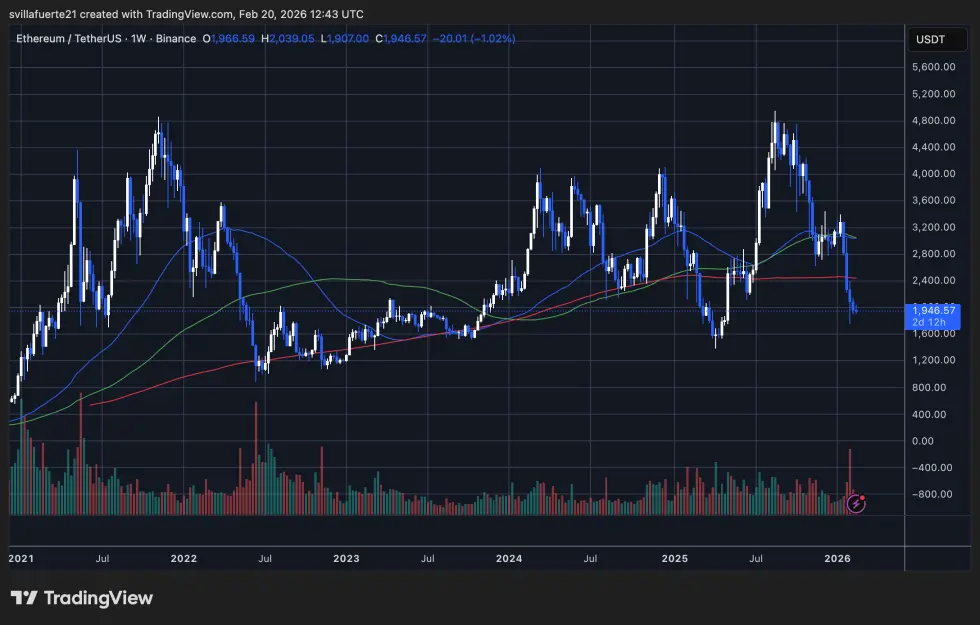 ETH testing critical demand level | Source: ETHUSDT chart on TradingViewTechnically, ETH is currently positioned below several major moving averages that previously acted as dynamic support. These levels now function as resistance, limiting upside attempts unless a strong reclaim occurs with expanding volume. The recent decline toward the $1,900 area reflects persistent selling pressure, while repeated failures near the mid-$2,000 range reinforce cautious market sentiment.
Related Reading: Retail’s Last Stand: The Crypto -$209B Liquidity Trap That Smart Money Refuses to TouchVolume activity has moderated compared with the impulsive rally phase, suggesting reduced speculative participation. While declining volume during corrections can sometimes signal seller exhaustion, confirmation of stabilization usually requires sustained buying interest rather than temporary rebounds.
From a structural perspective, immediate support appears concentrated near the recent local lows around the $1,800 region, while resistance remains clustered between roughly $2,200 and $2,600. Until Ethereum reclaims these levels convincingly, the broader technical outlook remains vulnerable, with consolidation or further downside still plausible.
Featured image from ChatGPT, chart from TradingView.com
![]() Editorial Process for bitcoinist is centered on delivering thoroughly researched, accurate, and unbiased content. We uphold strict sourcing standards, and each page undergoes diligent review by our team of top technology experts and seasoned editors. This process ensures the integrity, relevance, and value of our content for our readers.
Editorial Process for bitcoinist is centered on delivering thoroughly researched, accurate, and unbiased content. We uphold strict sourcing standards, and each page undergoes diligent review by our team of top technology experts and seasoned editors. This process ensures the integrity, relevance, and value of our content for our readers.
Disclaimer: The information on this page may come from third parties and does not represent the views or opinions of Gate. The content displayed on this page is for reference only and does not constitute any financial, investment, or legal advice. Gate does not guarantee the accuracy or completeness of the information and shall not be liable for any losses arising from the use of this information. Virtual asset investments carry high risks and are subject to significant price volatility. You may lose all of your invested principal. Please fully understand the relevant risks and make prudent decisions based on your own financial situation and risk tolerance. For details, please refer to
Disclaimer.
Related Articles
OnlyFans Founder Leonid Radvinsky Dies of Cancer at 43
Gate News report: On March 23, Bloomberg reported that Leonid Radvinsky, founder of OnlyFans, passed away from cancer at the age of 43. According to financial disclosure information from OnlyFans' parent company, the company had previously invested part of its operating funds in ETH, with a purchase cost of $19.889 million.
GateNews9m ago
BitMine increased holdings by 65,000 ETH last week, with total positions reaching 4.66 million ETH
BitMine increased its holdings by 65,341 ETH last week, bringing the total to 4,660,903 ETH, which accounts for 3.86% of the total Ethereum supply. Of these, 3.143 million ETH have been staked, and its asset reserves are valued at approximately $11 billion.
GateNews14m ago
ETH up 0.95% in 15 minutes: Whale transfers and short liquidations resonate to push prices higher
Between 2026-03-23 12:30 and 12:45 (UTC), ETH recorded a +0.95% return rate, with a price range of 2120.7–2147.02 USDT and a volatility amplitude of 1.24%. During this period, market attention increased significantly, with intensified capital flows and volatility, and increased short-term trading activity.
The primary drivers of this price movement were large on-chain transfers and position structure adjustments in the derivatives market. Whales collectively transferred 30,354 ETH into new wallets, causing changes to market liquidity structure, which drove spot trading and expected volatility upward. Meanwhile, perpetual futures funding
GateNews28m ago
Boyaa Interactive Doubles Down on Bitcoin and Ethereum With $70 Million Expansion Plan
Boyaa Interactive is investing $70 million in crypto assets, viewing Bitcoin and Ethereum as long-term reserves despite market volatility. This move aligns with its shift towards blockchain and Web3, although it carries risks associated with regulatory changes and price fluctuations.
CryptometerIo31m ago


