The tokenized real-world asset (RWA) market on Ethereum’s mainnet has surpassed $17 billion in issued value, according to data from The Block. The growth driver comes from major financial institutions like BlackRock and JPMorgan continuing to bring traditional funds and financial products on-chain.
This figure represents an increase of nearly 315% compared to a year ago, when the market size was only around $4.1 billion, thereby strengthening Ethereum’s position as the leading blockchain infrastructure for tokenized finance. Currently, Ethereum accounts for approximately 34% of the total on-chain RWA value across all networks. The total market capitalization of stablecoins issued on the Ethereum mainnet has also exceeded $175 billion, highlighting this network’s central role as the primary payment layer for USD-pegged tokenized assets.
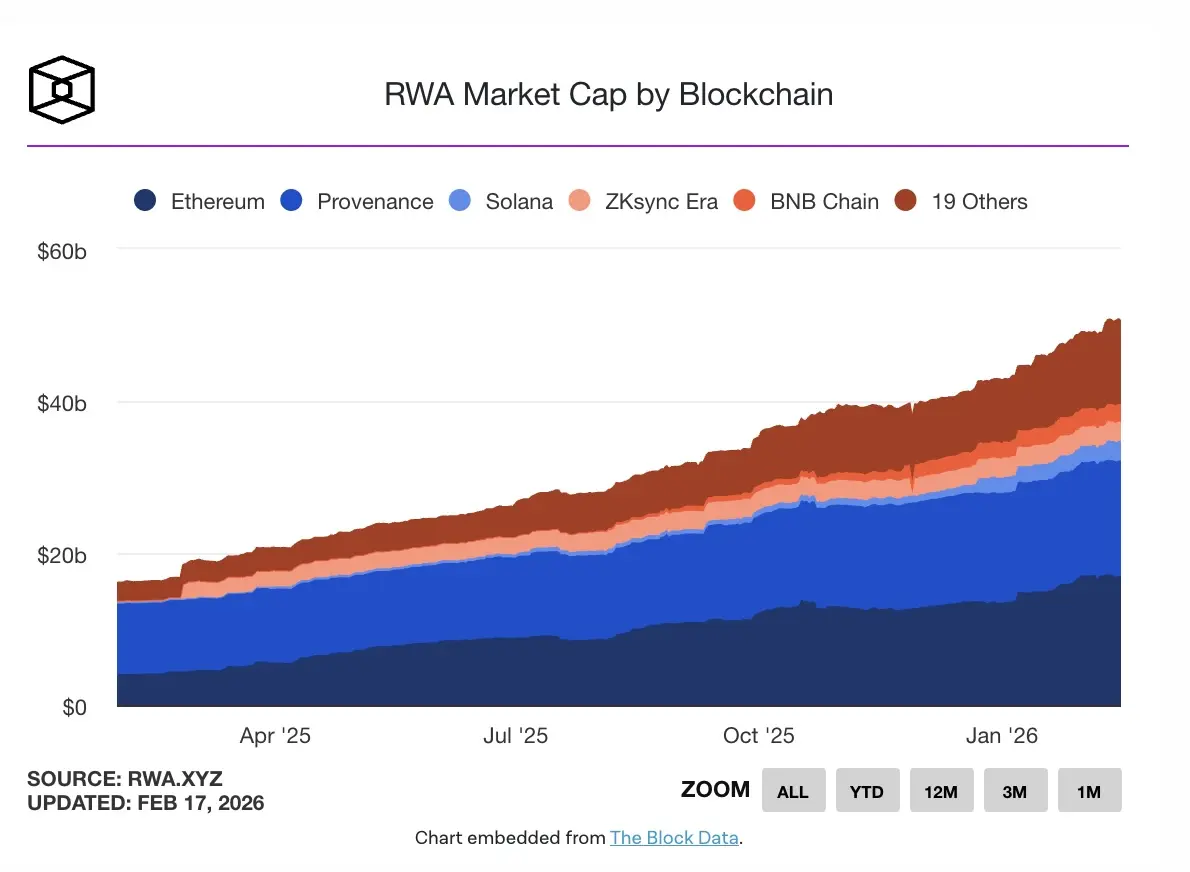
The RWA boom reflects the accelerating trend among traditional financial institutions to convert familiar products into blockchain-based formats. Many Wall Street institutions are developing native blockchain tools for payments, savings, and investment on Ethereum.
BlackRock’s BUIDL US Treasury Bond Fund, tokenized, is a flagship product in this group. Launched in 2024 via the Securitize platform, it invests in short-term US government securities and has become the largest tokenized money market fund on public blockchain infrastructure.
Earlier this month, BlackRock further expanded BUIDL’s utility by enabling direct on-chain trading through UniswapX, in collaboration with Securitize and Uniswap Labs. This is seen as one of the clearest intersections between institutional capital flows and the DeFi ecosystem.
JPMorgan also entered the market by launching its first tokenized money market fund on Ethereum in December, with an initial size of $100 million, targeting qualified investors. This move aligns with the bank’s long-term blockchain strategy and indicates that yield-generating tokenized products are gradually moving beyond crypto-native organizations.
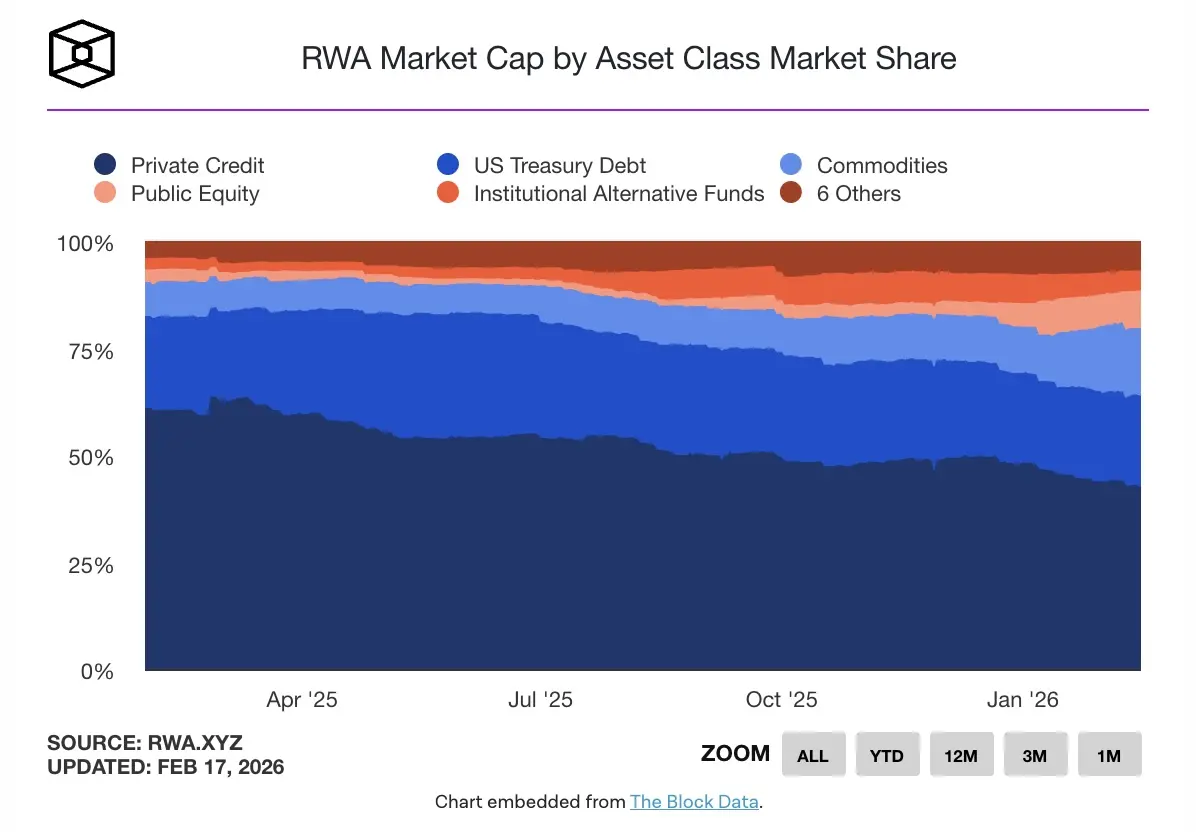
The growth momentum is not limited to government bonds. This week, Wintermute launched organized trading for tokenized gold and forecasts that the tokenized commodities segment could reach $15 billion by 2026. The commodities sector has already contributed over $5 billion to the total RWA value on Ethereum.
The trend of expanding RWAs on Ethereum also aligns with long-term forecasts from major financial institutions. Standard Chartered previously estimated that the tokenized real asset market could reach $2 trillion by 2028, with most issuances on Ethereum. Meanwhile, ARK Invest projects the total value of tokenized assets could rise to approximately $11 trillion by 2030.
Thach Sanh
Disclaimer: The information on this page may come from third parties and does not represent the views or opinions of Gate. The content displayed on this page is for reference only and does not constitute any financial, investment, or legal advice. Gate does not guarantee the accuracy or completeness of the information and shall not be liable for any losses arising from the use of this information. Virtual asset investments carry high risks and are subject to significant price volatility. You may lose all of your invested principal. Please fully understand the relevant risks and make prudent decisions based on your own financial situation and risk tolerance. For details, please refer to
Disclaimer.
Related Articles
Ethereum Korea Consortium Launches to Build Collaborative Blockchain Ecosystem
The Ethereum Korea Consortium launched on April 16 to shift South Korea's Ethereum focus from consumption to contributions, addressing challenges like market structure and regulatory issues. The initiative aims to enhance development and create a supportive ecosystem.
GateNews17m ago
Traditional Brokerage to Launch Spot Bitcoin and Ethereum Trading in Coming Weeks at 0.75% Fee
A traditional brokerage is set to launch spot cryptocurrency trading for retail clients, offering Bitcoin and Ethereum access. The service will include multiple trading platforms, a 0.75% fee, and additional crypto assets planned for the future, reflecting a trend of traditional finance entering the crypto space.
GateNews26m ago
ETH rises 0.65% in 15 minutes: spot buying led to net capital inflows
Between 2026-04-16 15:00 and 15:15 (UTC), the ETH price recorded a +0.65% return. The highest price in the range was 2330.16 USDT, while the lowest was 2308.58 USDT, with a swing of 0.93%. The short-term rally immediately drew market attention, increasing capital activity; volatility remained moderately elevated, characterized by strengthening spot buying power.
The main driving force behind this unusual move is that buy orders in the spot markets of major trading platforms continued to dominate. Within 15 minutes, the buy volume accounted for 58%–59%, and the total buy volume was about 2.2K–2.6K ETH
GateNews3h ago
Bitcoin, Ethereum and Solana ETFs Record Positive Net Inflows on April 16
Gate News message, according to the April 16 update, Bitcoin ETFs recorded a 1-day net inflow of +2,855 BTC (+$209.95M) and a 7-day net inflow of +11,849 BTC (+$871.52M). Ethereum ETFs showed a 1-day net inflow of +15,477 ETH (+$35.44M) and a 7-day net inflow of +90,366 ETH (+$206.94M). Solana ETFs
GateNews3h ago
Ethereum Foundation Announces ETH Rangers Project Results: Over $5.8M in Recovered or Frozen Assets
The Ethereum Foundation's ETH Rangers project has successfully completed, funding 17 researchers to enhance public security in the ecosystem. Achievements include recovering $5.8M in assets, identifying over 785 vulnerabilities, and developing several security tools.
GateNews4h ago
ETH drops 1.23% in 15 minutes: Retail’s concentrated sell-off and amplified ETF fund outflows weigh on the spot order book
2026-04-16 13:45 to 14:00 (UTC), ETH spot prices fell by 1.23% in just 15 minutes. The candlestick price range covered 2291.2 to 2336.98 USDT, with a swing of 1.96%. Market volatility intensified, sell pressure on the board became concentrated, and the trading community’s focus clearly shifted toward changes in capital outflows.
The main driver behind this abnormal move is large-scale, concentrated selling from retail. In the spot market, net outflows in the first 5 minutes reached as high as -$95.57M. Although some lead/major funds attempted to accumulate at lower prices (net inflows of +$18.95M in large orders over 5 minutes), the overall scale was limited and unable to effectively hedge the overall short-term selling pressure. Meanwhile, the ETH futures market did not show extreme liquidations or large-scale position closures, indicating that the core of the abnormal move came from a spot supply-and-demand imbalance rather than leveraged liquidation cascades.
In addition, ETH spot ETF funds have continued to experience net outflows in early April. On April 1, the single-day net outflow was $7.1M. The overall trend in Q1 was bearish, directly reflecting weakening institutional capital allocation intent and further undermining market confidence. Some funds have shifted to on-chain staking and emerging DeFi protocols. It is also worth noting that large holders with holdings in the 100,000-ETH range have continued to reduce their positions since the end of March. Whale capital outflows have persisted, and retail has followed the above signals, leading to a multi-factor selloff resonance effect in the short term. Although both the number of active addresses on the ETH chain and daily trading volume have hit historical highs, network usage and liquidity are overall strong, but capital flow has not formed any substantive spot buy orders, making it difficult to drive a price reversal.
At present, short-term market risk remains significant. Investors should pay attention to the strength of subsequent retail selling, the direction of ETF fund flows, and changes in large-holder positions. If large holders and major funds do not form a strong follow-through/acceptance, the spot market may continue to be affected by the release of structural supply. It is recommended that investors monitor key support zones in real time, track large on-chain fund movements, and watch for macro news developments, in order to reasonably mitigate the risk of short-term price fluctuations and promptly obtain more market information.
GateNews4h ago


