$8.8 billion options are expiring today, with BTC accounting for $7.54 billion and ETH for $1.2 billion. Bitcoin is trading at $82,761, well below the $90,000 level, with a put-call ratio (PCR) of 0.48 indicating bullish dominance but increasing defensive demand. Ethereum is at $2,751, below the $3,000 high, with a PCR of 0.70 showing a more balanced stance. Implied volatility (IV) has decreased, reflecting consolidation, while institutional fund outflows have intensified liquidity pressures.
Bitcoin Breaks Below $90,000, Bullish Options Face Setback
(Source: Deribit)
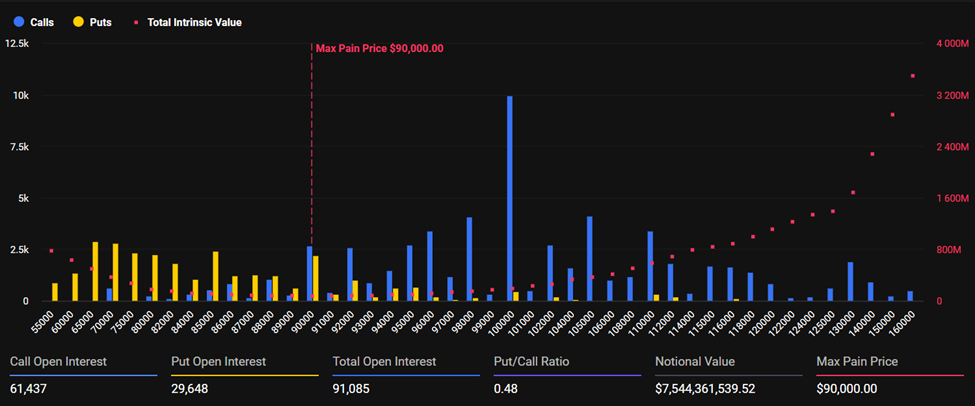
Most of today’s trading activity is concentrated in Bitcoin options, with a notional value of $75.4 billion, while Ethereum options total $12 billion in notional value. Bitcoin is currently trading at $82,761, far below its $90,000 peak. Despite some pullback, structurally, the position remains bullish.
Open interest (OI) in call options is 61,437 contracts, while open interest in put options is 29,648 contracts, leading to a put-call ratio (PCR) of 0.48. The total open interest in Bitcoin options is 91,085 contracts, highlighting the large leverage and position sizes approaching expiry. A PCR of 0.48 means about 2 call options for every put, indicating overall market still leans bullish, but this optimism is being tested.
When Bitcoin’s price hovers around $82,000 and many call options have strike prices at $90,000 or even $100,000, these options will expire worthless. Investors who bought these high-strike calls (possibly above $100,000) will lose their entire premium. The large-scale expiry of these call options signals a shift in market sentiment from extreme optimism to caution.
However, beneath the surface, traders are becoming increasingly defensive. Deribit analysts note that although Bitcoin remains range-bound, the demand for downside protection has surged as expiry approaches. A Deribit analyst states: “Demand for downside protection has increased, indicating that even though positions are still bullish, traders are remaining cautious.”
This defensive behavior is reflected in increased buying of put options. While total open interest in puts is less than calls, recent additions of protective puts at strike prices of $80,000 and $75,000 have risen significantly. Traders are preparing for deeper corrections even while maintaining long positions. This “buying insurance” behavior indicates subtle shifts in market confidence.
They add that options expiry could amplify volatility near key levels, especially around the maximum pain point. The hypothesis is that as expiry nears, prices tend to gravitate toward the maximum pain point, which is the price level where options buyers lose the most and sellers gain the most. For this expiry, the maximum pain point is estimated between $85,000 and $87,000, likely serving as a short-term price magnet for Bitcoin.
Ethereum PCR 0.70 Indicates a More Balanced Stance
(Source: Deribit)
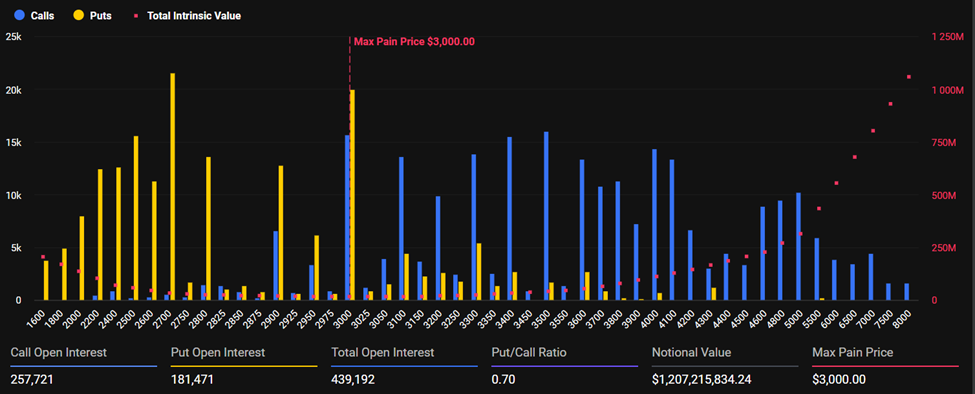
Ethereum’s situation is similar to Bitcoin’s but slightly more balanced. ETH is trading at $2,751, below its $3,000 high. Total open interest in ETH options is 439,192 contracts, with 257,721 call options and 181,471 put options. The resulting put-call ratio is 0.70, indicating a more neutral stance compared to Bitcoin, but still reflecting market caution rather than outright bearishness.
ETH’s PCR of 0.70 is higher than BTC’s 0.48, suggesting that ETH traders’ bearish sentiment is relatively stronger. This may reflect Ethereum-specific fundamentals: Layer-2 solutions divert transaction volume and fee income from the mainnet, ETH burn rates have declined leading to inflationary pressures, and institutional adoption remains weaker compared to Bitcoin. When investor confidence in Ethereum’s long-term prospects wanes, they tend to buy puts as hedges.
Ethereum’s maximum pain point is estimated between $2,800 and $2,900. The current price of $2,751 is very close to this zone, indicating possible consolidation around this level before expiry. A break above $3,000 would turn many calls in-the-money, prompting sellers to hedge and potentially pushing prices higher. Conversely, a drop below $2,700 would increase put buyers’ profits and add downward pressure.
BTC vs ETH Options Market Comparison
Notional Value: BTC $75.4B vs ETH $12B (a 6.3x difference)
PCR Ratio: BTC 0.48 (bullish) vs ETH 0.70 (more balanced)
Current Price vs Key Levels: BTC far from $90,000 (-8%) vs ETH near $3,000 (-8.3%)
Market Sentiment: BTC cautious bullish vs ETH neutral/bidirectional
IV Decline Masks Rising Liquidity Risks
On the macro level, market volatility expectations continue to weaken. According to Greeks.live analysts, implied volatility (IV) has been gradually declining, reinforcing the overall consolidation trend in the crypto markets. Greeks.live states: “Today marks the first monthly expiry of 2026, with over 25% of options positions expiring. As expected, the Fed did not cut rates. With no major events recently, the market remains quite stable, and implied volatility continues to trend downward.”
A decline in IV is often seen as a sign of market calm, but Greeks.live warns this could be “calm before the storm.” Bitcoin has retreated into its consolidation zone in the second half of the month, with $90,000 serving as a strong resistance level. The analysts add: “There appears to be no decisive factor capable of breaking this deadlock,” suggesting that options expiry itself may be one of the few catalysts for short-term volatility.
Beneath the calm surface, risks are brewing. Greeks.live points out that recent large outflows of institutional funds from exchanges have worsened liquidity pressures in the crypto market. US stocks related to crypto have also weakened, further dampening sentiment. Against the backdrop of escalating geopolitical tensions and growing fears, uncertainty and doubt persist.
Ahead of the Fed’s rate decision, some traders have been hedging short-term volatility by buying downside protection, and this trend continues even after the central bank’s decision to hold rates steady. With no clear macro catalysts recently, traders seem prepared for potential short-term market swings around expiry, hedging downside risks while waiting for a decisive breakout of Bitcoin from the $80,000 to $90,000 range.


