
Vitalik proposes Ethereum exit testing and standardization, Yakovenko criticizes stagnation as leading to demise, highlighting the fundamental divergence between Ethereum and Solana in the trade-off between decentralization and performance.
Vitalik Buterin’s “Exit Test” Sparks Industry Debate
Ethereum co-founder Vitalik Buterin recently issued a series of in-depth outlooks on the network’s future, defining 2026 as the key year for Ethereum to regain its core values and reverse the “regression” of the past decade.
In his statement, he clearly points out that Ethereum has made excessive compromises on decentralization and privacy in pursuit of mainstream adoption, resulting in current node operation difficulties, DApp reliance on centralized servers, and block-building power increasingly concentrated in a few large entities.
To address this, he proposes a highly indicative technical standard: the “Walkaway Test,” advocating that the Ethereum protocol should reach a state of “self-sufficiency.” The so-called “Walkaway Test” means Ethereum should have the capability to operate securely, reliably, and uninterrupted for decades even if the current development team and leadership collectively leave.
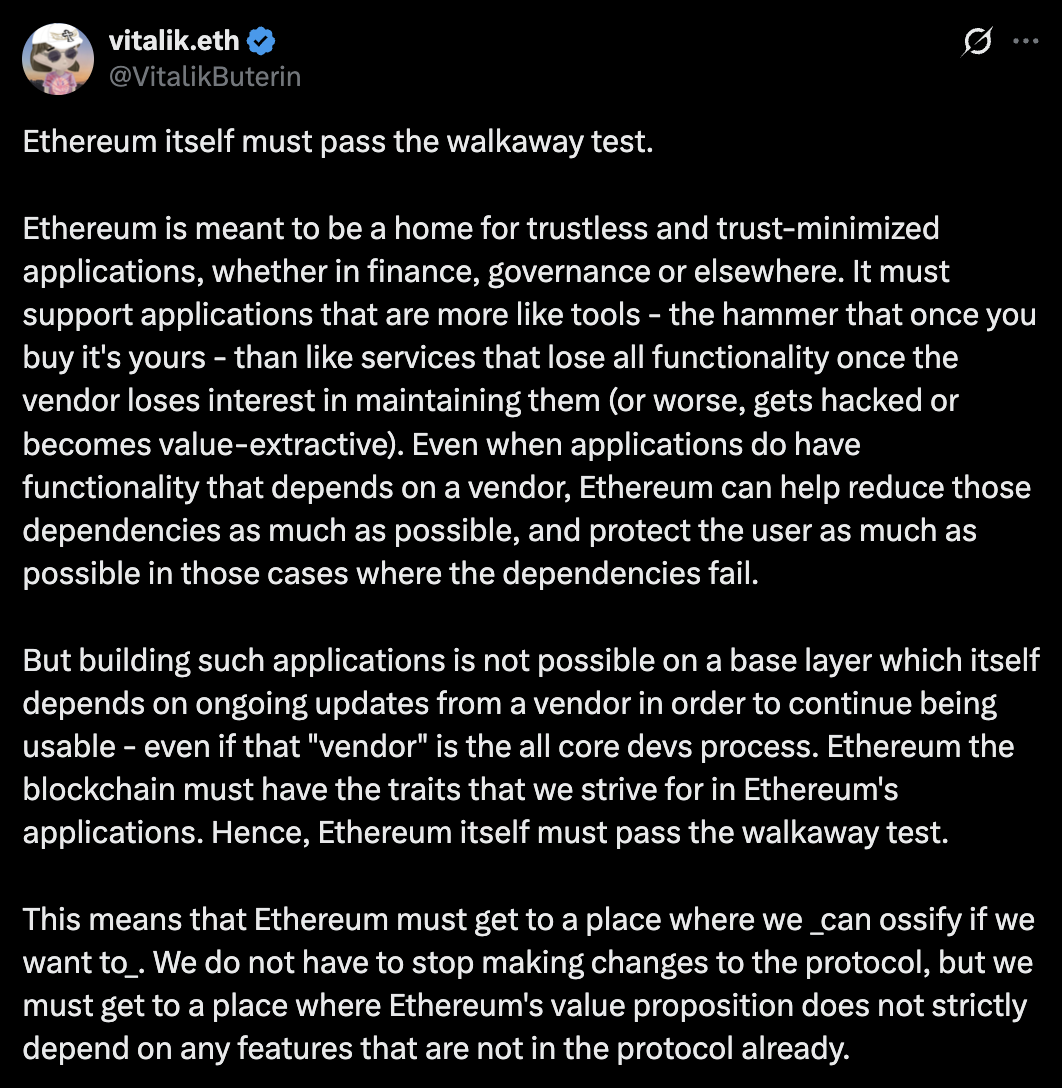
Image source: X/@VitalikButerin Vitalik Buterin proposes a highly indicative technical standard: the “Walkaway Test”
Vitalik emphasizes that an ideal blockchain protocol should implement “ossification” after reaching a certain stability stage, making it akin to basic tools like a hammer, which can serve as a trust foundation at the lowest layer without requiring mandatory updates from developers.
He believes that to truly minimize trust in applications, the underlying layer should not change frequently. This pursuit of protocol stability and “centuries-long cryptographic security” forms the core vision of Ethereum’s long-term development, but also invites high-profile skepticism from competitors.
“Not evolving is like waiting to die”: Yakovenko sharply criticizes the self-sufficiency theory as leading to protocol demise
In response to Vitalik Buterin’s ideas of “standardization” and “self-sufficiency,” Solana co-founder and Solana Labs CEO Anatoly Yakovenko publicly expressed a completely different stance on social platform X, directly challenging Ethereum’s long-term development approach.
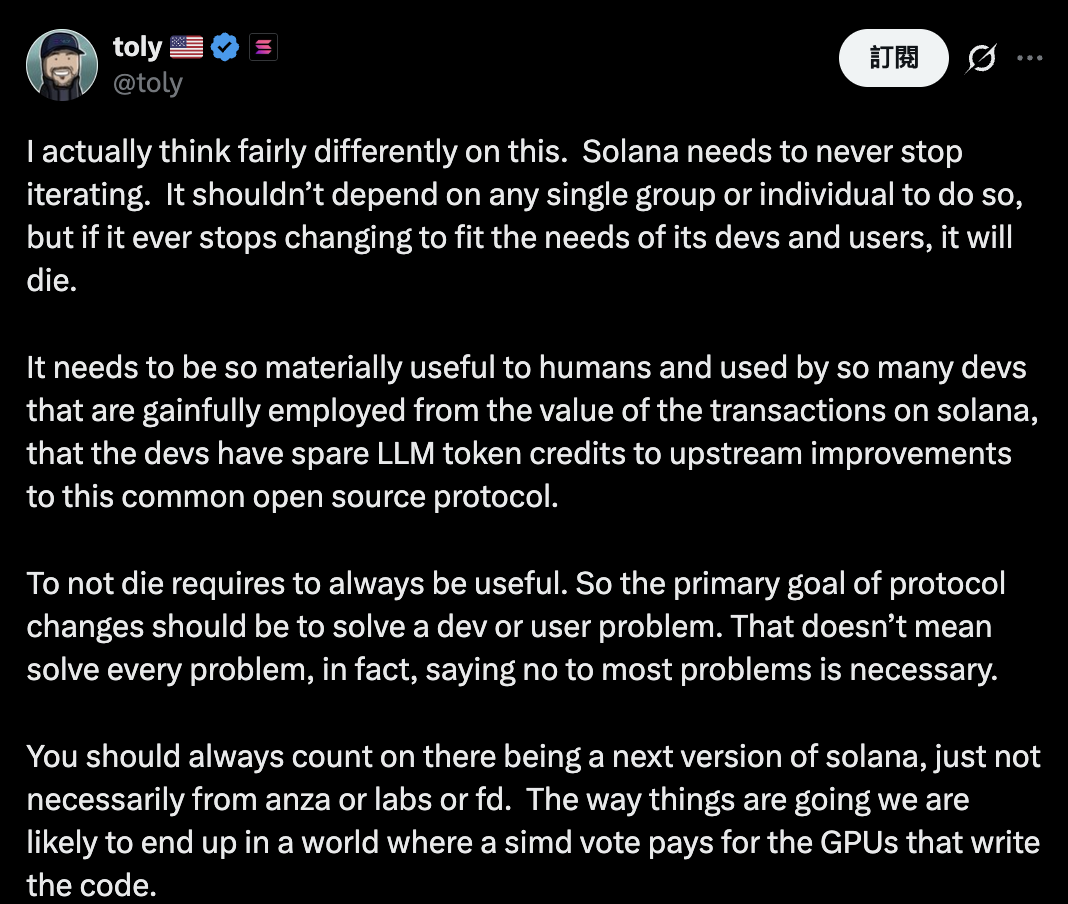
Image source: X/@toly Solana co-founder and Solana Labs CEO Anatoly Yakovenko immediately voiced a contrasting position, directly challenging Ethereum’s long-term development strategy
Anatoly Yakovenko sharply points out that blockchain networks must never stop iterating, warning that any protocol that halts adaptation to user and developer needs in pursuit of so-called self-maintenance will ultimately face death.
Yakovenko believes that a successful blockchain should provide “materially useful” benefits to humanity, which requires the network to continuously adjust and evolve to keep pace with rapidly changing technology environments and market demands. He opposes locking protocols into a specific state and emphasizes that Solana’s core philosophy is “never stop iterating.”
In his view, blockchains are not rigid tools but dynamic ecosystems. If the pursuit of Vitalik Buterin’s so-called “exit test” leads to abandoning innovation and adaptability, the network will soon be replaced by faster, more flexible competitors capable of solving real-world problems. This debate over “continuous innovation” versus “stabilization” has also thoroughly exposed the development gap between the two mainstream chains.
AI-driven and community collaboration: Solana’s new blueprint for decentralized evolution
While countering Vitalik Buterin, Anatoly Yakovenko also sketches out Solana’s future development blueprint, which contrasts sharply with Ethereum’s minimalistic protocol layer approach. He boldly predicts that future versions of Solana will not rely on core organizations like Solana Labs, Anza, or the Solana Foundation to drive development, but instead be maintained by a broader global contributor community.
He even proposes a sci-fi-inspired idea: future Solana network fees could directly fund AI-assisted development, utilizing artificial intelligence to write, improve, and optimize Solana’s codebase.
Yakovenko states that future upgrades should adopt a “selective mode,” aiming to address specific pain points faced by developers and users rather than blindly satisfying all demands. He suggests that the ecosystem could allocate computational resources through mechanisms like SIMD governance voting, rewarding those willing to contribute code to the protocol.
This perspective emphasizes that true decentralization is not about making developers “disappear,” but about dispersing and automating the power to develop so that no single entity can monopolize the network’s progress.
Compared to Ethereum’s attempt to build a “100-year unchangeable” fortress, Solana leans toward creating a living organism driven by artificial intelligence and collective wisdom, capable of infinitely expanding with market dynamics.
The crossroads of performance and value: the philosophical clash between two blockchain giants
The confrontation between Ethereum and Solana leaders essentially reflects the deepest philosophical clash in blockchain development: should we pursue absolute decentralization and privacy, or prioritize user experience and extreme performance?
Ethereum plans to, by 2026, leverage technologies like ZK-EVM, BAL, and Helios to re-decentralize power to individual node operators, even willing to accept slower development to protect user privacy. Vitalik Buterin’s advocacy for “garbage collection” mechanisms aims to minimize complexity, ensuring protocols are understandable and verifiable by beyond just experts.
However, for Yakovenko and his supporters, the pursuit of extreme simplification and ossification often means losing competitive advantage. Currently, Solana’s success as the fastest network with strong performance in consumer applications and fee revenue is built on rapid iteration. While Ethereum supporters criticize excessive feature updates for increasing bugs and centralization risks, Solana’s camp questions whether a protocol that cannot promptly fix errors or adopt new technologies (like quantum resistance) to respond to current threats is inherently more risky.
The debate highlights a dilemma in blockchain: should it become a stable, gold-like asset with little flexibility, or an internet-like platform that is complex but constantly evolving?
The evolution of the blockchain ecosystem
Whether it is Vitalik Buterin’s vision of “self-sovereignty” or Yakovenko’s “iterative survival,” both point toward a major paradigm shift in the blockchain industry by 2026. Ethereum will test its ability to regain its original decentralization through milestones like the Kohaku upgrade and Glamsterdam hard fork, including introducing better social recovery wallets that allow over ten million users to securely recover assets even if they lose keys, without succumbing to centralized platforms.
Meanwhile, Solana’s “Adapt or Die” spirit will continue to drive its exploration in high-performance industries, especially as AI involvement in development raises questions about maintaining network stability and security—becoming a focal point for global investors. Although the two chains pursue vastly different paths: one aims for a “world computer” with long-term stability, the other for pragmatic solutions to immediate human pain points, as Vitalik Buterin states, regardless of technological evolution, the core philosophy of blockchain should be “no central owner, no single point of failure.”
This clash between the two giants’ technologies is not just about differing opinions but will ultimately determine the future trajectory of global digital assets and trust infrastructure over the next decade.


