BitMine staking 1.53 million ETH accounting for 4% of the total supply has triggered a verification queue exceeding 2.3 million ETH, with wait times reaching a new high of 40 days. The total staked amount has surpassed 36 million ETH, representing 30% of the circulating supply, leading to liquidity tightening. The yield has compressed to 2.81%, with 21Shares forecasting three scenarios: baseline $4,800, optimistic $7,500, and bearish $1,800.
$5 billion staked triggering historic queue crisis
BitMine is the largest corporate holder of Ethereum, having successfully staked 1.53 million ETH worth over $5 billion. This large-scale allocation accounts for about 4% of all staked ETH and effectively pushes the network into a new phase of institutional stress testing. As a result, the total ETH locked on the Beacon Chain has exceeded 36 million, setting a new record. Notably, this figure accounts for approximately 30% of the network’s circulating supply.
This massive migration by BitMine immediately caused network congestion. The queue of Ethereum stakers has exceeded 2.3 million ETH, with an average wait time of about 40 days. This is the highest level since August 2023. The 40-day wait is significant for the market as it directly impacts ETH’s liquidity characteristics.
When a large entity stakes 1.53 million ETH, these assets do not disappear from the ledger—they just become more difficult to mobilize. Ethereum’s validator economic mechanisms and protocol rules create friction, fundamentally changing the asset’s liquidity profile. Unlike cold storage assets that can be sent to exchanges within minutes, staked ETH requires queuing for activation and has withdrawal restrictions.
For financial markets, this number is highly significant because the spot price of ETH is determined by available liquidity, not by the theoretical total supply. Therefore, if demand from other institutional participants remains unchanged and this “sticky” supply is removed from circulation, the reduced circulating supply could amplify price volatility in either direction. This change in liquidity structure makes ETH more akin to bonds rather than highly liquid assets.
The paradox of daily million-dollar earnings
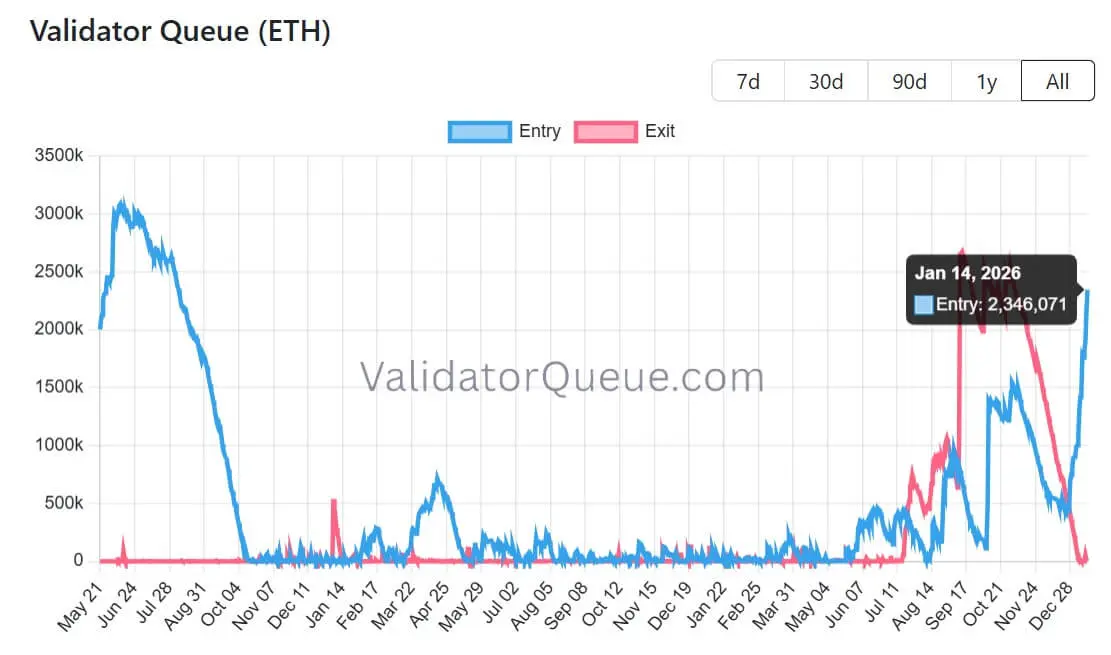
(Source: ValidatorQueue)
BitMine’s promotional materials emphasize the main driver of this strategy: yield creation. Earlier this week, the company forecasted that, assuming a combined staking rate (CESR) of 2.81%, its annual revenue would be approximately $374 million. This translates to over $1 million in daily income. For corporate finance departments, this yield transforms Ethereum from a speculative asset into a productive asset with native cash flow.
However, this corporate transformation introduces a paradox for the broader market. Ethereum’s revenue is generated endogenously from network activity and shared among all stakers. As more funds flow into staking contracts, the yield per ETH decreases. This compression creates a feedback loop that warrants close attention, especially as Ethereum’s annual staking yield declines while high-grade fiat yields remain attractive.
Three chain reactions of yield compression
Marginal stakers exit: When ETH staking yields fall to 2.81% and U.S. Treasury yields exceed 4%, capital may flow into fiat assets.
Liquidity trap intensifies: Falling yields prompt more withdrawals, but the 40-day wait makes exit difficult, creating a liquidity trap.
Price volatility amplifies: Reduced effective circulating supply magnifies the impact of buy/sell orders on prices, increasing market volatility.
Thus, the near-risk-free interest rate attractiveness in crypto diminishes, and marginal stakers may become sensitive to price movements or seek higher-risk avenues for returns. This yield competition could become a key factor influencing ETH’s price trajectory by 2026. If the Federal Reserve begins cutting interest rates, declining fiat yields will make ETH staking more attractive again; but if rates stay high, ETH stakers may face capital outflows.
Single entity 4% governance risk
BitMine holds about 36 million ETH, representing 4% of total staked ETH, making it a “top-tier” validator with enough influence to impact risk models. Ethereum’s security relies on widespread distribution of stake across numerous operators with different infrastructure. When a single corporate entity controls such a large validator share, institutional investors must weigh three specific risks: correlation risk, compliance pressure, and market reflexivity.
Correlation risk refers to if BitMine’s validator nodes share cloud service providers, client configurations, or key management systems, technical failures are no longer isolated events. Operational errors could instantly affect 4% of the network, creating “tail risk” that the protocol aims to avoid. Compliance pressure involves regulated high-profile players becoming targets of political or legal pressure; even without malicious intent, large validators might be forced to censor transactions, creating “protocol risk premium.”
Market reflexivity makes concentrated holdings a macro variable. If Ethereum rises on news of “adopting treasury bonds,” it could also fall due to fears of “treasury exit.” Investors now need to monitor not only the Ethereum Foundation or developer initiatives but also how BitMine plans to handle its large ETH holdings.
Three scenarios: $4,800 to $1,800
CryptoSlate uses scenario-based modeling to estimate how BitMine’s continued accumulation could reshape staking dynamics. In the baseline scenario, a “sticky staking” mechanism forms, with BitMine continuing to stake but at a slower expansion rate, maintaining stable staking demand, with yields gradually declining, and ETH trading at a slight premium as collateral assets. 21Shares projects a target price around $4,800 by the end of 2026.
In the optimistic scenario, Ethereum evolves into a true asset-balance sheet collateral, with BitMine signaling early corporate strategy. The market values Ethereum’s yields, settlement utility, and collateral options, supported by growth in stablecoins and tokenization. If on-chain USD demand accelerates, 21Shares forecasts a bullish target near $7,500.
The bearish scenario highlights “corporate financial reflexivity,” where accumulation periods tighten circulating supply. If corporate holders face financial stress or stricter risk constraints, the asset could be re-priced at a higher discount rate. If investors doubt the longevity of the strategy, ETH could be revalued at a higher discount rate, with 21Shares projecting a bearish price around $1,800.
Disclaimer: The information on this page may come from third parties and does not represent the views or opinions of Gate. The content displayed on this page is for reference only and does not constitute any financial, investment, or legal advice. Gate does not guarantee the accuracy or completeness of the information and shall not be liable for any losses arising from the use of this information. Virtual asset investments carry high risks and are subject to significant price volatility. You may lose all of your invested principal. Please fully understand the relevant risks and make prudent decisions based on your own financial situation and risk tolerance. For details, please refer to
Disclaimer.
Related Articles
Ethereum Foundation Launches "Hardness" New Direction: Censorship Resistance, Privacy, and Post-Quantum Security All at Once
The Ethereum Foundation emphasized "Harden the L1" as a core priority in its 2026 update, ensuring censorship resistance, privacy, and security are maintained while scaling. Led by three members, it covers technical improvements and user protection work, emphasizing the continuity and resilience of core attributes to meet user needs.
動區BlockTempo36m ago
Over the past 24 hours, the entire network has liquidated $311 million, with long positions accounting for 64% of liquidations.
On March 20, Gate News reported that across the entire network over the past 24 hours, liquidations reached $311 million, with long positions liquidated for $200 million and short positions liquidated for $111 million. Both long and short positions in Bitcoin and Ethereum experienced varying degrees of liquidation, with 103,431 people globally liquidated. The largest single liquidation occurred on the XYZ:GOLD-USD trading pair, valued at $3.675 million.
GateNews1h ago
Bitcoin Briefly Falls Below $70,000 Mark During Asian Session as Fed Hawkishness and Macro Uncertainty Weigh on Market Volatility
Bitcoin fell below 70,000 on March 19, touching approximately 69,537, reflecting market concerns about the Federal Reserve maintaining high interest rates. Bitcoin subsequently rebounded to around 70,180, demonstrating psychological support at the 70,000 level. Despite improved market fund inflows, cryptocurrencies continue to face challenges amid global macroeconomic pressures, with 70,000 becoming a critical near-term level.
区块客1h ago
ETH 15-minute gain of 0.67%: On-chain capital structure adjustment and derivatives long liquidation convergence driving price movement
2026-03-20 07:30 to 2026-03-20 07:45 (UTC), ETH recorded a return rate of +0.67% within 15 minutes, with a price range of 2136.67 - 2153.1 USDT and a volatility of 0.77%. The short-term price surge was accompanied by a rapid increase in trading volume, rising market attention, and intensified fluctuations.
The main driver of this movement is the concentrated transfer of large on-chain funds and the adjustment of capital structure between spot and derivatives markets. Data shows that early ICO holders transferred nearly 40,000 ETH (approximately $119 million) to
GateNews1h ago
A certain whale bought 17,000 ETH again 8 hours ago, with cumulative purchases exceeding 100,000 in the past 10 days.
Gate News reported that on March 20, according to monitoring by crypto analyst Remnants of Embers, a whale or institution that has been continuously accumulating ETH purchased 17,084.3 ETH again 8 hours ago, with a transaction amount of approximately $36.75 million. Since March 10, the entity has cumulatively purchased approximately 103,300 ETH through 5 addresses, with a transaction amount of approximately $222 million, at an average price of approximately $2,151.
GateNews2h ago
Ethereum TVL Continues to Lead L1 Track: DeFi, Institutional Capital, and Network Effects Build Moat
Ethereum maintains its leading position in the L1 blockchain market with its superior Total Value Locked (TVL), continuously attracting concentrated capital and users. Its mature smart contracts and decentralized architecture deepen the ecosystem, attracting institutional participation. Although other chains have advantages in efficiency and cost, Ethereum still leads significantly in stability and application composability. Future competition will focus on performance and application scenarios.
GateNews3h ago


