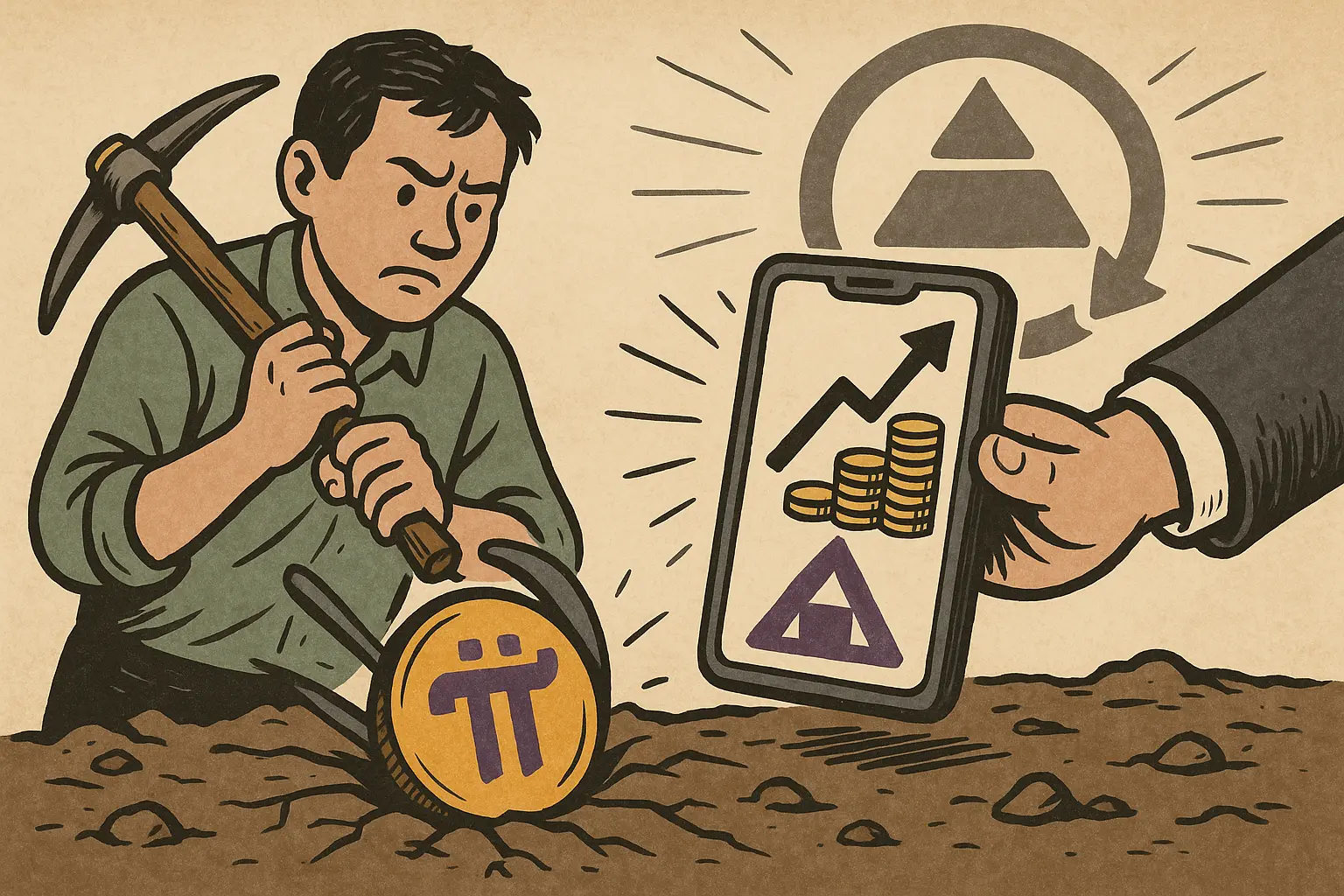
PINIX App announces 151% profit over 30 days mining, with a daily yield of 5%, claiming cloud mining requires no equipment. Depositing 1000 PI turns into 1500 PI in 30 days, sparking community doubts about a Ponzi scheme. PINIX has not released audited financial reports or disclosed revenue sources. Experts warn that a 151% 30-day return severely violates financial common sense, and similar models have historically collapsed.
Analysis of the Unreasonableness of 151% Monthly Return
PINIX App has released a new version for Pi coin mining, confirming a significant increase in profitability in the mining sector. This upgrade applies to a 30-day mining cycle, raising the overall mining yield to 151.314%, up from 134.314%. The update also increased the daily yield, now set at 5.044%. This news immediately drew attention from the Pi Network community, with many users curious and some cautious.
A return of over 150% in 30 days is a dangerous signal for all cryptocurrency markets. On one hand, similar models have failed in the past. Many projects rely on new deposits rather than actual earnings. Sustainable mining is almost impossible to generate such high returns. Let’s examine this claim with basic math.
If daily yield is 5.044%, theoretically, the principal grows by 5.044% each day. Compound interest over 30 days should be (1 + 5.044%)^30 ≈ 431%, not 151%. This mathematical inconsistency is itself a red flag. Even if calculated at 151%, it corresponds to a monthly rate of 151%, and an annualized return would exceed 180,000%. Such returns have never persisted in human financial history; even peak hedge funds cannot achieve this.
Comparison of 151% Monthly Return with Traditional Investments
US Stock Annual Average Return: about 10% (S&P 500 historical average)
High-Risk Hedge Funds: 20-30% annually are considered top-tier
PINIX Claimed Return: 151% monthly, over 180,000% annually
Historical Lesson: Madoff Ponzi scheme collapsed with promised annual returns of 10-12%
Features of Ponzi Schemes in Cloud Mining Models
PINIX team states that this update aims to improve mining efficiency, encouraging users to maximize $PI and $PINIX token yields. The system requires no physical mining hardware, instead adopting a cloud mining model. After depositing Pi tokens, users receive returns over a certain period. An example provided by the team shows that a deposit of 1000 PI can grow to over 1500 PI in 30 days.
This “deposit to earn interest” model has appeared repeatedly in crypto history and has been proven to be a Ponzi scheme multiple times. Genuine mining requires hardware, electricity costs, maintenance expenses—these costs limit profitability. Cloud mining claiming to be profitable without equipment—where does the profit come from? The only plausible explanation is: new user deposits pay old user “returns,” which is the classic Ponzi scheme definition.
PINIX has yet to release audited financial information or disclose its income sources. These gaps cause confusion among users. Transparency is crucial; a clear token economic model is vital, and future sustainability is more important than short-term profits. PINIX has not provided much technical documentation so far, fueling ongoing controversy.
Its close relationship with the Pi Network ecosystem warrants attention. PINIX is under Pi Network, a mobile-based mining platform emphasizing ease of use and community expansion. However, Pi Network itself is controversial, with limited scope. User opinions on third-party apps like PINIX are influenced by Pi Network’s own environment.
The mainnet of Pi Network has been delayed multiple times, KYC verification progress is slow, and the token has not yet fully circulated on mainstream exchanges. These issues cast doubt on Pi coin’s actual value. Building on this foundation, the high promised returns of PINIX App are even more suspicious.
Community Reactions and Risk Warnings
This news immediately sparked heated discussion on social media. Profit growth is seen as good news by some, who believe it means faster expansion of PINIX holdings. Others express skepticism, questioning sustainability. Some users even publicly accuse the project of being a scam. Although interactions are limited, responses are cautious without overreaction. High-yield crypto projects attract attention, and PINIX App is no exception.
High-return projects carry enormous risks; users must understand this. They need to verify information independently and should not invest funds they cannot afford to lose. The 151.314% surge of PINIX App in the ( mining field is bold, promising more efficient and faster returns. But it also raises serious concerns about sustainability and risk.
Crypto experts unanimously warn that any project promising over 100% monthly returns is 99% likely a scam. Such returns can only be achieved through Ponzi schemes: using new funds to pay old users’ “profits,” until new funds run out, system collapses, and latecomers lose everything. Countless similar cases in history—BitConnect, PlusToken, OneCoin—used high returns to attract victims, then ran away with the money.
For Pi coin holders considering participating in PINIX, extreme caution is advised. Even if you believe in Pi Network’s long-term value, it doesn’t mean third-party apps like PINIX are trustworthy. If you choose to try, only invest a tiny amount you can afford to lose, and be prepared for the platform to disappear at any time. A wiser choice is to stay completely away from such high-return promises and focus on the development of the official Pi Network ecosystem.
Disclaimer: The information on this page may come from third parties and does not represent the views or opinions of Gate. The content displayed on this page is for reference only and does not constitute any financial, investment, or legal advice. Gate does not guarantee the accuracy or completeness of the information and shall not be liable for any losses arising from the use of this information. Virtual asset investments carry high risks and are subject to significant price volatility. You may lose all of your invested principal. Please fully understand the relevant risks and make prudent decisions based on your own financial situation and risk tolerance. For details, please refer to
Disclaimer.


