
MSCI retains MicroStrategy but freezes the number of shares, cutting off the link between new share issuance and passive buying, ending the flywheel effect. Bull Theory’s quantitative analysis shows that every 20 million newly issued shares result in a $600 million passive buy-in loss. MicroStrategy plans to issue over $15 billion in new shares by 2025. Under the new regulations, dilution effects lack support, increasing the risk of price retracement.
The Hidden Deadly Trap in MSCI’s Freeze Clause
The threat of large-scale forced sell-offs related to cryptocurrency stocks has been avoided. However, this breathing space comes with a structural flaw that fundamentally changes the economic dynamics of “Bitcoin Treasury” trading. MSCI states: “Currently, for those digital assets with holdings listed in the preliminary list that account for 50% or more of total assets, their treatment in the index will remain unchanged.”
After the announcement, MicroStrategy’s Executive Chairman Michael Saylor praised the company’s successful inclusion in the benchmark index, with stock prices soaring over 6%. However, the market quickly uncovered the deadly clause hidden in the fine print. MSCI also implemented a technical freeze on the share counts of these entities: “MSCI will not increase the number of shares (NOS), Foreign Inclusion Factor (FIF), or Domestic Inclusion Factor (DIF) for these securities. MSCI will delay any additions or size adjustments for all securities on the preliminary list.”
Through this decision, MSCI effectively cuts off the link between new share issuance and automatic passive buying. This only eliminates the “downside risk” of forced liquidation, but the “upside risk” mechanism of index trading has been dismantled. The market responded immediately; JPMorgan previously indicated that if completely excluded, it could trigger passive sell-offs of $3 billion to $9 billion in MSTR. Such large volumes could cause a sharp drop in stock prices and force MicroStrategy to sell Bitcoin. While the worst-case scenario is avoided, the cost is losing a more critical growth engine.
How the Flywheel Effect Was Completely Destroyed
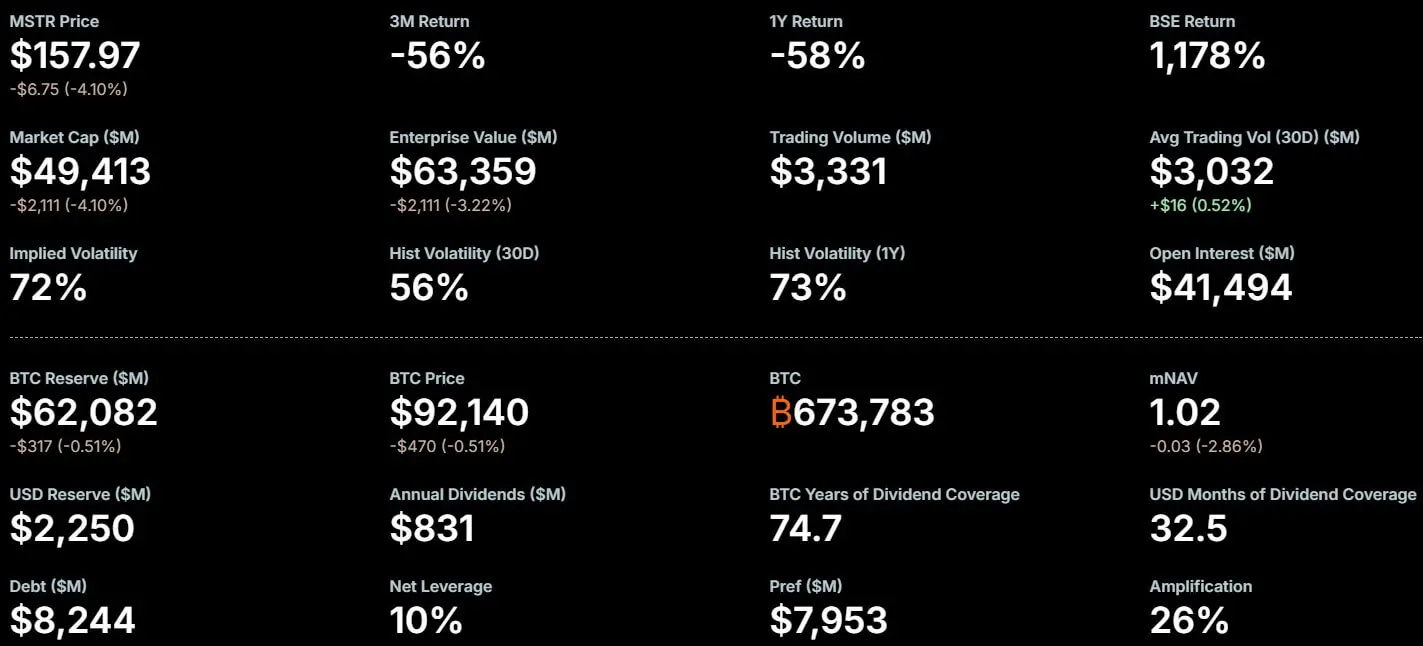
(Source: MicroStrategy)
Historically, when MicroStrategy issued new shares to fund Bitcoin acquisitions, index providers would eventually update the share counts. Consequently, passive funds tracking the index are mathematically compelled to buy proportionally of the newly issued shares to minimize tracking error. This creates a guaranteed, price-insensitive demand source that helps absorb dilution effects. This is MicroStrategy’s “flywheel effect”: Issue new shares → Index updates weights → Passive funds are forced to buy → Price support → MicroStrategy continues issuing → Cycle repeats.
Under the new “freeze” policy, this cycle is broken. Even if MicroStrategy significantly expands its circulating shares to raise funds, MSCI effectively ignores these new shares in index calculations. The company’s weight in the index will not increase, so ETFs and index funds are not forced to buy the new shares. Market analysts point out that this shift forces the market back to fundamentals. Without the support of benchmark index tracking demand, MicroStrategy and its peers now must rely on active fund managers, hedge funds, and retail investors to absorb the new supply.
Crypto research firm Bull Theory quantified this liquidity gap in a client report. The firm assumed a treasury company with 200 million shares outstanding, with about 10% typically held by passive index funds. In Bull Theory’s model, if a company issues 20 million new shares to raise capital, the old index mechanism would ultimately force passive funds to buy 2 million of those shares.
Quantitative Analysis of the Liquidity Gap
Passive Buy Under Old Mechanism: For every 20 million shares issued, passive funds are forced to buy 2 million shares (10%)
Assumed Price per Share: $300
Automatic Buy Scale: $600 million in price-insensitive buying pressure
Under the New Regulation, Passive Buy: Zero
Bull Theory states that, according to MSCI’s latest freeze policy, the $600 million bid will drop to zero. “Now, MicroStrategy must seek private buyers, offer discounts, or reduce financing.” This means the forced demand from index funds has been eliminated. Therefore, this presents a major obstacle for MicroStrategy, which issued over $15 billion in new shares in 2025 to actively accumulate Bitcoin.
If the company attempts to replicate such a large issuance in 2026, it will do so in a market environment lacking passive support. Without this structural support, the risk of price retracement during dilution events will increase significantly. Investors might sell upon each new issuance announcement, expecting prices to fall due to the absence of passive buy-in. This expectation can become self-fulfilling, creating a negative feedback loop.
Spot ETFs Become the Biggest Winner
MSCI’s decision to restrict these companies’ shares, rather than expel or ignore them, also significantly alters the competitive landscape of the asset management industry. Over the past year, US spot Bitcoin ETFs have matured as an asset class and attracted strong institutional interest. From this perspective, MicroStrategy’s competition with fee-charging Bitcoin ETFs offers investors a way to gain passive Bitcoin exposure through operating company structures.
The new regulation freezes digital asset companies’ index weights, weakening their ability to expand effectively via the stock market. If MicroStrategy’s ability to raise cheap capital is limited, large asset allocators may shift funds from the company’s stock to spot ETFs, which do not carry operational risks or exhibit premium/discount volatility relative to NAV. This capital flow will directly benefit the issuers of spot ETFs, including major Wall Street banks, effectively capturing the fees previously reflected in stock premiums.
By weakening MicroStrategy’s “flywheel” effect, index providers may inadvertently or deliberately create a more favorable competitive environment for traditional asset management products. It’s a zero-sum game: the passive buy-in lost by MicroStrategy becomes incremental capital for spot ETFs. For ETF issuers like BlackRock and Fidelity, MSCI’s decision is an unexpected boon.
Disclaimer: The information on this page may come from third parties and does not represent the views or opinions of Gate. The content displayed on this page is for reference only and does not constitute any financial, investment, or legal advice. Gate does not guarantee the accuracy or completeness of the information and shall not be liable for any losses arising from the use of this information. Virtual asset investments carry high risks and are subject to significant price volatility. You may lose all of your invested principal. Please fully understand the relevant risks and make prudent decisions based on your own financial situation and risk tolerance. For details, please refer to
Disclaimer.
Related Articles
Bitcoin Bearish Sentiment Hits 5-Week High As Fear Returns to Crypto Market
Bitcoin (BTC) is heading into the end of the weekend with a familiar mix of nerves and opportunity. A new Santiment readout, amplified by Crypto Rover, says bearish sentiment around BTC has jumped to a five-week high, while the market itself is hovering near $66,972, with an intraday high of $67,487
BlockChainReporter7m ago
TD Cowen analyst reiterates a Buy rating for Strategy (MSTR), with a 2026 target price of $440
Gate News message, April 6, 150 billion-dollar investment bank TD Cowen analyst Lance Vitanza reiterated a buy rating for Bitcoin reserve company Strategy (MSTR), with a 2026 target price of $440.
GateNews11m ago
Solo Bitcoin Miner Wins $210K Block Reward Against Huge Odds
A solo Bitcoin miner has achieved something that most people in the crypto space consider nearly impossible today. The miner successfully validated a block and secured a reward worth around $210,000. This win came despite facing extremely low probability odds, estimated at roughly 1 in 28,000. In a
Coinfomania23m ago
BTC profit/loss trade ratio is 2.95, the highest level in 12 weeks
Gate News message: On April 6, according to Santiment data, the BTC profit-loss trade ratio reached 2.95, the highest level in 12 weeks. This indicator measures the ratio of profitable trades to losing trades; the current value shows that the share of profitable trades in the market is significantly higher than that of losing trades, reaching a recent peak level.
GateNews41m ago
BTC 15-minute pullback of 0.66%: Trade policy shock combined with large holders selling off triggers downside pressure
From 06:15 to 06:30 (UTC) on 2026-04-06, the BTC price dropped from 68807.2 to 69308.1 USDT; the 15-minute return recorded -0.66%, and the amplitude reached 0.72%. During this period, market volatility intensified, with trading volume and social discussion heat increasing in tandem, reflecting intense short-term capital games.
The main driving force behind this abnormal movement came from sudden changes at the macro policy level. The United States has recently increased tariffs and continued its high-tariff policy, causing a sharp drop in global risk appetite and prompting investors to withdraw en masse from high-volatility assets. Related con
GateNews1h ago


