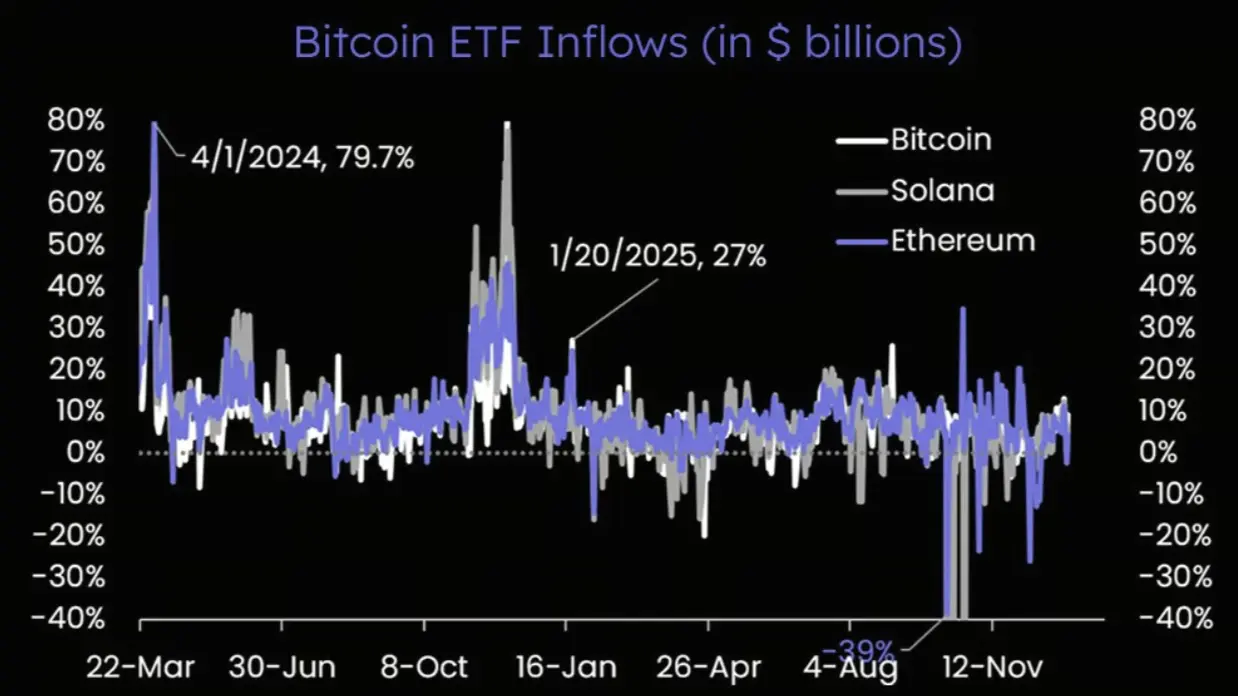
Bitcoin ETF fatigue became a defining theme of 2025 as investors grew tired of overanalyzing noisy daily flow reports that rarely reflected lasting trends. Constant scrutiny of overnight numbers—often twisted into forced narratives about risk sentiment—obscured the bigger picture.
(Sources: X)
In reality, bitcoin ETF fatigue stemmed from the fact that most days contributed little to cumulative totals. A year-end review reveals just ten outlier sessions—five massive inflows and five sharp outflows—that shaped the entire 2025 capital movement for U.S. spot Bitcoin ETFs. These pivotal days clustered around clear catalysts like price momentum, macro shifts, and calendar effects, cutting through bitcoin ETF fatigue to highlight how institutions actually deploy and withdraw capital. This focused lens provides clearer context for navigating bitcoin ETF fatigue into 2026.
Understanding the Roots of Bitcoin ETF Fatigue
Bitcoin ETF fatigue emerged because daily aggregated flows mix unrelated mechanics: rebalances, basis trades, platform quirks, and committee decisions. This noise creates misleading headlines while true directional moves concentrate in high-conviction sessions. By isolating outliers, we dispel bitcoin ETF fatigue and reveal institutional behavior patterns more accurately.
- Daily Reality: Most sessions net near-zero impact.
- Outlier Dominance: ~10 days drove the year’s net flows.
- Key Insight: Capital enters/exits decisively, not incrementally.
- Maturity Signal: ETFs proved efficient for large-scale Bitcoin exposure.
Top 5 Inflow Days That Overcame Bitcoin ETF Fatigue
These sessions demonstrated how bitcoin ETF fatigue fades when conditions align for aggressive positioning:
- October 6, 2025: +$1.21B
Largest single-day inflow amid clear upside breakout—classic momentum chasing as underweight institutions finally committed.
- November 12, 2025: +$873M
Broad relief rally without extreme volatility, reflecting reopened risk budgets and macro stabilization.
- January 10, 2025: +$640M
Anniversary milestone and fresh-year resets drove deliberate allocations in calm markets.
- July 19, 2025: +$512M
Selective rotation during typically quiet summer, capital shifting into Bitcoin as risks clarified.
- December 17, 2025: +$457M
Rapid snap-back after prior outflows, highlighting resilient underlying demand.
Top 5 Outflow Days That Fueled Bitcoin ETF Fatigue
Redemptions were equally concentrated, often tied to predictable de-risking rather than panic:
- December 15, 2025: –$358M
Year-end housekeeping and tax-loss harvesting dominated mid-month trimming.
- December 16, 2025: –$277M
Controlled continuation of portfolio cleanup ahead of holidays.
- September 3, 2025: –$241M
Renewed macro caution triggered broad risk reduction.
- June 4, 2025: –$198M
Measured profit-taking after spring gains.
- August 8, 2025: –$176M
Thin summer liquidity amplified modest redemptions.
Key Takeaways to Move Past Bitcoin ETF Fatigue in 2026
Bitcoin ETF fatigue taught that daily noise distracts from structural signals:
- Inflows surge when momentum or macro relief aligns.
- Outflows cluster around calendar mechanics or risk aversion.
- The ETF wrapper enables efficient, large-scale capital movement—maturing Bitcoin’s institutional integration.
Heading into 2026, filtering out daily headlines in favor of outlier context will help manage bitcoin ETF fatigue more effectively. Focus on when—and why—institutions move decisively, rather than reacting to every minor print.
In summary, bitcoin ETF fatigue in 2025 highlighted the importance of perspective: ten decisive days defined the year, while hundreds of others added little. This pattern underscores Bitcoin’s evolving role in traditional portfolios through regulated, scalable vehicles. For ongoing monitoring, track aggregated weekly or outlier flows via reliable sources, and always use compliant platforms when researching cryptocurrency investments.
Disclaimer: The information on this page may come from third parties and does not represent the views or opinions of Gate. The content displayed on this page is for reference only and does not constitute any financial, investment, or legal advice. Gate does not guarantee the accuracy or completeness of the information and shall not be liable for any losses arising from the use of this information. Virtual asset investments carry high risks and are subject to significant price volatility. You may lose all of your invested principal. Please fully understand the relevant risks and make prudent decisions based on your own financial situation and risk tolerance. For details, please refer to
Disclaimer.
Related Articles
Analyst: April could be a key observation period for Bitcoin; the RSI is in the neutral range, and volatility may rise
April is typically a stronger month for Bitcoin’s performance, with a historical average monthly gain of about 11.3%. But since 2020, this pattern has become less stable. Bitcoin’s relative strength indicator is currently 47%, and market sentiment is being influenced by geopolitical and inflation concerns. This suggests that April’s volatility may rise, so it’s important to watch whether the market can form a clear direction.
GateNews12m ago
Caltech Research Shows Quantum Bitcoin Threat Could Arrive with 10,000 Qubits
A team from Caltech and startup Oratomic published research on March 31, 2026 demonstrating that a fault-tolerant quantum computer capable of running Shor’s algorithm could be built with as few as 10,000 physical qubits, dramatically reducing previous estimates that placed the requirement at one million qubits or higher.
GateNews25m ago
Empery Digital reduced its holdings by 79 BTC last week, bringing its position down to 3,359 BTC
Gate News reports that on April 1, Nasdaq-listed Bitcoin treasury company Empery Digital disclosed that it sold 79 bitcoins last week at an average price of $71,031, generating total proceeds of approximately $5.6 million. Its total bitcoin holdings have decreased to 3,359 bitcoins. Additionally, the company revealed that to date, it has invested about $137 million to repurchase 23,630,147 shares of common stock. Going forward, it will continue to sell bitcoin as needed to fund future stock buybacks and may also repay some outstanding debt.
GateNews54m ago
A certain CEX still has 4,619 BTC in outstanding borrowings owed to the related party Winklevoss Capital
On April 1, Arkham analyst Emmett Gallic disclosed that a cryptocurrency exchange has not yet repaid a BTC loan of 4,619 BTC, worth approximately $314 million, with an annual fee rate of 4%-8%, no fixed maturity date, and lenders able to demand repayment at any time. Historically, the exchange has borrowed more than 11,000 BTC and 133,000 ETH.
GateNews1h ago
BTC 15-minute modest uptrend of 0.49%: institutional fund flows are driving short-term price anomalies
2026-04-01 03:00 to 2026-04-01 03:15 (UTC), BTC fluctuated in the 67,663.9 to 68,103.8 USDT range. The candlestick return rate recorded +0.49%, with an amplitude of 0.65%. During this period, market attention warmed up, with on-chain activity and trading volume increasing in tandem. Heightened short-term capital inflows and outflows triggered mild price fluctuations, and traders’ sentiment turned more cautious.
The main driving force behind this unusual move was dominated by institutional fund flows, including whales and institutions making large transfers to exchanges and withdrawals within 10 minutes; meanwhile, whales also transferred large amounts to the exchange and moved funds out to other addresses, indicating active capital repositioning during this period.
GateNews1h ago


