
Pai Coin 4-hour chart shows a clear ascending triangle pattern, with the price rebounding strongly from the support trendline and approaching the resistance zone of $0.2129 to $0.2160. Bitcoin and Ethereum have risen over 7% this week, boosting market sentiment. Pai Coin’s technical breakout conditions are now mature, with a target of $0.2404, representing a potential increase of about 13%.
Three Major Bullish Signs of Pai Coin’s Ascending Triangle
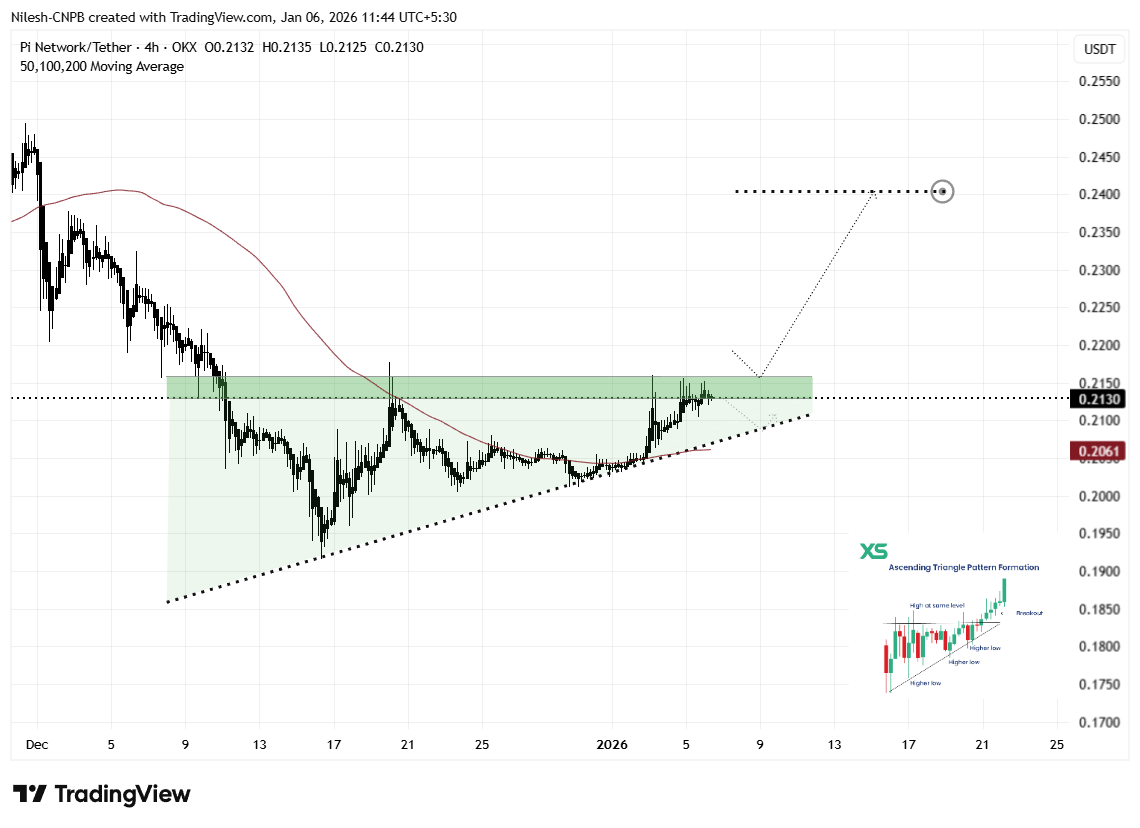
(Source: Trading View)
Pai Coin is forming a textbook ascending triangle pattern on the 4-hour chart. The core feature of this pattern is a series of higher lows continuously approaching a flat resistance zone, indicating that despite multiple rejections at the same level, buying interest remains strong. Ascending triangles are generally considered bullish continuation patterns, especially when they appear after a prolonged consolidation, with a significantly increased probability of a successful breakout.
The first bullish sign is the continuous elevation of lows. Recently, Pai Coin rebounded strongly near the upward support trendline, with the price once again approaching the upper boundary of the triangle. Each pullback is supported at higher levels, demonstrating that buyers still control the market and are willing to buy on dips rather than close positions. This dip-buying behavior is a typical characteristic of institutional and smart money participation.
The second bullish sign is the ongoing narrowing of volatility. As the price oscillates between the upward support line and the horizontal resistance line, the range of fluctuation gradually decreases. This compression process is similar to a spring being squeezed tighter and tighter; once the direction breaks out, the energy released often propels the price rapidly. Historically, initial moves after an ascending triangle breakout tend to be swift, providing traders with a shorter entry window.
The third bullish sign is multiple tests of resistance without breaking support. Pai Coin has tested the $0.2160 resistance level several times, but each time the pullback after failure is shallower than the previous, and the support trendline remains effective. This behavior indicates that selling pressure is gradually being absorbed. Once the last batch of profit-taking and panic selling are cleared, breaking resistance will become relatively easier.
Key Price Levels and Breakout Path
Currently, Pai Coin is in the third or fourth test of the $0.2160 resistance level. According to technical analysis theory, the more times a resistance is tested, the higher the probability of a successful breakout, as each test consumes some selling pressure. If the price can decisively break above this resistance and sustain above it, then retest the resistance as support, it will confirm the ascending triangle structure and potentially trigger a stronger rally.
The confirmation of a breakout is not only about the price piercing the resistance level but also about volume. An ideal breakout should be accompanied by a significant increase in volume, indicating genuine buying interest rather than a false breakout. Additionally, a daily close above $0.2160 is another critical confirmation signal. Temporary intraday breakouts may be false signals; only a close above the level can reduce the risk of being trapped by a false breakout.
Using the classic measurement method for ascending triangles, the target price after breakout is usually the vertical distance from the pattern’s bottom to the resistance level added to the breakout point price. Based on this calculation, Pai Coin’s technical upside target is around $0.2404. This target aligns with previous price structures, further reinforcing the bullish outlook. More aggressive traders might even set their target at the psychological level of $0.25.
Three Key Price Thresholds for Pai Coin Breakout
First threshold: $0.2160 (current resistance, breakout requires volume confirmation)
Second threshold: $0.2200 (psychological level, daily close above needed to confirm trend)
Third threshold: $0.2404 (technical measurement target, representing about 13% potential gain)
Risk Management and Trading Strategy
Although the technical signals are clearly bullish, caution remains essential. Pai Coin only gained about 5% over the past week, significantly less than Bitcoin and Ethereum’s 7% rise, indicating that Pai Coin’s upward momentum might be somewhat lacking. If Pai Coin fails to break the resistance, the price could fall back toward the upward support trendline. As long as this support line remains valid, the overall bullish structure stays intact.
However, if the price drops sharply below the upward support trendline, the pattern will invalidate, and any breakout attempt will be delayed. This invalidation often leads to rapid declines, as technical traders relying on the pattern will quickly cut losses. Therefore, strict stop-loss placement is crucial. Conservative traders can set stops about 2-3% below the support line, while aggressive traders might place stops just below the recent support lows.
From a risk-reward perspective, the current Pai Coin trade setup is relatively favorable. Entering at the current price with a stop-loss below the support line and a target at $0.2404 offers a risk-reward ratio of approximately 1:2.5, which is considered ideal in technical trading. Investors should only commit funds they can afford to lose and avoid excessive leverage.
With 2026 approaching, the overall cryptocurrency market continues to show strong momentum. This recovery trend is gradually spreading to mainstream cryptocurrencies like Pai Coin. The dual signals of improving market sentiment and the tightening of the ascending triangle pattern suggest Pai Coin is approaching a critical turning point—one that could determine its next major move in the new year.
Disclaimer: The information on this page may come from third parties and does not represent the views or opinions of Gate. The content displayed on this page is for reference only and does not constitute any financial, investment, or legal advice. Gate does not guarantee the accuracy or completeness of the information and shall not be liable for any losses arising from the use of this information. Virtual asset investments carry high risks and are subject to significant price volatility. You may lose all of your invested principal. Please fully understand the relevant risks and make prudent decisions based on your own financial situation and risk tolerance. For details, please refer to
Disclaimer.
Related Articles
Ethereum Foundation researcher: The zkAttester client can eliminate the burden of re-executing blocks, so even consumer-grade hardware can participate in verification
An Ethereum Foundation researcher presented the zkAttester client solution at the EthCC conference, addressing the computational burden of node re-execution, allowing validators to verify zero-knowledge proofs directly, lowering CPU performance requirements, shortening the time for new node synchronization, and helping enable Ethereum light verification and scaling.
GateNews33m ago
Ethereum Foundation: Has completed roughly 20% of its quantum-resistance preparations and plans to achieve full quantum resistance by 2032.
An Ethereum Foundation researcher, Antonio Sanso, updated the progress on Ethereum’s post-quantum security at the EthCC conference, noting that quantum computing will threaten the ECDSA algorithm in the mid-2030s. Ethereum has completed about 20% of its post-quantum readiness and plans to fully implement quantum resistance from 2028 to 2032. The main challenge is signature size, and the research team will address it through account abstraction and the introduction of LeanVM.
GateNews33m ago
Ethereum Foundation Researcher: The VOPS scheme can reduce node storage requirements by 25x
Ethereum Foundation researcher CPerezz introduced the VOPS technology at the EthCC conference, aiming to solve Ethereum’s state bloat problem and reduce the storage requirements for full nodes. VOPS nodes only need to store basic fields, reducing storage requirements by 25x, enabling users to participate in transactions, and accelerating Ethereum’s move toward statelessness.
GateNews1h ago
Alameda Research today releases a $3.56 million ETH collateral pledge, and still holds more than $300 million in tokens
Gate News message. On April 1, according to Arkham monitoring, Alameda Research today cleared the pledge of $3.56 million worth of Ethereum. Three weeks ago, the firm had allocated $17 million worth of SOL tokens. Currently, Alameda Research still holds $300 million in SOL, $35 million in Bitcoin, and $20 million in USDT.
GateNews2h ago
Tom Lee’s Bitmine Acquires 71,179 ETH As Holdings Near The 5% Target
Bitmine Immersion Technologies reported $10.7 billion in assets and accumulated 4.73M ETH, representing 3.92% of the total supply. It launched the MAVAN staking platform, generating $177M annually while navigating market dynamics influenced by rising oil prices.
CryptoFrontNews2h ago
A certain CEX had $1.104 billion in 24-hour trading volume, with XRP, BTC, and ETH ranking in the top three.
According to CoinGecko data, on April 1, a certain CEX saw trading volume of $1.104 billion within the past 24 hours. XRP, BTC, ETH, USDT, and ONT each ranked among the top five by trading volume. This trading-volume ranking shows that XRP had the largest trading volume, reaching $113.3 million.
GateNews2h ago


