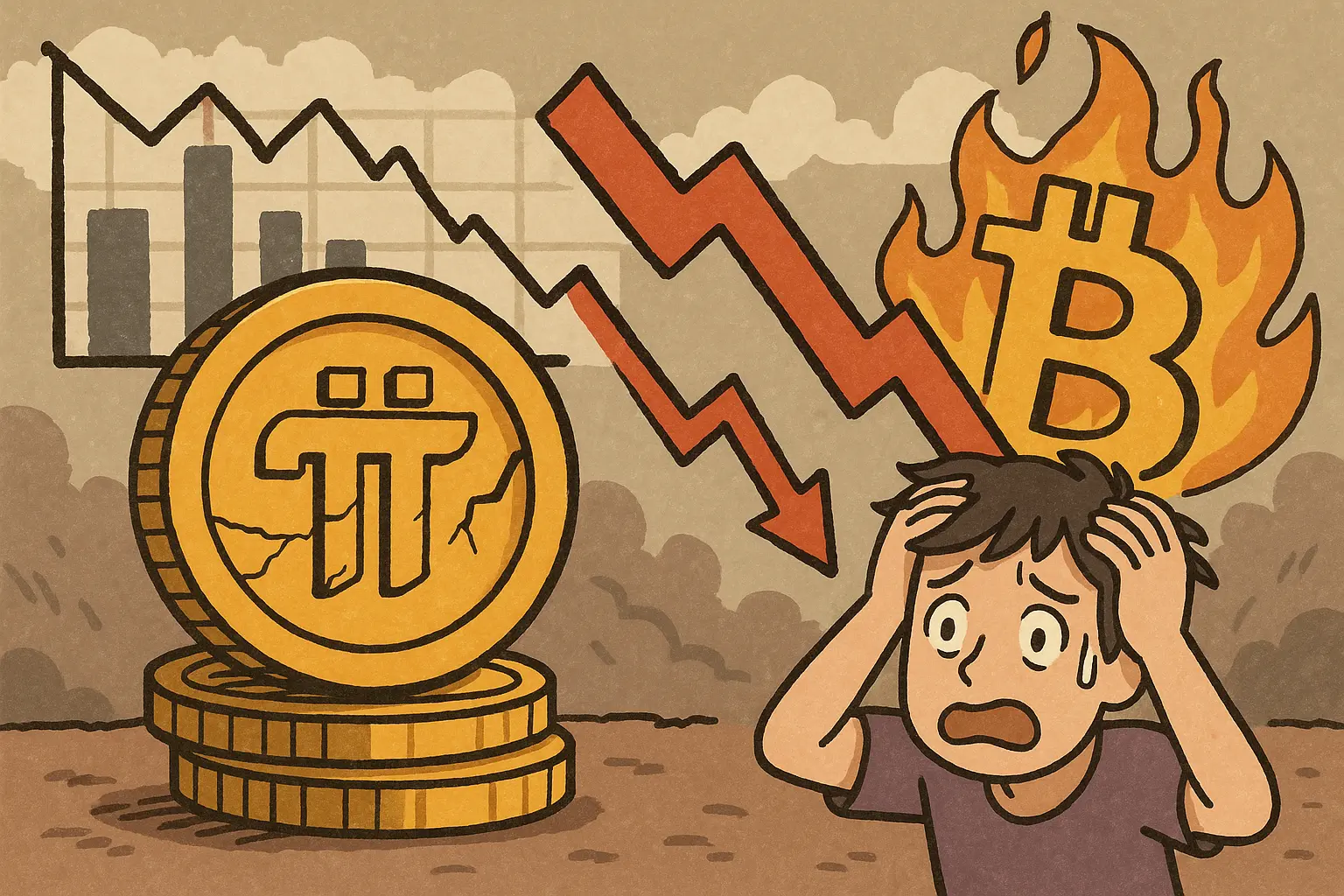
Pi coin surged to a high of $2.98 after its listing in February 2025 but then plummeted by 87%, falling to a low of $0.1585 in October. Currently, it trades at $0.209. Analysts point out core weaknesses: when Bitcoin rises, Pi coin increases slowly; when Bitcoin falls, Pi coin drops faster. The large token unlock in January and the opaque roadmap have intensified market panic.
Why is Pi coin falling behind in a bull market?
The underperformance of Pi coin conceals structural issues. When Bitcoin approached its all-time high of $108,000 at the end of 2024 and early 2025, most altcoins saw significant gains, but Pi coin rapidly collapsed after peaking at $2.98. This performance reflects deep market skepticism about Pi Network’s fundamentals.
First is liquidity issues. Pi coin’s trading depth is far below mainstream altcoins, making large buy or sell orders prone to causing sharp price swings. When Bitcoin rises and boosts market sentiment, funds preferentially flow into more liquid assets like ETH, SOL, XRP, etc. Pi coin, with poorer liquidity, only receives crumbs. Conversely, during Bitcoin’s decline and panic, investors tend to liquidate less liquid assets first to avoid risk, putting additional selling pressure on Pi coin.
Second is trust crisis. Pi Network’s mobile mining model has amassed a large user base, but these users hold coins at near-zero cost, lacking real capital investment. After listing, many zero-cost Pi holders will cash out at any price, creating persistent selling pressure. This “mine-and-sell” behavior causes Pi coin to face profit-taking pressure during any rebound.
Third is the lack of transparency in the roadmap. While Pi core team has outlined plans extending to 2026, many details remain unclear. This opacity has drawn criticism from some community members and continues to limit development momentum. Investors cannot assess the project’s real progress or future potential, leading to speculative trading based solely on price movements, further increasing Pi coin’s volatility and weakness.
Supply shock risk from token unlock in January
Adding to concerns, a large amount of tokens is expected to unlock in January. Although some data shows exchange liquidity is slowly declining, investors worry whether the upcoming unlock will trigger another round of selling. Token unlock mechanisms are a double-edged sword; they reward the team and early investors but also increase market supply.
When a large volume of tokens is unlocked and enters the market in a short period, if there isn’t enough buy-side absorption, prices will inevitably be pressured downward. Pi coin’s current market depth and trading volume clearly cannot easily absorb the supply shock from large unlocks. Historical experience shows many altcoins experience 20% to 50% retracements during major unlock periods; Pi coin’s poorer liquidity could mean even greater risks.
Three major downside risks converge
0.20 USD support level is at risk: This psychological and technical support is crucial for Pi coin. If it continues to break below this zone, downside risk will significantly increase. The next support may be around $0.15, implying about 25% further decline.
Token unlock selling pressure imminent: The large unlock in January will directly increase circulating supply. Without corresponding demand growth, supply and demand imbalance will push prices down. If unlockers sell en masse in the short term, it could trigger a chain reaction of panic.
Technical indicators are bearish overall: Relative Strength Index (RSI) is low but not oversold; moving averages show a bearish alignment; trading volume continues to shrink. These indicators suggest the trend has not reversed, and prices may continue to find a bottom.
For current Pi coin holders, assessing risk tolerance is essential. If unable to withstand further declines, reducing positions above $0.20 USD may be prudent. If continuing to hold, setting clear stop-loss points is necessary to prevent further losses.
Long-term value depends on utility, not speculation
Although the price trend of Pi coin is weak, supporters believe that project value should not be judged solely by short-term market fluctuations. They believe Pi coin’s long-term success depends on real-world application rather than speculation. If Pi Network can successfully build a practical ecosystem, even with short-term price weakness, there is still a chance for a rebound in the long run.
Supporters point out that future value may be influenced by factors such as: using Pi for real-world payments, applications and markets built around Pi, developers creating apps requiring Pi, and merchants accepting Pi for goods and services. From this perspective, Pi coin’s price will depend on engagement and usage, not hype.
However, this idealistic narrative faces harsh realities. Currently, merchant acceptance of Pi is very low; on-chain activity is far below mainstream blockchains; developer ecosystem is almost nonexistent. Most holders still see Pi as a speculative asset rather than a payment tool, and reversing this perception will take years. More critically, in the crypto payment space, Pi faces competition from Bitcoin Lightning Network, stablecoins, and traditional payment systems, with no clear technological advantage.
For new investors considering Pi coin, it’s important to recognize a harsh reality: even if Bitcoin enters a bull market, Pi coin may not rebound in tandem. The past 10 months’ price behavior has proven that Pi coin’s correlation with Bitcoin is asymmetric; it cannot enjoy the full benefits of a bull market and may suffer double the damage in a bear market. Unless Pi Network makes breakthrough progress in practical applications, it will be difficult to reverse its current weakness in the short term.
Disclaimer: The information on this page may come from third parties and does not represent the views or opinions of Gate. The content displayed on this page is for reference only and does not constitute any financial, investment, or legal advice. Gate does not guarantee the accuracy or completeness of the information and shall not be liable for any losses arising from the use of this information. Virtual asset investments carry high risks and are subject to significant price volatility. You may lose all of your invested principal. Please fully understand the relevant risks and make prudent decisions based on your own financial situation and risk tolerance. For details, please refer to
Disclaimer.
Related Articles
Today’s top 100 cryptocurrencies by market cap: ZEC up 14.40% leads the gains, PI down 8.65% leads the losses
On March 17, in the cryptocurrency market, Zcash (ZEC) showed the largest gain with an increase of 14.40%, while Pi (PI) experienced the largest decline with a decrease of 8.65%. The overall market showed significant volatility.
GateNews8h ago
Crypto Market News Today: AERO and PI Are Sinking Fast, But DeepSnitch AI Is the 200x Gem You Need to Secure Your Financial Future
Anyone keeping up with crypto market news today knows that regulatory changes are changing everything right now. As government agencies start shifting their stance on decentralized platforms, traders who are still relying on outdated market trends are getting hurt.
Instead of watching your
CaptainAltcoin11h ago
Pi Network Begins Second Mainnet Migration Rollout
Pi Network has begun its second mainnet migration phase, allowing users to transfer more mined Pi coins to the blockchain. This updates users on KYC verification requirements, enhances security with two-factor authentication, and has elicited mixed reactions from the community as it progresses toward a fully active ecosystem.
Coinfomania13h ago
Pi Network Gains Attention in India Amid Utility Push
Pi Network, launched in 2019, introduced a mobile-first approach to cryptocurrency mining by allowing users to mine Pi Coin directly from their smartphones without requiring high computational power.
The project reached a major milestone with the launch of its open mainnet in early 2025. This is en
Coinfomania16h ago
Pi Coin 86% Rally Reverses as Technical Signals Point to Further Decline
Pi Coin surged approximately 86% between February 28 and March 13, 2026, reaching nearly $0.30 before reversing sharply to trade near $0.20, as bearish divergence between price and the Relative Strength Index (RSI) signaled fading momentum.
CryptopulseElite20h ago
Pi Network Launches Second Migration of Smart Contracts, Technical Rebound Signals Emerge
Pi Network (PI) token closed at $0.1955 on Monday after declining for four consecutive trading days. Last week, Pi developers launched on-chain smart contracts through a v20 node upgrade and announced plans for a second mainnet migration. From a technical perspective, the PI price is currently stable near the 50-day EMA and the 61.8% Fibonacci retracement level, a position that has historically been associated with technical rebounds.
MarketWhisper22h ago


