
- Bill Morgan attributes the quantity of XRP on exchanges to Bitcoin movement, not the supply shock theory.
- XRP can make investors wealthy as long as they prioritize smart custody, smart tax planning, and proper wealth structures.
Crypto expert Bill Morgan argues that the XRP price movement is influenced more by the prevailing Bitcoin (BTC) trend rather than the supply shock. His comment comes amid some crypto community members claiming that the availability of the Ripple-backed coin is rapidly diminishing on exchanges.
Bill Morgan Dismisses XRP Supply Shock Theory
In an X post, expert Bill Morgan, also a Ripple advocate, commented on the growing discussions surrounding the XRP supply shock theory. He countered the XRP supply shock theory, similar to how he criticized the Ripple escrow dump theory.
Morgan argued that the supply shock theory has no significant explanatory value in understanding XRP price movements. Rather, he highlighted the Bitcoin price movement as the predominant factor influencing XRP.
The Ripple advocate was responding to comments alleging an XRP supply decline on exchanges worth 1.5 billion coins. This situation can be linked to changing investor sentiments. Large holders, often referred to as whales, are reportedly moving their coins to centralized exchanges (CEXs), possibly for long-term custody.
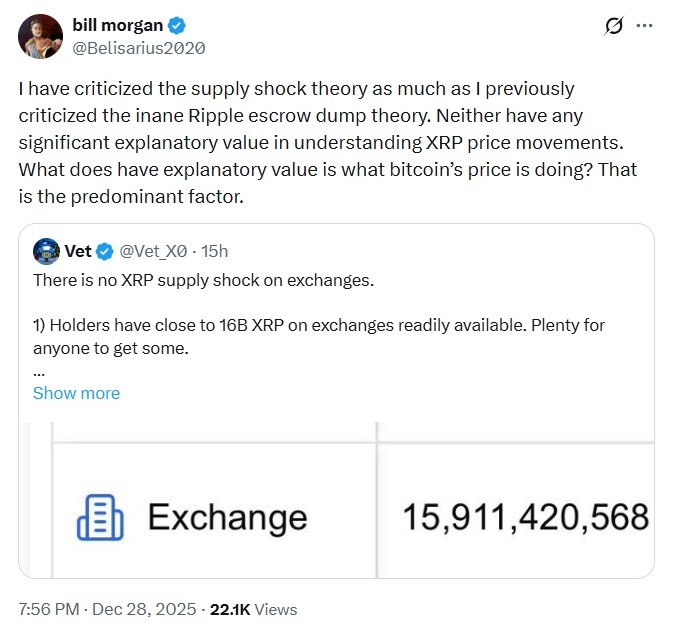
XRP Supply Shock Debate | Source: Bill Morgan on X
In addition to Morgan, Vet, an XRPL dUNL validator, also dismissed the XRP supply shock myth. He argued that holders have about 16 billion XRP readily available on exchanges, which is enough to go around.
Vet added that XRP holders on exchanges could send their coins in seconds if the price fluctuates upwards or downwards.
As a result, XRP listed on order books for sale is dynamic. Due to the elastic nature, it can thicken or dry out in seconds, back and forth. Vet noted that in some cases, a $10 million buy can push the price higher. In contrast, even a $100 million purchase does not stop the price from going down sometimes.
Is XRP a Guaranteed Path to Wealth?
Many industry leaders have weighed in on the XRP supply shock myth. They have raised concerns about its potential impact on the price of the digital asset.
Others think it is a direct influence of the growing demand for XRP exchange-traded funds (ETFs). Since the spot XRP ETF launched in late November, the funds have reportedly accumulated over $1.25 billion in net assets.
As highlighted in our previous article, the XRP ETFs even outpaced their BTC and Ethereum counterparts in a day. Specifically, on December 4, spot XRP ETFs attracted $12.84 million, while Bitcoin and Ethereum ETFs recorded net outflows.
Note that as the XRP expands, the number of coins available on exchanges for direct trading is declining.
According to unknownDLT, a popular crypto voice on X, XRP ETFs are increasingly absorbing the available supply. In recent weeks, a massive 750 million tokens were absorbed. Thus, the analyst believes that the market will see a possible XRP supply shock by early 2026.
XRP ETFs are absorbing supply fast. With only ~1.5B XRP left on exchanges and ~750M absorbed in weeks, a supply shock is likely by early 2026.
This aligns with the Clarity Act, forcing price discovery and enabling real institutional use.
2026 is the inflection point where XRP… pic.twitter.com/FVhwiVgi4B
— {x} (@unknowDLT) December 26, 2025
Amid the XRP supply shock thesis, many investors believe their holdings alone will make them rich. The XRP price has surged minimally by 0.8% over the past 24 hours to $1.9, while trading volume jumped 60.3% to $1.7 billion.
In a previous article, we discussed, market analyst Jake Claver stressed that simply holding XRP is not a guaranteed path to wealth. He, therefore, urged investors to prioritize smart custody, smart tax planning, and proper wealth structures.
Disclaimer: The information on this page may come from third parties and does not represent the views or opinions of Gate. The content displayed on this page is for reference only and does not constitute any financial, investment, or legal advice. Gate does not guarantee the accuracy or completeness of the information and shall not be liable for any losses arising from the use of this information. Virtual asset investments carry high risks and are subject to significant price volatility. You may lose all of your invested principal. Please fully understand the relevant risks and make prudent decisions based on your own financial situation and risk tolerance. For details, please refer to
Disclaimer.
Related Articles
Zonda Exchange CEO Blames Missing Founder for $336M in Lost Bitcoin
Zonda CEO Przemysław Kral has attributed the exchange's loss of access to 4,500 BTC, valued at $336 million, to missing founder Sylwester Suszek's failure to transfer private keys. Amid allegations of bankruptcy and intensified withdrawal requests, Kral insists Zonda remains solvent and will pursue legal action while searching for Suszek, who disappeared in 2022.
GateNews48m ago
BTC drops 0.52% in 15 minutes: Whale inflows to exchanges combined with insufficient liquidity amplify sell pressure
From 2026-04-17 10:15 to 2026-04-17 10:30 (UTC), the BTC price rapidly fell within the 75214.3 – 75725.9 USDT range. The cumulative return over 15 minutes was -0.52%, and the amplitude reached 0.68%. During this period, market sentiment shifted from cautious to bearish, volatility on the board increased, mainstream trading pairs saw an increase in主动 sell-side volume, buy-side acceptance became constrained, and overall trading activity declined significantly.
The primary driver behind this unusual move is that large holders (whales) concentrated their short-term inflows into exchanges. On-chain data shows that net inflows to addresses holding more than 1000 BTC per address changed from a steady state to a positive value, directly boosting exchange balances over the short term. Historical data indicates that whale inflows to exchanges are highly correlated with sell pressure in the medium to short term. In the same period, order book snapshots reflected a significant increase in the volume of主动 sell orders, and the成交价梯度 shifted downward, highlighting that weak market absorption capacity caused a short-term drop in price.
In addition, in the derivatives market, the long/short positioning structure tilted toward shorts. The number of主动 sell contracts exceeded that of buys in a short time, and rising pressure to close long positions further intensified the downtrend. Market liquidity overall was relatively weak; the number of active addresses over the past 10 minutes was only about 42k, and both fees and the mempool were near their lowest levels of the recent month. Against a backdrop of insufficient capital absorption, the marginal impact of large sell orders was amplified. On the macro front, the Federal Reserve’s monetary policy tightening and industry media repeatedly downgraded BTC’s near-term expectations led investors’ risk appetite to generally decline, creating a resonance at the level of market sentiment.
In the short term, it is still necessary to stay alert to liquidity risk and the price impact of one-way large transactions in specific trading pairs. Going forward, focus on key developments such as changes in whales’ on-chain holdings, exchange balances, and rebounds in activity metrics, as well as the potential impact of macro policy direction on risk assets. Relevant users should primarily guard against the risk of sharply amplified short-term price volatility and promptly track more market information.
GateNews1h ago
Bitcoin Developers Propose Freezing Coins That Skip Quantum-Safe Migration Under BIP-361
A draft proposal circulating among Bitcoin developers would give holders roughly five years to move their coins to quantum-resistant addresses or watch them become permanently unspendable on the network.
Key Takeaways:
BIP-361, co-authored by Casa CTO Jameson Lopp, proposes freezing Bitcoin in le
Coinpedia1h ago
BTC slides 0.70% in the short term: On-chain fund outflows and derivatives deleveraging align to weigh on the market
Between 09:30 and 09:45 (UTC) on 2026-04-17, the BTC price’s return within 15 minutes was -0.70%. During the day, it fluctuated in the 75511.9 to 76307.6 USDT range, with an amplitude of 1.04%. Short-term market sentiment became more cautious; although capital activity increased, volatility noticeably accelerated.
The main driving force behind this move is the large-scale outflow of funds on-chain and active deleveraging in the derivatives market. On-chain data shows that, within this time window, the net outflow from BTC exchanges increased, with a 24-hour net outflow of -2,844.68 BTC. Investors transferred a large amount of BTC to cold wallets, significantly weakening market liquidity and pressuring buy-side demand, which dragged prices lower. In the derivatives space, open interest in perpetual contracts fell in tandem; some leveraged funds actively reduced exposure, indicating the market’s more conservative stance on short-term price action, thereby further weakening support.
In addition, multiple large transfers and whale address activity occurred frequently during the anomaly period, amplifying pressure on capital flows and causing sentiment in the derivatives market to turn even colder. The funding rate dropped briefly within the window, indirectly reflecting that some position holders moved into cold wallets for safer risk management. At the same time, the number of active addresses remained persistently high at over 120k, suggesting network participation was not hit and the fundamentals remained stable; however, the combined effect of frequent outflows amplified market volatility in the short term.
What needs to be watched is that continuous net outflows of funds on-chain and a decline in holdings pose a threat to the stability of support levels. Large address behavior could lead to further capital escaping. In the short term, focus on changes in exchange BTC balances, on-chain transfer volumes, whale address flow, and the dynamics of derivatives open interest. If capital does not return later, volatility risk may further expand; it is recommended to closely monitor real-time market conditions and key on-chain indicators.
GateNews2h ago
The U.S. vetoes the Iran-war powers resolution, while the BTC price trades in a range near $75,000
On April 17, Bitcoin traded in a tight range near $75,500. The U.S. vetoed a war-powers resolution against Iran, while Israel and Lebanon reached a 10-day ceasefire—geopolitical signals moved in opposite directions. Institutional fund inflows coexisted with outflows on-chain; Bitcoin’s correlation with the Nasdaq briefly turned negative—leaving the market waiting for a breakout in either direction.
GateInstantTrends2h ago
BTC breaks through 76000 USDT
Gate News bot message, Gate market data shows that BTC has broken through 76000 USDT, with the current price at 76188.7 USDT.
CryptoRadar2h ago


