
On December 26, Solana stablecoin USX plummeted 90% to $0.1 due to liquidity exhaustion. PeckShield issued an early warning, and after emergency capital injection from Solstice Labs, it rebounded to $0.94. The issuer emphasized that collateral remains above 100%, and primary market redemptions are normal. This de-pegging was not due to a protocol vulnerability but rather market structural liquidity depletion, with Solstice requiring third-party verification.
Liquidity Trap: From $1 to $0.1 in 48 Hours
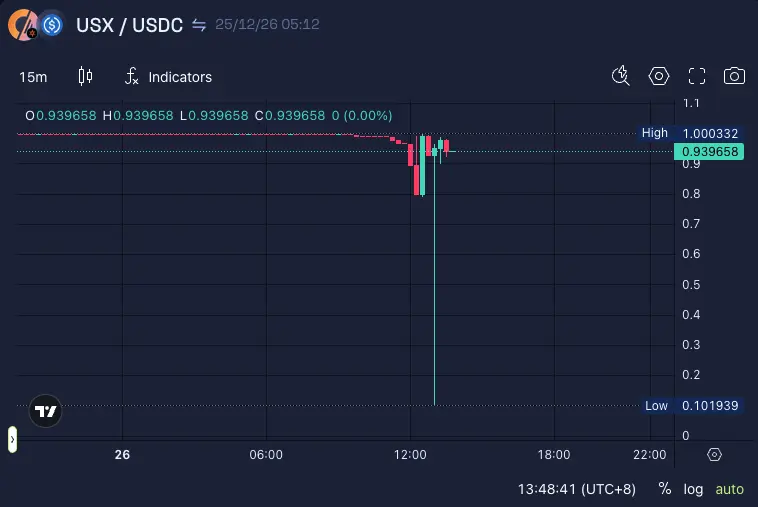
(Source: Trading View)
On December 26, USX’s liquidity on the secondary market of the Solana network suddenly dried up. According to on-chain monitoring data, USX’s trading price once fell to $0.10, then rebounded somewhat. Due to the rapid and large price decline, the event quickly attracted widespread attention in the cryptocurrency market. Security firm PeckShieldAlert issued an early warning of this de-pegging event, noting that USX’s price significantly deviated from the $1 target.
Monitoring data shows that USX’s liquidity on secondary trading venues rapidly declined. As liquidity decreased, selling pressure sharply pushed down the price. USX’s price bottomed near $0.10, far below its intended peg. This de-pegging was not caused by protocol bugs or collateral failure but driven by market structural pressures, with insufficient liquidity exacerbating price volatility. Such events are more common in markets with scarce or dispersed liquidity. When liquidity providers withdraw simultaneously, even small sell orders can cause extreme price swings.
This flash crash pattern is not unique in DeFi history. In 2022, USDe on Binance fell to $0.65, and in 2021, the algorithmic stablecoin IRON from IRON Finance collapsed from $1 to $0 within hours. Common features include liquidity exhaustion leading to failure of price discovery mechanisms, where a few trades can cause extreme prices. USX dropping to $0.1 means that even a $100,000 sell order, in the absence of buy-side support, can break the price through.
Solstice Emergency Rescue and Collateral Truth
After the price drop, USX’s issuer Solstice immediately intervened to restore market stability. The Solstice team confirmed that shortly after the event, they injected new liquidity into the secondary market. Following the intervention, USX’s price rebounded to about $0.94. Although still below parity, this marked a rapid recovery from the intraday low. Solstice stated that this incident was limited to secondary market trading. According to the team, primary market trading functions remained normal throughout the event.
Three Core Claims of Solstice’s Official Response
Adequate Collateral: USX assets maintained over 100% collateralization, with net asset value unaffected, and no custodial assets damaged.
Normal Redemptions: 1:1 redemptions in the primary market were fully available during market volatility, allowing users to exit at net asset value at any time.
Third-party Certification: An independent auditing firm has been requested to conduct additional verification, with transparent reports to be published upon completion.
Solstice emphasized that no custodial assets were harmed. The company described this event as a liquidity mismatch rather than a solvency issue. This distinction is crucial: solvency issues imply insufficient collateral to support the circulating supply, representing a systemic risk; liquidity mismatch means assets are sufficient but cannot be liquidated promptly or the market lacks buyers, which is a temporary market structural problem.
PeckShield regards the de-pegging as a failure of market structural liquidity. This qualitative view supports Solstice’s explanation but also raises questions: why did liquidity suddenly dry up? Possible reasons include: large liquidity providers withdrawing from Solana DeFi; market depth generally reduced during the Christmas holiday; USX itself has low notoriety, with insufficient market maker allocation; or panic sentiment causing multiple liquidity providers to withdraw simultaneously.
Systemic Risk Warnings in Stablecoin De-pegging
The USX incident highlights ongoing risks in the expanding stablecoin sector. Even without collateral issues, secondary market dynamics can quickly break the price peg during liquidity shortages. Traders point out that extreme price swings bring both risks and opportunities. Some traders bought at $0.1 and quickly gained 840% returns (from $0.1 to $0.94). However, such extreme volatility can also cause users unable to exit in time to face sudden losses.
As more projects launch stablecoins on different blockchains, analysts expect similar events to occur. Lack of liquidity, dispersed trading venues, and rapid market sentiment swings can combine to cause peg failures, even temporarily. The brief collapse of USX underscores a key lesson: stablecoins depend not only on collateral but also on continuous and sufficient liquidity. Without both, even on mainstream networks like Solana, price stability can be shattered within minutes.
For stablecoin users, this event offers important insights. First, do not consider all stablecoins risk-free; even projects claiming 100% collateral can temporarily collapse during liquidity crises. Second, small stablecoins often have limited market depth, making them more vulnerable to extreme prices under market pressure. Third, during holidays like Christmas, market liquidity generally declines, increasing risks for holding small stablecoins. Fourth, primary market redemptions are available, but when thousands redeem simultaneously, congestion or delays may occur, and secondary market sales tend to be faster but at worse prices.
Disclaimer: The information on this page may come from third parties and does not represent the views or opinions of Gate. The content displayed on this page is for reference only and does not constitute any financial, investment, or legal advice. Gate does not guarantee the accuracy or completeness of the information and shall not be liable for any losses arising from the use of this information. Virtual asset investments carry high risks and are subject to significant price volatility. You may lose all of your invested principal. Please fully understand the relevant risks and make prudent decisions based on your own financial situation and risk tolerance. For details, please refer to
Disclaimer.
Related Articles
Artelo Biosciences, a Solana treasury company, has raised an additional $11 million.
BlockBeats News, on March 29, the US-listed Solana treasury company Artelo Biosciences announced the private sale of a total of 3,188,407 shares of common stock at a price of $3.45 per share, raising a total of $11 million. The new funds will be used for general corporate purposes and to repay some transitional debt. Artelo currently holds 45,883 SOL.
BlockBeatNews2h ago
21shares will distribute staking rewards to ETH and SOL ETF investors on March 31.
Gate News message: On March 29, crypto exchange-traded product issuer 21shares announced that on March 31 it will distribute staking rewards to investors in its Ethereum exchange-traded fund TETH and Solana exchange-traded fund TSOL. Among them, the per-share distribution amount for TETH investors is 0.012530 US dollars, and for TSOL investors it is 0.016962 US dollars.
GateNews2h ago
Solana Price at $80 and Maxis Are Nowhere to Be Found – Analyst Says That Tells You Everything
Solana is down to $82 on the weekly chart. From the highs near $250, that’s a 77% drop. Crypto Patel asks “Where Are All The Solana Maxis Now?.” They told their followers to buy above $250, and screamed “to the moon” at the all-time high. Now the price is $80, and they’re silent. Not a single t
CaptainAltcoin9h ago
Base58 Labs’ BASIS 2026 Blueprint Forges a New Standard for BTC, ETH, SOL & PAXG
[PRESS RELEASE – London, UK, March 17th, 2026]
New roadmap positions BASIS as an institutional-grade digital asset management platform built for macro volatility, tokenized safe-haven demand, and frictionless Web3 onboarding.
Base58 Labs today unveiled the BASIS 2026 Technical Blueprint &
CryptoPotato11h ago
Solana and TRON Trend Down While BlockchainFX Secures AOFA License—Why This $15M Launch Is The Top Crypto To Buy In 2026
The global market is shifting as traditional finance and digital assets finally collide in a massive way. While old-school giants are seeing heavy corrections on the daily charts, savvy early adopters are rotating capital into high-utility platforms. If you are searching for the top crypto to b
CaptainAltcoin12h ago


