The Spot XRP ETF has achieved net inflows for 26 consecutive trading days, with a single-day inflow of 43.89 million USD on December 22. XRP fell below 1.90 USD on December 24. This drop is attributed to the Japanese Finance Minister threatening to intervene in the foreign exchange market again, raising concerns about the closure of yen arbitrage trades, while the PCE inflation in the U.S. for the third quarter rose to 2.8%, suppressing risk appetite, and the market's expectations for a rate cut by The Federal Reserve (FED) in March next year have plummeted.
Yen intervention threat reopens arbitrage trading release wave
The core risk of today's XRP news comes from fluctuations in the yen exchange market. On Tuesday, the USD/JPY fell for the second consecutive day, with Japanese Finance Minister Shunichi Suzuki reiterating the warning: “These actions are completely inconsistent with fundamentals, and the government will take appropriate measures against excessive behavior.” The USD/JPY once dropped to 155.649, while the yield on 10-year Japanese government bonds, although retreating from Monday's multi-decade high of 2.1%, still remains above 2%.
The operational logic of the yen arbitrage trade is as follows: Investors borrow yen at near-zero interest rates, convert it to US dollars, and then purchase high-yield assets such as cryptocurrencies. When the yen strengthens or Japanese government bond yields rise, the profit margin of this trade is compressed, forcing investors to close their positions. The painful memory of August 5, 2024, is still fresh, when the Bank of Japan raised interest rates and reduced the amount of government bond purchases, triggering massive closures of yen arbitrage trades. The USD/JPY plummeted from 161 to 141.684, and the price of XRP also crashed from $0.6591 to $0.4320, a decline of up to 34%.
The current fall of the USD/JPY from 157 to 155 is not enough to trigger the turmoil seen in August, but the market memory effect has led to a rapid cooling of risk appetite. More concerning is the possibility that if the Japanese government fails to continuously boost the yen through the foreign exchange market, it may force the Bank of Japan to adopt more aggressive interest rate hikes. Once the policy rate rises from the current 0.25% to 0.5% or even higher, the cost of yen arbitrage trades will significantly increase, triggering a new round of global risk asset sell-offs.
The 10-year Japanese government bond yield breaking 2% is a key turning point. This level is the first time it has been reached since the early 2000s, indicating that the market expects Japan to emerge from a 30-year low-interest-rate environment. The rising yield has narrowed the interest rate differential between the U.S. and Japan, reducing the attractiveness of yen arbitrage trades. XRP, as a high-risk cryptocurrency asset, is often one of the first targets for capital withdrawal in arbitrage trades.
Inflation 2.8% masks a strong appearance of GDP 4.3%
Another pressure on XRP news today comes from contradictory signals in the U.S. macroeconomy. The U.S. GDP growth in the third quarter increased by 4.3% compared to the previous quarter, higher than the 3.8% in the second quarter and far exceeding the market expectation of 3.3%. Generally, strong economic growth momentum boosts demand for risk assets. However, the Personal Consumption Expenditures (PCE) price index rose by 2.8% compared to the previous quarter, higher than the 2.6% from the last quarter, indicating a still severe inflation environment.
Market commentator Paul Barron accurately summarized this tug-of-war: “Dual engines: consumer spending + AI capital expenditure boom = strong combination. The problem is: the overheating price deflator suggests that inflation is not over yet. Worse still: GDP and employment are decoupling, with strong economic growth but limited job growth.” This combination of “high growth + high inflation + low employment” is precisely the stagflation precursor that the Federal Reserve (FED) is most unwilling to see.
According to the CME FedWatch tool, market expectations for a rate cut in March have fallen from 52.9% on December 22 to 45.7% on December 23. The rapid cooling of rate cut expectations has directly impacted the cryptocurrency market, as digital assets are highly dependent on the liquidity environment. When the market expects interest rates to remain high for a longer period, the cost of capital rises, and speculative assets are the first to face a sell-off.
Barron emphasized: “Strong GDP growth means rising risk appetite, but persistent inflation will keep the Federal Reserve (FED) in a hawkish stance. BTC, ETH, and XRP benefit from the 'new economy' narrative, but concerns over inflation are expected to lead to their volatility.” This contradictory nature explains why the continuous inflow into ETFs cannot prevent the fall of XRP, as the deterioration of the macro environment is overwhelming the improvement in fundamentals.
Can the ETF's wild influx over 26 days hold the 2.0 USD line?
(Source: Trading View)
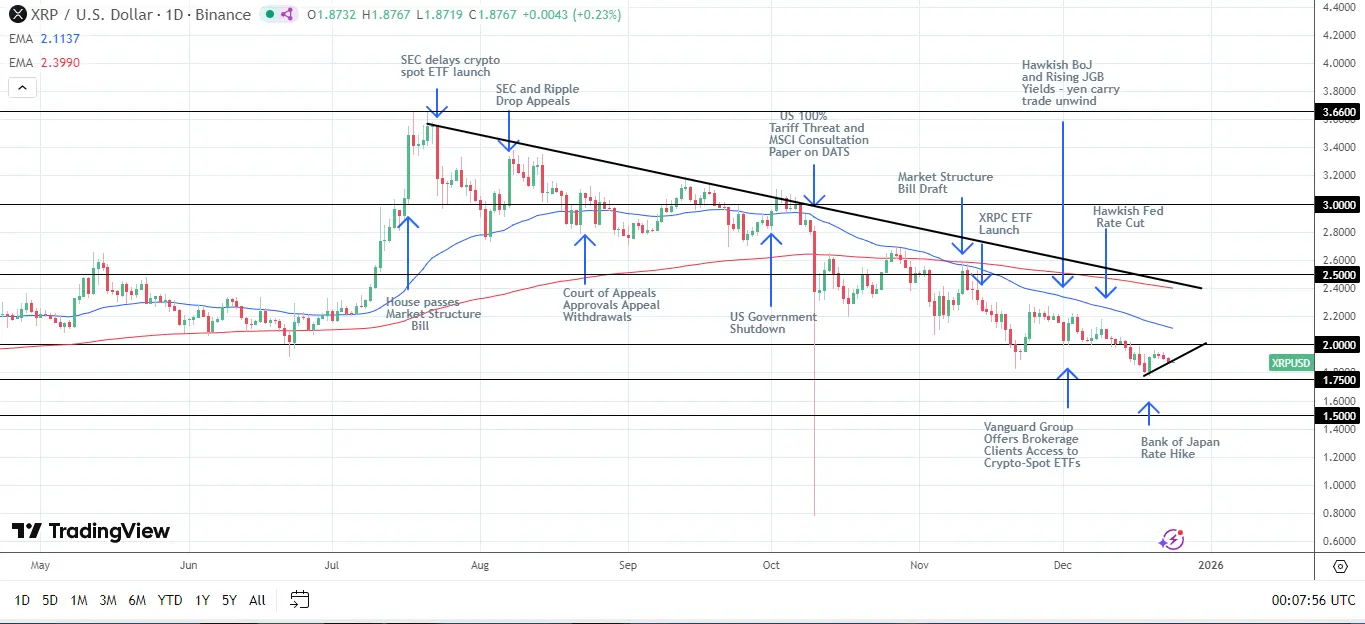
Despite facing macro headwinds, the biggest highlight in today's news about XRP is the resilience of Spot ETF demand. On December 22, a net inflow of $43.89 million was recorded, and ETF issuers have achieved net inflows for 26 consecutive trading days. This sustained inflow indicates that institutional investors are confident in the long-term prospects of XRP and have not changed their allocation strategies due to short-term fluctuations.
On the technical side, Tuesday's closing price was $1.8724, significantly below the 50-day EMA ($2.1137) and the 200-day EMA ($2.3990), indicating a short-term bearish trend. However, the fundamentals are increasingly overshadowing the technicals, with support from ETF inflows, optimistic regulatory sentiment, and legislative progress potentially driving a price rebound before the technical indicators strengthen.
Key Technical Levels and Scenario Analysis
Support Levels: $1.75 (short-term defense line), $1.50 (deep support)
Resistance Levels: $2 (psychological barrier), $2.1137 (50-day EMA), $2.5 (mid-term target), $3.0 (long-term target)
Optimistic Scenario (Probability 55%): If it returns to $2.0 and maintains stability, it will pave the way to the 50-day EMA. A continued breakthrough of the 50-day EMA indicates a short-term trend reversal, with a mid-term target of $2.5 (4-8 weeks) and a long-term target of $3.0 (8-12 weeks). Catalysts include The Federal Reserve (FED) rate cut in March, Senate passage of the market structure bill, and continuous inflow into ETFs.
Pessimistic Scenario (Probability 45%): If it continues to fall below the downward trend line, the bullish structure will fail, with targets of $1.75 or even $1.50. Triggering factors include aggressive interest rate hikes by the Bank of Japan, U.S. economic data cooling further expectations for interest rate cuts, MSCI removing digital asset reserve companies (DAT), or capital outflows from the XRP Spot ETF.
Disclaimer: The information on this page may come from third parties and does not represent the views or opinions of Gate. The content displayed on this page is for reference only and does not constitute any financial, investment, or legal advice. Gate does not guarantee the accuracy or completeness of the information and shall not be liable for any losses arising from the use of this information. Virtual asset investments carry high risks and are subject to significant price volatility. You may lose all of your invested principal. Please fully understand the relevant risks and make prudent decisions based on your own financial situation and risk tolerance. For details, please refer to
Disclaimer.


