The most significant protocol upgrade in Uniswap's seven-year history is about to take place. The fee switch proposal, known as “UNIfication,” has received support from over 62 million votes, with voting ending on Thursday. This proposal will destroy 100 million UNI tokens from the Uniswap Foundation treasury. Since the voting began, the price of UNI has pumped by approximately 25%.
Catalyst for UNI price rebound from the bottom
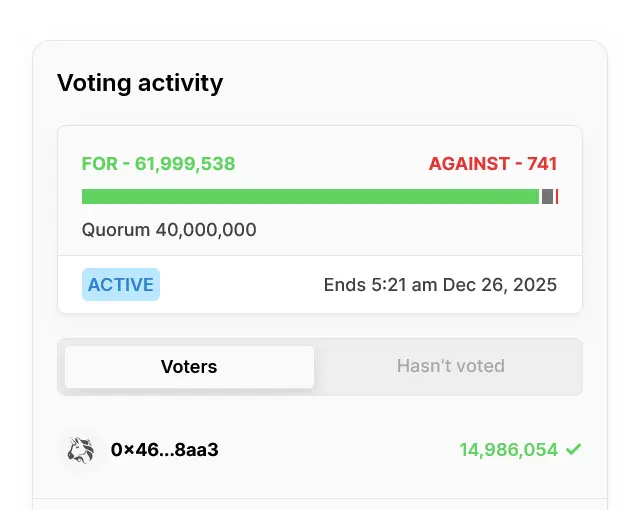
(Source: Uniswap)
Uniswap Token has been experiencing a month-long slump before the voting activation. In a broader market pullback, the price of UNI dropped to a seven-month low of $4.88, with criticisms of its lack of value capture mechanisms reaching a peak. However, since the UNIfication voting began on December 20, the price trend of UNI has completely reversed, rising approximately 25% within a week, with the current trading price at $6.08.
This price rebound is not the first occurrence. At the beginning of November, when the news of the UNIfication proposal first broke, it stimulated the price of the UNI token to surge nearly 40% in just ten days, skyrocketing from about $7 to $9.70 on November 11. This market reaction clearly shows that investors have long been waiting for Uniswap to implement some form of value feedback mechanism. As a token with a market capitalization of $3.8 billion, ranked 39th, the biggest complaint about UNI has been that despite Uniswap being the largest decentralized exchange with a trading volume exceeding $4 trillion, token holders have not been able to benefit from the protocol's revenue.
The sensitive reaction of prices to proposals also exposes the core dilemma of DeFi token economics: the governance rights themselves have limited appeal to most investors, and only when the token is linked to protocol revenue does the market grant a valuation premium. The passing of the UNIfication proposal means that Uniswap has finally acknowledged this reality and is starting to translate protocol value into token value.
100 million tokens burned and supply-demand dynamics restructured
The core of the UNIfication proposal is to burn 100 million UNI tokens from the Uniswap Foundation treasury. This number accounts for 10% of the total supply of 1 billion UNI, making it one of the largest single token burns in the DeFi space. The economic logic of token burning is simple and effective: reduce the supply, and with demand remaining the same or increasing, the price naturally rises.
Moreover, the fee-switching mechanism will create ongoing token burn pressure. Once the fee-switching for Uniswap v2 and v3 is activated on the Unichain mainnet, the protocol will begin to extract a portion of the transaction fees for the repurchase and burn of UNI tokens. This mechanism is similar to the stock buyback plans of listed companies, but due to the transparency of blockchain, all burn records will be publicly accessible, avoiding the information asymmetry issues found in traditional finance.
The introduction of the protocol fee discount auction system further enhances the practicality of UNI. Liquidity providers can obtain fee discounts by holding or staking UNI tokens, creating a second holding incentive beyond governance rights. When liquidity providers buy and lock UNI to reduce costs, the circulating supply further decreases, forming a dual squeeze effect of supply and demand.
Three Major Value Creation Mechanisms of the UNIfication Proposal
One-time burn of 100 million UNI: Immediately reduces the total supply by 10%, providing instant support for the token price and sending a signal to the market of the foundation's confidence in the long-term value of the protocol.
Sustained Cost Burn Mechanism: A portion of the protocol revenue will be used to buy back and burn UNI, creating deflationary pressure and directly linking the token value to the growth of Uniswap trading volume.
Fee Discount Auction System: Create economic incentives for liquidity providers holding UNI, lock circulating supply, and enhance protocol competitiveness to attract more liquidity.
Support from crypto giants behind 62 million tickets
As of earlier on Monday, nearly 62 million votes were cast for the UNIfication governance proposal, far exceeding the threshold of 40 million votes. Surprisingly, only 741 votes opposed the proposal, accounting for about 0.001% of the total votes, while abstentions were slightly over 1.5 million. This overwhelming support rate is extremely rare in DeFi governance history, demonstrating the community's strong desire for the protocol upgrade.
Some heavyweight figures in cryptocurrency with significant voting power publicly support the UNIfication proposal. Jesse Waldren, founder and managing partner of Variant (a venture capital firm focused on cryptocurrency), cast a supportive vote, bringing institutional investor confidence to the proposal. Kain Warwick, founder of the decentralized finance protocols Infinex and Synthetix, also voted in favor, and as a veteran builder in the DeFi space, he has a deep understanding of the technical feasibility and economic rationale behind the protocol upgrade.
It is worth noting that Ian Lapham, who previously worked as an engineer at Uniswap Labs, also voted in support of the proposal. As an insider, he has first-hand knowledge of the implementation details of Uniswap's technical architecture and fee switch, and his support guarantees the technical reliability of the proposal. The participation of these heavyweight figures not only brings voting weight to the proposal but more importantly conveys a signal to the market that “smart money” is optimistic about the future of Uniswap.
Commitment to Development Ecosystem and Long-term Growth
When proposing the initiative, the Uniswap Foundation assured developers that funding to promote the development and growth of the protocol would not be halted due to token burns. The Foundation clearly stated that supporting developers would remain a priority, planning to establish a growth budget to achieve these goals, which includes distributing 20 million UNI tokens to incentivize developers and expand the ecosystem.
This balancing strategy is crucial. The long-term value of DeFi protocols depends on continuous innovation and ecosystem expansion. Sacrificing development resources for short-term token prices will undermine the competitiveness of the protocol. Uniswap's choice to advance both token burn and developer incentives demonstrates the management's understanding of sustainable growth. Although the 20 million UNI developer budget may seem small compared to the 100 million burn amount, considering that these tokens will be used to attract and retain top talent, its long-term returns may far exceed the immediate effects of token burn.
Since its launch in November 2018, Uniswap has processed over $4 trillion in trading volume, firmly holding its position as the leading decentralized exchange. The passing of the UNIfication proposal marks Uniswap's transition from a purely governance protocol token to a value capture token, which could redefine the standards of DeFi token economics.
Disclaimer: The information on this page may come from third parties and does not represent the views or opinions of Gate. The content displayed on this page is for reference only and does not constitute any financial, investment, or legal advice. Gate does not guarantee the accuracy or completeness of the information and shall not be liable for any losses arising from the use of this information. Virtual asset investments carry high risks and are subject to significant price volatility. You may lose all of your invested principal. Please fully understand the relevant risks and make prudent decisions based on your own financial situation and risk tolerance. For details, please refer to
Disclaimer.
Related Articles
Uniswap Labs Launches Developer Platform with AI Tools and Expanded API Access Across 18 Blockchains
Uniswap Labs launched a Developer Platform offering tools for DeFi integration, including an AI toolkit, API playground, and liquidity management features. With over 500,000 developers accessing resources, the platform aims to simplify integration and enhance developer capabilities.
GateNews04-17 07:24
Uniswap daily trading volume surpasses $2.0 billion, hitting a one-year high
Gate News message, April 13, decentralized exchange Uniswap recently saw its daily trading volume surpass $2 billion, setting a new high in nearly one year. Data shows that Uniswap’s trading volume surge is mainly driven by growing expectations that recent spot Ethereum ETFs will be approved, with market activity rising significantly. Uniswap is one of the largest decentralized exchanges in the Ethereum ecosystem; its current main trading pairs include ETH/USDC, ETH/USDT, and other mainstream assets, and demand for stablecoin swaps continues to grow.
GateNews04-13 06:02
A certain address received 5 million UNI tokens worth $15.8 million again from the Uni Timelock contract after three months
Gate News update: On April 11, according to on-chain analyst Ai Yi monitoring, an address received 5 million UNI again from the Uni Timelock contract after three months, worth $15.8 million. This address has received a cumulative total of 10 million UNI, which is currently held in custody in a certain CEX.
GateNews04-11 03:31
Uniswap founder seeks to integrate Anthropic technology, planning to test Mythos on the platform
Gate News update: On April 10, Uniswap founder Hayden Adams posted on a social platform today, asking whether there are any Anthropic (an AI technology company) related resources for coordination, and said he hopes to test Mythos on Uniswap.
GateNews04-10 04:31
Uniswap and PancakeSwap Lead the Pack of Top DEXEs By Weekly Volume
Phoenix reports the top 9 best-performing decentralized exchanges, with Uniswap leading at $1.25B in 24H volume. The DEX market holds 14.91% against centralized exchanges, totaling $38.76B weekly volume.
BlockChainReporter04-07 19:04


