Author: Rick, Messari Research Analyst; Translation: @GoldFinanceXZ
With 2026 approaching, the relationship between Ethereum’s price and fundamentals is clearer than ever since the NFT frenzy.
As of December 16, 2025, Ethereum’s price has fallen below $3,000. Based on the MVRV indicator and its dominant position in tokenized assets, ETH appears to offer a constructive long-term investment opportunity for allocators.
The MVRV Z-Score is used to assess whether ETH is overvalued or undervalued relative to its fair value. This indicator compares market capitalization (i.e., spot price multiplied by circulating supply) with realized value (i.e., the total capital inflow into ETH). It is formally defined as: MVRV Z-Score equals the difference between market cap and realized cap, divided by the standard deviation of market cap (cumulatively calculated from the earliest available data point).
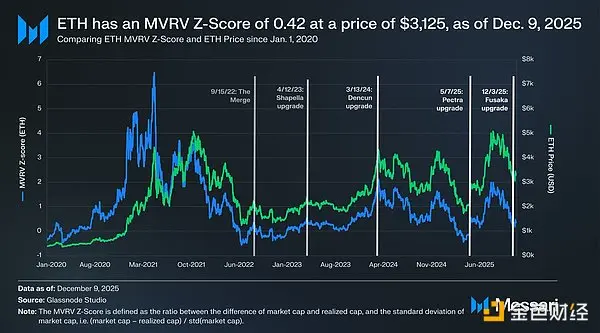
During the NFT boom of 2021 to 2022, ETH’s MVRV Z-Score soared close to 6, indicating extreme market euphoria. Since The Merge, this indicator has reverted toward the mean, currently fluctuating mainly between 0 and 2—0 indicates undervaluation, 1 is near fair value, and 2 leans toward overvaluation. On May 7, 2025, when Ethereum’s significant upgrade Pectra went live, ETH was around $1,800, and the MVRV Z-Score was approximately -0.1. As the price subsequently hit new all-time highs, the MVRV gradually rose toward 2. By December 3, 2025, after the Fusaka upgrade, ETH traded at about $3,189, with an MVRV Z-Score of 0.47, indicating that at a significantly higher price level, it still appeared undervalued, suggesting a similar post-upgrade market structure but with more robust fundamentals.
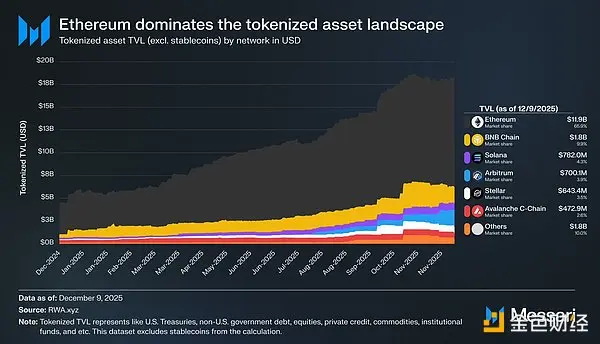
On-chain data further reinforce the bullish thesis for Ethereum. In the asset tokenization space, Ethereum is the core settlement layer. According to RWA.xyz data (excluding stablecoins), Ethereum hosts a total of $11.9 billion in tokenized assets locked, accounting for 65.9% of the market share. While other layer 1s and rollups have developed, their scale remains far behind. As institutions migrate treasuries, credit, and other real-world assets onto crypto channels to improve capital efficiency and reduce operational costs, Ethereum’s liquidity, tooling ecosystem, and compliance-oriented infrastructure are continuously deepening its moat.
The low signals from the MVRV Z-Score, the positive price performance after upgrades, and the increasing dominance in tokenized assets all point in the same direction. However, this still only reveals a small part of Ethereum’s bullish narrative. As spot ETFs bring regulated capital into ETH, and digital asset treasury companies (DATs) continue to accumulate ETH supply, the market’s free float gradually tightens, and price sensitivity to marginal demand increases. For allocators seeking exposure with real economic throughput and scalable smart contracts, current ETH prices are more an opportunity to build core positions for 2026 than a risk at the cycle’s end.
Disclaimer: The information on this page may come from third parties and does not represent the views or opinions of Gate. The content displayed on this page is for reference only and does not constitute any financial, investment, or legal advice. Gate does not guarantee the accuracy or completeness of the information and shall not be liable for any losses arising from the use of this information. Virtual asset investments carry high risks and are subject to significant price volatility. You may lose all of your invested principal. Please fully understand the relevant risks and make prudent decisions based on your own financial situation and risk tolerance. For details, please refer to
Disclaimer.
Related Articles
Aave Leads Coalition Requesting $71M Frozen ETH Release for rsETH Recovery
Constitutional AIP Filed for Frozen ETH Release
A coalition of major DeFi protocols filed a Constitutional AIP on the Arbitrum forum Saturday morning requesting the network's DAO release approximately $71 million in frozen ETH to support rsETH recovery efforts. Aave Labs is listed as the lead
CryptoFrontier12m ago
XRP Ledger Records $1.1B Net Inflows Over 30 Days, Surpassing Ethereum's $879M
Gate News message, April 25 — XRP Ledger topped all major blockchains (excluding stablecoins) in net capital inflows over the past 30 days, drawing $1.1 billion according to data from RWA.xyz. Ethereum trailed at approximately $879 million in inflows, followed by Stellar with $643 million and BNB
GateNews1h ago
If ETH Breaks $2,421, Major CEX Short Liquidations Could Reach $493M
Gate News message, April 25 — According to Coinglass data, if Ethereum breaks above $2,421, cumulative short liquidations across major centralized exchanges could reach $493 million.
Conversely, if ETH drops below $2,212, cumulative long liquidations across major CEXs could reach $482 million.
GateNews1h ago
Aave, Kelp, LayerZero seek $71M frozen ETH release on Arbitrum
A coalition of major DeFi protocols filed a Constitutional AIP on the Arbitrum forum Saturday morning requesting the network's DAO release approximately $71 million in frozen ETH to support DeFi United, a cross-protocol relief effort organized following the $292 million Kelp DAO exploit. Aave Labs l
CryptoFrontier2h ago
OpenSea CMO Adam Hollander Buys uPEG, Ethereum Token Surges Over 300%
Gate News message, April 25 — OpenSea CMO Adam Hollander purchased a small amount of uPEG, an Ethereum-based token, this evening, stating he was "simply interested in the concept and wanted to experiment." The purchase triggered a sharp rally, with uPEG surging over 300% in a short
GateNews5h ago
Ethereum Foundation Sells 10,000 ETH to Bitmine for Nearly $24 Million
Gate News message, April 25 — The Ethereum Foundation sold 10,000 ether to Bitmine Immersion Technologies on Friday, finalizing an over-the-counter deal at an average price of $2,387 per ETH, totaling approximately $23.87 million. The sale will fund the EF's core operations and activities, including
GateNews6h ago


