Taiwan FinTech Association Director Wen Hongjun warns that USD stablecoins USDT and USDC occupy approximately 99% of the global market share. If Taiwan does not quickly issue its own New Taiwan Dollar stablecoin, it may become marginalized in emerging digital financial infrastructure. This is not just a payment issue but a competition over monetary sovereignty and control of financial ledgers. The Financial Supervisory Commission states that if virtual asset legislation and related regulations are passed promptly, Taiwan’s issued stablecoin could be launched as early as the second half of 2026.
USD Stablecoins’ Monopoly and the 99% Currency Sovereignty Crisis
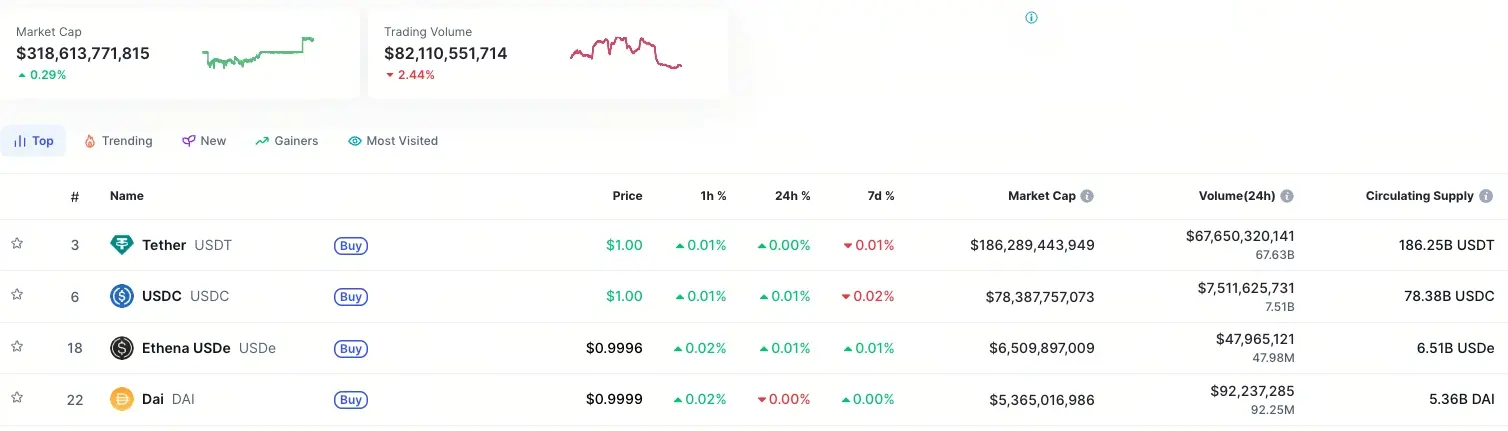
(Source: CoinMarketCap)
2025 is widely regarded as the “Year of Stablecoins.” Stablecoins are cryptocurrencies designed to maintain stable value, typically pegged 1:1 to fiat currencies, and are widely used as settlement currencies for digital assets and tokenized real-world assets (RWA). Because USD-pegged stablecoins like USDT and USDC currently account for about 99% of the global market share, this near-monopoly raises deep concerns over monetary sovereignty.
Wen Hongjun told Central News Agency in an interview on Friday that this issue is not just about payment convenience but also a competition over monetary sovereignty and control of financial ledgers. When global digital financial settlements are built on USD stablecoins, the monetary sovereignty of other countries is effectively weakened. For an economy like Taiwan, deeply integrated into global supply chains, financial settlements are long locked into the USD stablecoin system. Taiwanese manufacturers and exchanges have long used large volumes of USDT and USDC, but all settlement logic is centered on the US dollar.
Wen Hongjun emphasizes that a New Taiwan Dollar stablecoin can serve as an exchange medium and accounting unit for RWA transactions, enabling on-chain financial products to be priced in NTD. Without a NTD stablecoin, Taiwan’s financial products may struggle to circulate globally. When Taiwan has a compliant, transparent, and regulated NTD stablecoin, certain segments of the supply chain—such as settlement, financing, and margin—can begin to be priced in NTD, gradually expanding the space for financial autonomy.
As countries develop new accounting systems outside traditional banking ledgers, Japan and South Korea are actively launching their own currencies supporting stablecoins. Wen Hongjun warns that if Taiwan delays, it could miss a strategic opportunity. This is not a theoretical threat but a real ongoing development. When South Korea and Japan’s stablecoins start circulating within regional supply chains, Taiwanese enterprises without a corresponding NTD stablecoin will be forced to continue using USD or other countries’ digital currencies, losing influence in the digital financial era.
10% of Taiwanese Businesses Are Already Using Stablecoins to Meet Real Needs
Data from the Taiwan External Trade Development Council shows that nearly 5% of local Taiwanese companies and over 10% of Taiwanese companies operating overseas are already experimenting with stablecoins for cross-border payments. This figure proves that the demand is real, not hypothetical. Wen Hongjun said that export-oriented tech companies may already be receiving USD stablecoins, and without a NTD stablecoin, converting these funds into local currency could reduce efficiency and weaken competitiveness.
Exchanges like MaiCoin have repeatedly called for Taiwan to issue its own NTD stablecoin, citing the need for a truly digital, programmable NTD tool for corporate fund management and international competitiveness. Industry players focusing on cross-border supply chains and payment services, such as XREX, also emphasize that Taiwan must maintain a key financial role within the global supply chain by having an internationally interoperable NTD stablecoin—rather than forever being a passenger in the USD-centric US dollar universe.
The most tangible scenario for the general public is cross-border remittances and remittances by overseas workers. Foreign workers transferring wages home, or Taiwanese businesses managing funds across Southeast Asia, mostly still rely on SWIFT, with reconciliation often taking several days. Industry demonstrations have shown that if cross-border settlement between banks is handled with stablecoins, the process can be shortened from several days to minutes, and remittance costs could be significantly reduced. For the new generation accustomed to mobile payments, such an experience will soon become a basic requirement.
From an industry innovation perspective, the Web3 ecosystem has already demonstrated that decentralized finance, NFTs, on-chain gaming, and asset tokenization all require a relatively stable digital token as a settlement unit. Currently, this role is almost monopolized by USDT and USDC. If compliant NTD stablecoins are introduced in the future, Taiwanese startups and projects can design business models based on NTD logic, avoiding the need to circle through USD and then back. This is not just a currency exchange risk but also a matter of mindset and discourse power.
Implementation Path and Dual-Track System in 2026
The Chair of the Financial Supervisory Commission, Peng Jinlong, recently stated that if virtual asset legislation and related regulations are passed quickly, Taiwan’s issued stablecoin could be launched as early as the second half of 2026. The Virtual Asset Service Law planned by the Executive Yuan draws heavily from the EU’s MiCA regulation, aiming to bring crypto assets and stablecoins into a comprehensive regulatory framework. The FSC pointed out a timetable during a legislative inquiry, stating that if the special law is successfully passed with three readings in this legislative session, and subordinate regulations are established within half a year, Taiwan’s version of a stablecoin could be operational around June or July 2026.
Three Key Implementation Points for the NTD Stablecoin
Reserves and Trust Mechanism: Backed by 100% or near-100% secure reserves, primarily held in regulated banks and trust accounts.
KYC and Anti-Money Laundering: Managed by licensed virtual asset service providers, integrating customer verification into existing systems.
Bank Interoperability Design: The NTD stablecoin must allow real-time, low-cost 1:1 conversions between bank accounts and wallets.
From a monetary system architecture perspective, the NTD stablecoin and CBDC can form a dual-track system—public and private. The CBDC issued by the central bank is closer to digital cash, managed directly by the central bank, and can be used in public payments, government subsidies, and social welfare distribution. Privately issued stablecoins are more akin to tokenized deposits or electronic money, designed by banks or payment institutions within a regulatory framework. The two are not mutually exclusive but serve different roles.
Wen Hongjun suggests that Taiwan could leverage its semiconductor advantages to issue a dedicated USD stablecoin, reducing global transaction costs, while also using a NTD stablecoin within Taiwan’s semiconductor and AI supply chains for payments. This dual-coin strategy would enable participation in international markets while maintaining control over the domestic currency’s sovereignty. Taiwan has played a key role in the semiconductor supply chain; whether it can maintain similar importance in digital finance and Web3 supply chains will largely depend on how the NTD stablecoin is designed today.
Disclaimer: The information on this page may come from third parties and does not represent the views or opinions of Gate. The content displayed on this page is for reference only and does not constitute any financial, investment, or legal advice. Gate does not guarantee the accuracy or completeness of the information and shall not be liable for any losses arising from the use of this information. Virtual asset investments carry high risks and are subject to significant price volatility. You may lose all of your invested principal. Please fully understand the relevant risks and make prudent decisions based on your own financial situation and risk tolerance. For details, please refer to
Disclaimer.
Related Articles
USDC Circulation Decreases by 700M in 7 Days to 78B; Reserves Stand at 78.2B
Gate News message, April 25 — In the seven days through April 23, Circle issued approximately 5.1 billion USDC while redeeming about 5.8 billion, resulting in a net decrease of 700 million USDC in circulation. Total USDC circulation stands at 78 billion, backed by approximately 78.2 billion in
GateNews12h ago
OSL Group and Circle Partner to Expand USDC Access Across Trading and Payment Platforms
Gate News message, April 24 — OSL Group (HKEX: 863), a global stablecoin payment and trading platform, announced a partnership with Circle (NYSE: CRCL), a leading financial platform company, on April 22 to expand USDC access across OSL's payment and trading ecosystem.
Through OSL Global, OSL's
GateNews04-24 19:19
Major CEX Launches Crypto Payment Card on Mastercard Network in Australia, Enabling USDC Payments
Gate News message, April 24 — A leading centralized exchange has launched a crypto payment card in Australia, partnering with Mastercard and Immersve to enable crypto-backed payments at merchants accepting Mastercard, including Google Play and Apple Pay. The service supports USDC and 37 USDC
GateNews04-24 18:42
Circle Mints 500M USDC on Solana in Two Transactions
Gate News message, April 24 — Circle, the stablecoin issuer, just minted 500 million USDC on the Solana blockchain, according to on-chain data.
The minting was completed in two separate transactions, each involving 250 million USDC.
GateNews04-24 15:32
Bermuda Bay ZK Enables Private Yield Farming on USDC via Morpho Integration
Gate News message, April 24 — Bermuda Bay ZK introduced a zero-knowledge privacy solution that embeds confidentiality features directly into blockchain infrastructure, including wallets, stablecoins, liquidity pools, and DeFi protocols. Unlike traditional approaches relying on separate privacy
GateNews04-24 14:21
OSL Group Partners with Circle to Expand USDC Access Across Trading and Payment Platforms
Gate News message, April 24 — OSL Group (HKEX: 863), a global stablecoin payment and trading platform, announced a partnership with an affiliate of Circle Internet Group, Inc. (NYSE: CRCL) on April 22 to expand USDC access across its payment and trading platforms.
Through OSL Global, users can conv
GateNews04-24 12:16


