In the past year, Tether – the issuer of the USDT stablecoin – has accumulated Bitcoin and gold at a rate that puts them on par with many national treasuries. Just in the recent quarter, Tether bought more gold than the total amount purchased by all central banks combined, bringing the total amount of physical gold held to 116 tons.
This move indicates that Tether is building a “multi-asset” reserve, including traditional instruments such as gold and government bonds, combined with Bitcoin and secured loans, in order to enhance financial strength and long-term risk resilience.
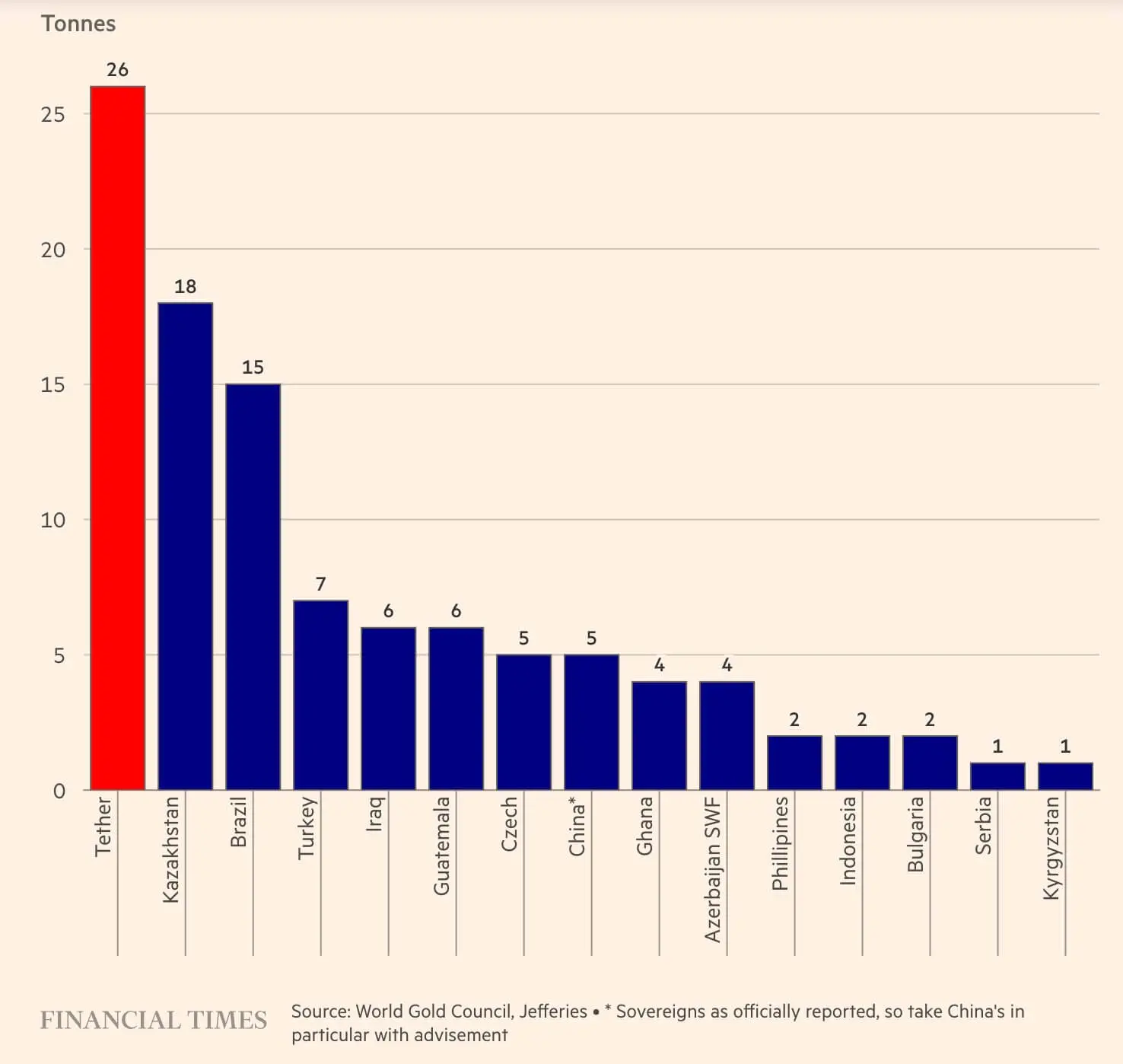 The accumulation of gold by Tether (Source: Financial Times)## S&P downgrades USDT – reasons and basis
On November 26, credit rating agency S&P Global downgraded the ability to maintain the exchange rate of USDT to 5 - the lowest level in their stablecoin rating scale. According to S&P, the reason is not the quality of the assets, but focuses on:
- Liquidity and clarity of reserves:
- The increase in the proportion of Bitcoin and secured loans creates price volatility and counterparty risk.
- Tether currently holds about 10 billion USD in Bitcoin and approximately 15 billion USD in secured loans, in addition to 13 billion USD in gold.
- While gold is a “hard” asset with long-term value, it is difficult to liquidate quickly and cannot meet large withdrawal demands like short-term government bonds.
- Lack of transparency:
- Tether does not disclose the details of the types of eligible assets to be included in reserves.
- There are no public guidelines on how to handle a sharp decline in the value of an asset or group of assets.
- Lack of information about the supervising parties, partners, and the structure of the market money makes it difficult to determine the reliability of the reserves.
S&P believes that the current reserve structure is less suitable for the model of a stablecoin that is committed to a one-to-one immediate conversion with USD. This is a crucial point for investors and regulators, as the ability to respond to withdrawal requests quickly is an essential standard for any stablecoin.
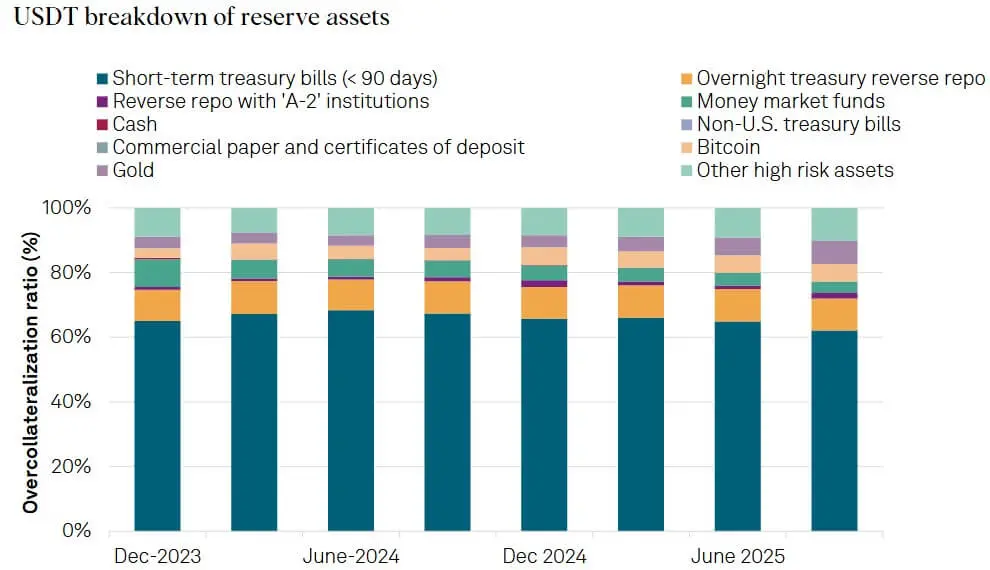 Tether's USDT stablecoin reserves (Source: S&P 500)## Tether explains investment strategy
CEO Paolo Ardoino argues that holding Bitcoin, gold, and land is a long-term hedge against global instability and national budget weakness. Tether has further invested in:
- Mining companies and gold mining rights,
- Tokenized gold enterprises,
- Safe storage services and gold-backed lending.
Mr. Ardoino reacted directly to S&P's downgrade:
“We take pride in what is criticized… When a company challenges the pull of the outdated financial system, traditional financial media will be worried.”
According to Tether, this strategy not only strengthens the company's balance sheet but also generates sustainable profits, despite reserves not fully adhering to traditional stablecoin models.
The crypto market still places trust in USDT
Contrary to the view of S&P, the market still values USDT highly:
- This stablecoin has maintained its peg to USD for over 10 years, despite the collapse of other exchanges, lending platforms, and stablecoins.
- USDT has deep liquidity on global exchanges and is the base currency for many crypto transactions, especially in emerging markets.
- The market capitalization currently stands at over 184 billion USD, reaching a record high.
In addition, the profit from short-term government bonds (~15 billion USD/year ) creates a strong “capital cushion”, helping to absorb the price volatility of Bitcoin and secured loans, far exceeding the standard risk model of S&P.
For users and traders, these factors are more important than traditional assessment rates. The market sees:
- Large government bond reserves,
- Gold reserves are increasing,
- Profitable business model,
- Stable and reliable withdrawal mechanism.
Transparency remains a key factor
However, experts emphasize that transparency remains the most important factor:
- Holding gold and Bitcoin is not a weakness, but rather a lack of detailed information on how reserves are managed, how to choose partners, and manage secured loans.
- Even with a solid balance sheet, the lack of transparent reporting makes it difficult for institutional investors and regulators to assess actual risks.
Improvements in transparency will help reduce volatility for large holders and bring USDT closer to the standard of a global payment asset.
Thạch Sanh
Disclaimer: The information on this page may come from third parties and does not represent the views or opinions of Gate. The content displayed on this page is for reference only and does not constitute any financial, investment, or legal advice. Gate does not guarantee the accuracy or completeness of the information and shall not be liable for any losses arising from the use of this information. Virtual asset investments carry high risks and are subject to significant price volatility. You may lose all of your invested principal. Please fully understand the relevant risks and make prudent decisions based on your own financial situation and risk tolerance. For details, please refer to
Disclaimer.
Related Articles
Tether Freezes $3.29M USDT Linked to Rhea Finance Exploit
Tether froze $3.29 million in USDT linked to Rhea Finance exploit, ensuring user protection and ecosystem trust. Blockchain tracking enabled this action against suspicious wallets after attackers moved funds to evade detection.
GateNews19h ago
Tether 挹注 150M美元救援 Drift Protocol,反觀 Circle 因疏失遭集體訴訟
Drift Protocol faced a $280 million loss due to a hack, prompting Tether to launch a $150 million recovery plan, switching settlement assets to USDT. Meanwhile, Circle faces a lawsuit for failing to freeze stolen funds, highlighting regulatory ambiguities in the crypto industry.
ChainNewsAbmedia23h ago
Former Treasury Secretary Paulson: Contingency plan for a U.S. debt crisis must be prepared in advance; consequences will be very severe
Former U.S. Treasury Secretary Henry Paulson urged U.S. authorities to draw up contingency plans to address a potential collapse in demand for U.S. national debt when he was interviewed by Bloomberg on April 17, 2026 (Thursday). He said that once a crisis erupts, the consequences would be extremely severe. On the same day, the U.S. Department of the Treasury completed the largest debt buyback in a single transaction in history, accepting approximately $15 billion in old bonds maturing from 2026 to 2028.
MarketWhisper04-17 05:08
Drift Protocol Secures $147.5M Funding from Tether to Relaunch as USDT-Based Exchange
Drift Protocol, a Solana-based decentralized derivatives exchange, plans to relaunch as a USDT-based perpetual futures exchange after a $270 million exploit, securing up to $147.5 million in funding from Tether and partners for recovery and operations.
GateNews04-17 01:51


