The recent drop of Bitcoin below the 80,000 USD mark has caused a wave of insomnia among individual investors, according to a new report from CEX.io.
Although the price later recovered above the 90,000 USD level, the drop of about 30% from the recent peak has forced many investors to monitor price fluctuations throughout the night. This behavior has gone beyond normal anxiety: nearly 70% of those surveyed admitted to trading mistakes and “bad orders” stemming directly from lack of sleep, leading to physical fatigue that exacerbates losses in their portfolios.
Monitoring the price until late at night
A survey by CEX.io indicates a notable change in habits: 68% of participants reported that they check prices almost every night after going to bed, while only 8% said they never do so.
This reflects how market volatility increasingly influences lifestyle habits and sleep hours. Data also shows that sleep deprivation is becoming “normal” in crypto trading. More than half of the respondents admitted to staying up until at least 2 AM due to market fluctuations, while 33% stayed up until 4 AM or later. In total, 81% reported insomnia while waiting for trading opportunities or important events.
 *How cryptocurrency traders stay up late (Source: CEX.io)*The main reason investors stay up late is not the fear of liquidation, but FOMO (the fear of missing out on opportunities), mentioned by 59% of survey participants. This habit reflects a market increasingly driven by emotions rather than technical analysis.
The quality of sleep is also closely related to market trends: 64% of investors sleep better when the market is up, while only 10% sleep well in a down market.
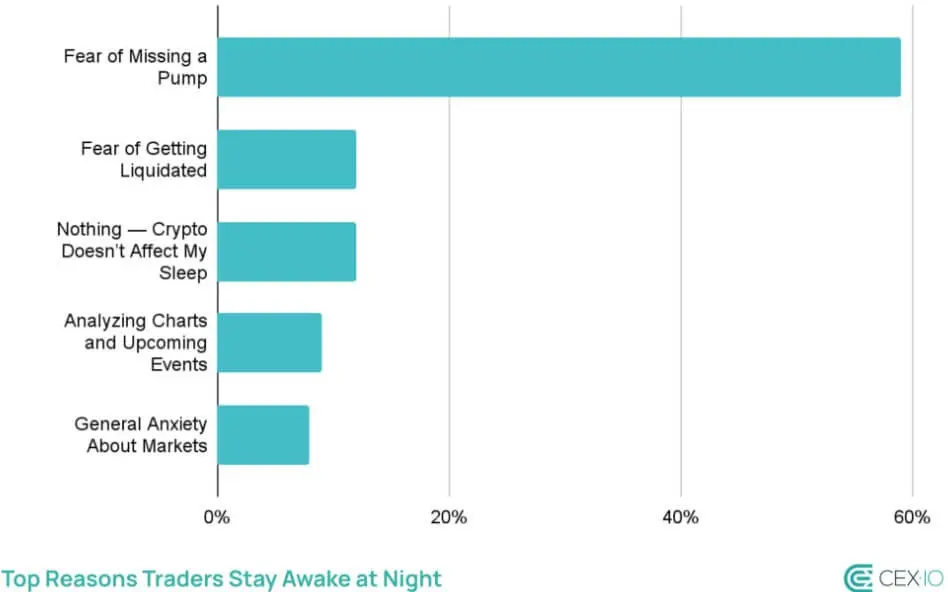 *Why cryptocurrency traders are always alert (Source: CEX.io)*CEX.io believes that this insomnia is not just a reaction to prices, but also related to changes in the timing of volatility. According to data from Blockworks Research, the strongest price fluctuations currently occur between 18:00 and 06:00 UTC ( 01:00–13:00 Vietnam time) — a time when the order books of institutions are sparse as liquidity providers in the US cease operations.
In the cross-time frame between Asia-Pacific, smaller orders can also trigger significant fluctuations. For individual investors in the EMEA region, this timeframe coincides with rest periods, forcing them to choose between sleeping and actively managing risks.
Thạch Sanh
Disclaimer: The information on this page may come from third parties and does not represent the views or opinions of Gate. The content displayed on this page is for reference only and does not constitute any financial, investment, or legal advice. Gate does not guarantee the accuracy or completeness of the information and shall not be liable for any losses arising from the use of this information. Virtual asset investments carry high risks and are subject to significant price volatility. You may lose all of your invested principal. Please fully understand the relevant risks and make prudent decisions based on your own financial situation and risk tolerance. For details, please refer to
Disclaimer.
Related Articles
XRP Breaks Above $1.40 as Spot ETF Inflows Hit $17.6M Milestone
XRP breaks $1.40 after Ripple partnership boosts investor confidence and market momentum.
Spot XRP ETFs record $17.6M inflows, signaling rising institutional demand and interest.
Technical indicators show resistance ahead, with support holding near $1.40 and $1.3840.
Ripple’s XRP is
CryptoNewsLand35m ago
PEPE Reclaims 0.00000400 — Is This 1.8% Move the Start of a Bigger Run?
PEPE rebounds from 0.00000385 support, forming higher lows and stronger bullish structure.
Technical indicators like MACD and RSI show momentum with room for further upside.
Key resistance at 0.00000410; support at 0.00000380 critical for trend continuation.
PepeCoin — PEPE, has
CryptoNewsLand5h ago
ETH drops 0.58% in 15 minutes: derivatives liquidity contraction and proactive position reduction dominate short-term pullback
From 2026-04-19 04:30 to 2026-04-19 04:45 (UTC), within ETH’s 15-minute candlestick chart, the return recorded -0.58%, and the price range was 2321.62 to 2342.04 USDT, with an amplitude of 0.87%. The short-term selloff occurred against a backdrop of increased overall market volatility and a broad decline in the prices of major crypto assets; overall market risk appetite clearly fell, and traders’ wait-and-see sentiment strengthened.
The main driver behind this abnormal move is a sharp contraction in liquidity in the derivatives market and leveraged funds proactively reducing positions. Data shows that over the past 24 hours, the ETH/USD perpetual contract trading volume dropped 67.16% to approximately 74.87 million, open interest edged down 3.33% to 329 million, and liquidation amounts did not expand unusually. This structure indicates that the market lacks the risk of passive cascades; more funds chose to proactively step aside and wait on the sidelines, intensifying short-term selling pressure.
In addition, the long/short structure in which shorts held the upper hand (long/short ratio 47.48%:52.52%) and sentiment synchronization with the panic range reinforced the downward price trend. During the same period, major coins such as BTC and SOL also fell 2%-3.4% in tandem, further showing that this pullback was driven by system-wide risk sentiment. On-chain funds did not show any large abnormal transfers or large-scale liquidations of DeFi protocols; spot and on-chain liquidity remained generally stable, and no sudden system risk resonance was observed.
Current volatility-related risks still need close monitoring, especially as overall risk appetite continues to contract—ETH’s short-term price may face further downside probing. Watch subsequent changes in derivatives trading volume and open interest, extreme shifts in the long/short ratio and funding rate, and promptly monitor on-chain fund flows, large transfers, and any signs of amplified platform net outflows. For more market anomalies and deeper analysis, please continue to follow our upcoming market updates.
GateNews6h ago
Spark Protocol's January delisting of rsETH proves prudent as Aave faces ETH liquidity crisis
Spark Protocol's strategy of delisting low-usage assets and tightening collateral has faced initial backlash but proved wise during market turmoil. While maintaining higher interest rate caps, SparkLend ensures liquidity, unlike Aave, which now faces significant risks.
GateNews6h ago
Request Network (REQ) Surges 23.68% in 15 Minutes, 24-Hour Gain Reaches 116.52%
Request Network (REQ) surged 23.68% in just 15 minutes, reaching $0.152, with a 24-hour rise of 116.52% and trading volume over $8 million. Factors include retail interest and whale accumulation. Resistance at $0.160 and support at $0.122 are under observation.
GateNews7h ago
Solana Price Stalls Near $80 as ETF Outflows Weigh
Solana trades around $80, facing bearish sentiment due to ETF outflows and declining retail participation. Technical indicators show mixed signals, with resistance at $87 and $98, while support at $77 remains critical for stability.
CryptoFrontNews12h ago


