Author: Ignas Translator: Shan Ouba, Golden Finance
In the previous article, I referred to this phenomenon as the Great Rotation, but there is little detailed information that clearly explains its impact. As Ray Dalio might say, this phenomenon is common in other industries, but it has never occurred in the development history of cryptocurrencies.
Traditional finance practitioner Jordi Visser provided the best explanation for this: BTC wins, and early BTC believers are cashing in their profits.
This is not a panic sell-off, but a natural transition of ownership from concentration to decentralization. Among all traceable on-chain indicators, whale sell-offs are a key signal.
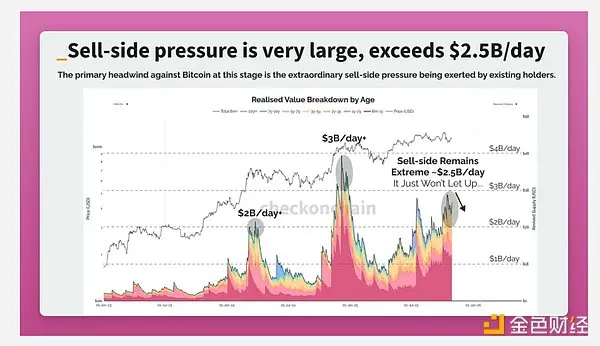
Long-term holders sold 405,000 BTC in just 30 days, accounting for 1.9% of the total circulating supply.
For example, Owen Gunden.
Owen Gunden is one of the early Bitcoin whales. He made large transactions on Mt. Gox, accumulating a massive position, and also served as a board member of LedgerX. His associated wallet holds over 11,000 BTC, making him one of the largest individual holders on-chain.
Recently, his wallet began transferring large amounts of BTC to the Kraken exchange. He transferred thousands of tokens in several batches, which usually indicates a sell-off. On-chain analysts believe he might be preparing to liquidate most of his holdings, worth over $1 billion.
Since 2018, he has never tweeted, but this move aligns with my great rotation argument. Some whales are turning to ETFs for tax benefits or selling BTC for portfolio diversification, such as buying ZEC?
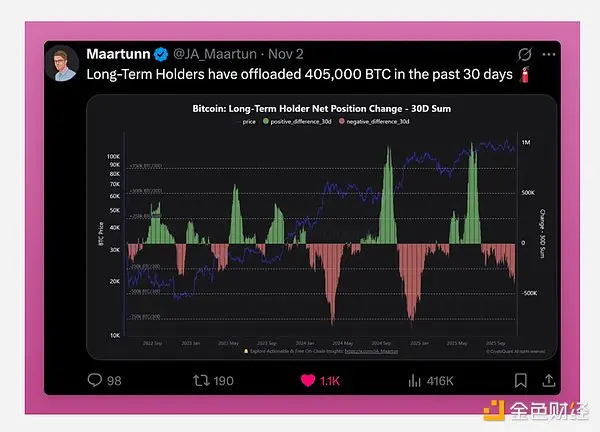
As supply shifts from early whales to new buyers, unrealized profit prices continue to rise. New whales are gradually taking control of the market.
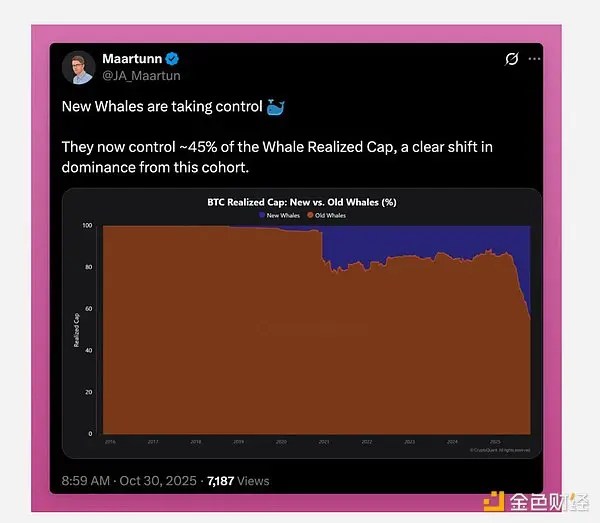
The rise of MVRV provides a glimpse that the average cost benchmark has shifted from early miners to ETF buyers and new institutions.
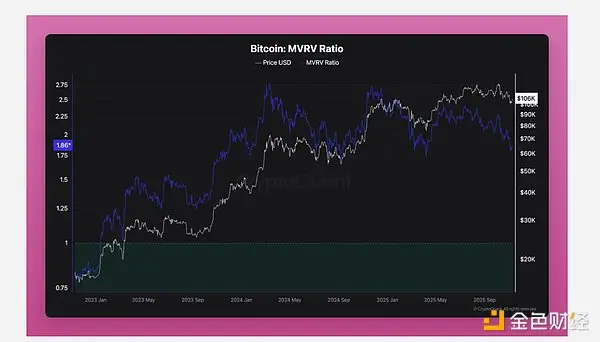
Some may think this looks bearish, as early whales have held positions for years with substantial profits, while new whales are currently at a loss. The average cost benchmark is close to $110,800, raising concerns in the market that if BTC continues to perform weakly, new whales may sell off.
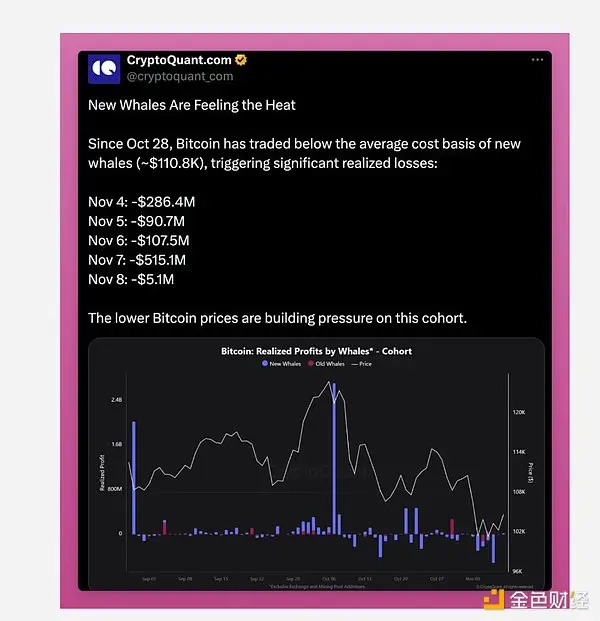
However, the rise of MVRV indicates that ownership is spreading and the market is maturing. Bitcoin is shifting from a small number of low-cost holders to a more diversified group of holders with higher cost bases. This is a bullish signal. So, what about the situation of altcoins?
Ethereum
BTC has won, what about ETH? Does ETH also show the same large rotation pattern? Similar to BTC, this phenomenon may partially explain the price lag of ETH.
On the surface, ETH seems to have also achieved success. Both have ETFs and DATs, and both have gained institutional attention, although their natures differ. Data shows that ETH is in a similar transitional phase, just earlier in the process and slightly more chaotic. In fact, ETH has begun to catch up with BTC in one significant shift, with approximately 11% of ETH currently held by DATs and ETFs.
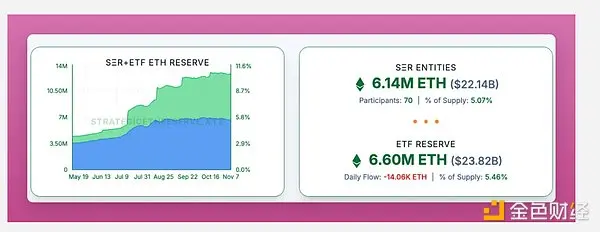
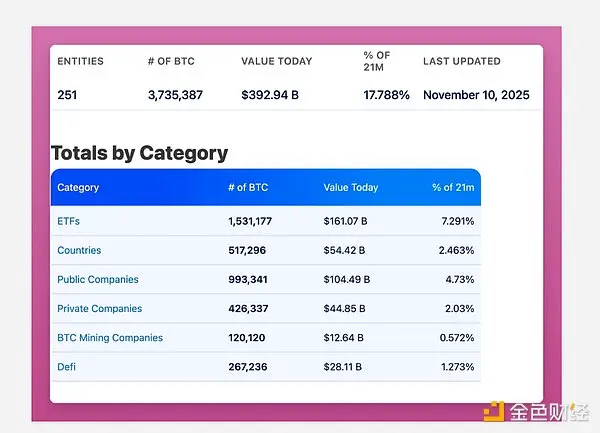
About 17.8% of BTC is held by spot ETFs and large treasury funds. Considering Saylor's continuous buying over the years, the pace at which ETH is catching up is already quite fast.
I once tried to find data related to ETH to verify whether there was a phenomenon similar to the old whales selling to new whales like in BTC, but I was unsuccessful. I even contacted Ki Young Ju from CryptoQuant, who stated that due to ETH using an account model instead of Bitcoin's UTXO model, the relevant data is difficult to compile.
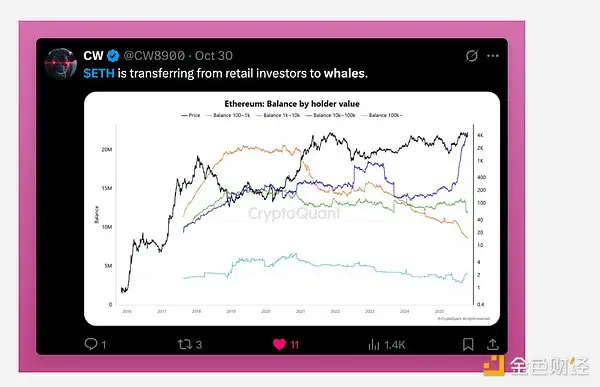
In any case, the main difference between the two seems to be that the ownership of ETH is shifting from retail investors to giant whales, while the core shift of BTC is from early whales to new whales.
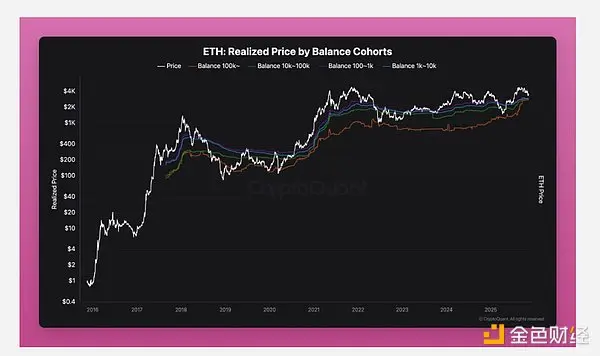
The chart below also shows that the ownership of ETH is shifting from retail investors to whales.
Large wallets holding over 100,000 ETH are seeing their realized prices rise rapidly, indicating that new large buyers are entering at higher prices while smaller holders are selling off.
Pay attention to how all the lines, orange, green, and purple, converge to the same level today.
This indicates that wallets of different sizes have similar cost bases, meaning that early low-cost tokens have been transferred to new holders.
This cost basis reset usually occurs at the end of the accumulation period, before a significant price increase. Structurally, this indicates that the supply of ETH is concentrating in the hands of more powerful holders.
ETH is bullish.
The rationality of this transition lies in:
In terms of ETH, retail investors are capitulating and exiting, while whales and funds are continuously accumulating. The reasons include: 1. The popularization of stablecoins and tokenized applications 2. The launch of staking ETFs 3. Accelerated institutional adoption.
Retail investors once saw ETH as a gas fee, but their faith in ETH wavered after the emergence of other L1s. In contrast, whales view it as interest-bearing collateral and continue to accumulate it for long-term on-chain returns.
BTC has already emerged victorious, while ETH remains in a gray area. As a result, whales are positioning themselves in advance to seize the opportunity before institutions enter the market. The combination of ETF and DAT is making the base of ETH holders more institutionalized, but it is still unclear whether these institutions are more inclined towards long-term growth.
The main bearish news is that ETHZilla announced it will sell ETH to repurchase company shares. While this is not enough to trigger panic, it has set a precedent.
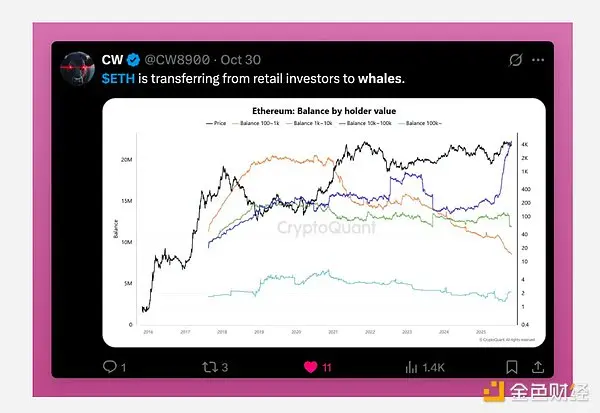
Overall, ETH aligns with the major rotation argument. Its structure is not as clear as BTC's, due to a more diverse holder base and richer use cases, such as liquid staking to a few large wallets, and the reasons for holders transferring tokens on-chain are more complex.
Solana
It is not easy to clarify Solana's position in this rotation. Even trying to identify team wallets or major holders is fraught with difficulties; I have tried.
Nevertheless, some patterns are gradually emerging.
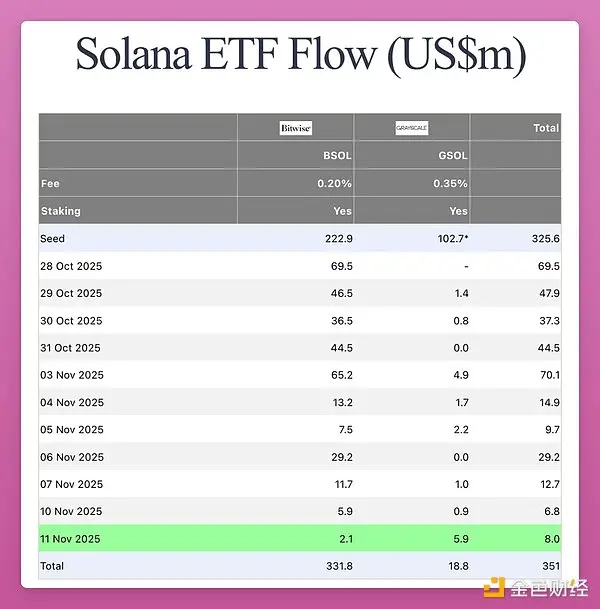
Solana is entering a similar institutional phase as Ethereum. Last month, the U.S. spot Solana ETF quietly launched, generating almost no buzz on CT. The scale of capital inflow is not particularly high, totaling $351 million, but it has maintained positive inflows every day.
Some early DATs have also started buying Solana, and the scale is quite considerable:
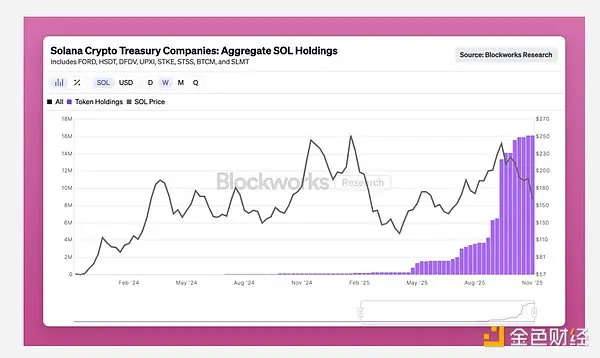
Currently, 2.9% of the circulating Solana is held by DAT, valued at approximately $2.5 billion. For more information about the structure of Solana DAT, you can read related articles by Helius.
Therefore, Solana now has the same traditional financial investment infrastructure as Bitcoin and Ethereum, with regulated fund and corporate treasury holdings, just on a smaller scale.
Although on-chain data is chaotic, the supply is still concentrated in the hands of early insiders and VC wallets.
These tokens are slowly being transferred to new institutional buyers through ETFs and treasury.
The great rotation has affected Solana, just a cycle later than Bitcoin and Ethereum.
Therefore, if Bitcoin's rotation with Ethereum is nearing its end to a certain extent, the price could skyrocket at any time, while Solana's trend is even harder to predict.
Where to go next?
Bitcoin matured first, followed closely by Ethereum but with a slight lag, while Solana requires more time. So, what phase is this cycle currently in?
In previous cycles, the script was simple: BTC surged, followed by ETH, gradually transmitting the wealth effect. Native cryptocurrency users profited from mainstream coins and turned to small-cap altcoins, driving the entire market up.
But this time is different.
The cycle is stuck at the BTC stage. Even if BTC rises, early whales either turn to ETFs or cash out and leave the cryptocurrency casino completely, improving their real lives.
No wealth effect, no capital overflow, only the PTSD left by the FTX collapse, as the market continues to struggle forward.
Altcoins no longer compete with BTC in terms of currency identity, but rather shift towards competing in practicality, yield, and speculation.
However, most altcoins will be unable to pass these tests.
Only a few categories can survive:
- Public chains with real use cases: Ethereum, Solana, and perhaps one or two other projects.
- Products that have cash flow or accumulate real value
- Assets with unique demands that cannot be replaced by Bitcoin, such as ZEC.
- Infrastructure that can capture transaction fees and attention
- Stablecoins and RWA
Native innovations and experimental projects in cryptocurrency will continue to emerge, so I do not want to miss out on new hot assets.
But all other projects will become noise.
The fee switch of Uniswap is a key turning point. It is not the first project to do this, but it is the most well-known DeFi protocol. This move puts pressure on all other protocols, forcing them to follow suit and start sharing fees with token holders.
Among the 10 lending protocols, 5 have started sharing income with holders. Therefore, the DAO is transforming into an on-chain company, and the value of the tokens will depend on the income generated and distributed. This will be a key area in the next round of rotation.


